
On Friday, March 18, 1938, record producer John Hammond gathered five Jazz musicians in a New York City recording studio for a recording session.
The musicians were: Buck Clayton, trumpet; Eddie Durham, trombone & electric guitar; Freddie Green, rhythm guitar; Walter Page, bass; and Jo Jones, drums. They were, at the time, all members of the Count Basie Orchestra.
This ensemble, tentatively called Eddie Durham & His Base Four, cut four numbers that day: “Laughing At Life,” “Good Mornin’ Blues,” “I Know That You Know” and “Love Me Or Leave Me.”
Those recordings were designed to be the first in Jazz to feature the electric guitar.
“Laughing At Life” was the first piece that the group recorded.
Dave Oliphant wrote in his 1996 book, Texan Jazz, that Eddie Durham’s performance on “Laughing At Life:” “abounds with riff-like figures as well as sixteenth-note pickups to boppish licks. He leaps from low to high notes, plays bluesy, falling-off moans, and utters sudden whines in the upper register.”
Listen for yourself. (You’ll be glad you did!)
John Hammond had originally produced this session to be released by Brunswick Records. But when they declined, he sold the sides to Milt Gabler of New York’s Commodore Music Shop. Somewhere along the line, the name of the group was changed so as to be perfectly clear about the geographically-specific style of Jazz that they played.
“Laughing At Life” b/w “I Know That You Know” by the Kansas City Five was released as Commodore Records #510, a 78 rpm disc, in 1938.
“Laughing At Life” was written in 1930. The song’s music was composed by Bob Todd and Cornell Todd and the lyrics were penned by Charles Kenny and Nick Kenny.
Ruth Etting, “America’s Sweetheart of Song,” was the first to record “Laughing At Life,” waxing her rendition on September 29, 1930, for Columbia Records.
Scott Yanow, writing in the All Music Guide to Jazz, sees Eddie Durham’s work on the four Kansas City Five recordings as being “among the first worthwhile examples of the electric guitar on record.”
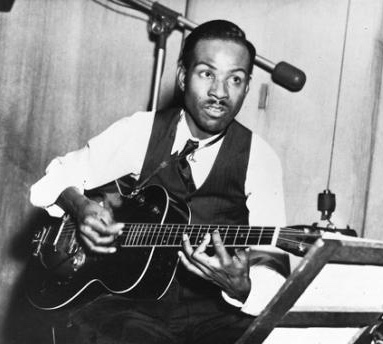
This is a recording studio photo of Eddie Durham, circa 1940.
J.T.L.Y.K.: The majority of the sources that I used in putting together this post listed March 18, 1938 as the date of the Kansas City Five recording session. However, a couple of sources did have the date as March 16, 1938.
Good music doesn’t get old, whatever its birthdate.
P.S.: If you’re interested in reading more about some of the other early recordings that feature an electric guitar, go into the Archives for June, 2010 and check out my post of June 15 called Recent Discoveries.

 sixstr stories