
The journey continues: Rising to a higher elevation.
Mississippi Sheiks was a string band from Bolton, Mississippi.
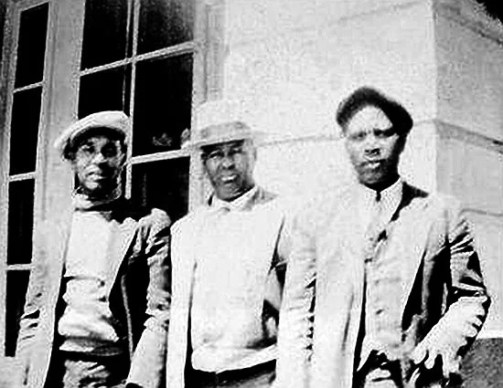
[Pictured, L-R: Armenter “Bo Carter” Chatmon (1893/4-1964), Alonzo “Lonnie” Chatmon (1890-1942) & Walter Vinson/Vincson (1901-1975).]
They made their first recordings on February 17, 1930 in Shreveport, Louisiana for OKeh Records.
The fourth of the six songs they recorded that day, the one that would eventually become their greatest hit, was called “Sitting On Top Of The World.”
The song was written and performed by singer/guitarist Walter Vinson and violinist Lonnie Chatmon. (For some reason, the copyright registration of “Sitting On Top Of The World” lists the composers as being Walter Jacobs & Lonnie Carter.)
Check it out!
“Sitting On Top Of The World” is part of this journey because its melody bears more than a passing resemblance to the melody of “You Got To Reap What You Sow.” Initially, both tunes are in 4/4 time and a major key (A flat for “You Got To Reap…” and F for “Sitting…”); make use of flatted “Blues” notes and a “swing” or triplet-based rhythm; and are built out of seven melodic phrases.
But that’s not all, folks! Take a look.
(For those of you who can read standard music notation, I transcribed the first verse of both songs from the original recordings, putting each in the key of G for a more direct visual comparison.)
Here is the first verse of “You Got To Reap What You Sow” by Leroy Carr.

And here is the first verse of “Sitting On Top Of The World” by Mississippi Sheiks.

Comparing the melodies phrase by phrase, there really are a number of similarities. One is in the notes that some of the phrases end on.
For instance, each second phrase (“I want you to know” and “and all the fall”) ends on a B natural note; and then each third phrase (“you got to reap baby” and “just tryin’ to find my”) and fourth phrase (“just what you sow” and “little all and all”) ends on a G.
There are also rhythmic similarities, with most phrases in each tune ending on the first downbeat of a measure and the frequent use of eighth-note triplets.
The big difference, however, lies between the seventh phrase of the two melodies.
“You Got To Reap What You Sow” ends with a two beat phrase and the lyric “what you sow.”
“Sitting On Top Of The World” ends with an elongated five beat phrase. The lyric – “I’m sitting on top of the world” – mandates this extension. The change in the last phrase results in the lengthening of the entire melody (and chord progression) to nine measures for “Sitting On Top Of The World” as compared to the eight measures of “You Got To Reap What You Sow.”
Here again is “You Got To Reap What You Sow.”
___________________________________________
Over the next five years, Mississippi Sheiks – often including Bo Carter/Chatmon, Sam Chatmon and others – recorded about 70 original tunes and became the most important, popular and successful string band of the 1930’s.
“Sitting On Top Of The World” has been covered by a near-countless number of artists including Ray Charles, Bill Monroe, Howling Wolf, Doc Watson, The Grateful Dead, Cream, Bob Dylan, Sweet Honey In The Rock, Bill Frisell, Richard Shindell and Jack White.
Along with Leroy Carr’s “How Long – How Long Blues,” it was the other of the first two songs that Muddy Waters mastered on the guitar.
“Sitting On Top Of The World” was inducted into the Grammy Hall of Fame in 2008 and selected for preservation in the National Recording Registry by the Library of Congress in 2018.
____________________________________________
The trail takes a turn.
Charlie (or Charley) Patton (1891-1934)…

… was born in Hinds County, Mississippi. He was a friend of, played music with and was possibly related to, the Chatmon brothers.
The singer, guitarist and songwriter made a recording for Paramount Records on May 28, 1930 in Grafton, Wisconsin of a song called “Some Summer Day.”
The melody of “Some Summer Day” is virtually identical to the melody of “Sitting On Top Of The World.” The lyrics of the last phrase are: “‘Cause he’s stealing here some summer day.”
Here you go!
Charley Patton made his first recordings on June 14, 1929 and his last on January 31, 1934. The fifty-eight sides that he produced over those years have established him as not only the Father of the Delta Blues, but possibly one of the most important American musicians of the 20th century.
____________________________________________
One good turn deserves another.
Walter Vinson liked the melody of “Sitting On Top Of The World” so much that he wrote another set of lyrics for it. He called his new song “Things ‘Bout Coming My Way.”
He liked his new song so much that he couldn’t wait to record it with the Mississippi Sheiks and recorded it instead – on January 19, 1931 – as “Sam Hill from Louisville.” Walter sang and played guitar on the recording and he was joined by “Papa” Charlie McCoy (1909-1950) on slide guitar.
“But after all / by my hard travelin’ / things about comin’ my way.”
Give a listen! (This has some great guitar work!)
Coming up in Part 3: A divergence.

 sixstr stories
Brilliant work illuminating such wonderful music.
Keep on keepin on!
Regards
Thom
Thank you for your kind words, Thom. So nice to hear from you! I hope that all is well. Eric