A Photo a Week Challenge: Music

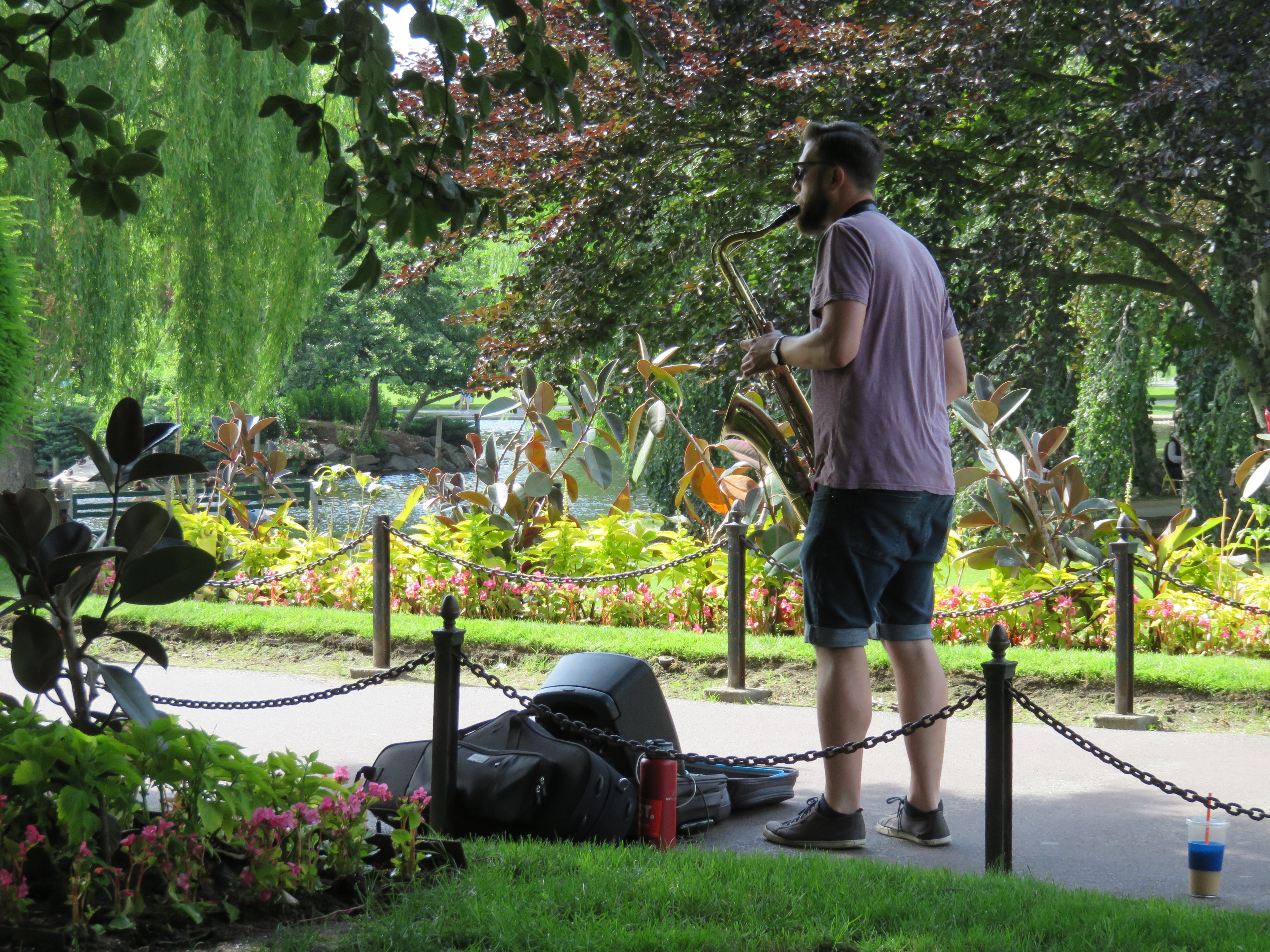
This is my first time entering a photo challenge. But when I found the nancy merrill photography blog and the topic of her weekly photo challenge, one image immediately came to mind.

I took this photograph on Father’s Day in 2005 at The Press Room in Portsmouth, NH.

I call it: “Jazz On A Summer Sunday Evening.”

Here’s the link to nancy’s blog.

https://nadiamerrillphotography.wordpress.com/2018/08/02/a-photo-a-week-challenge-live-music/

Posted in Random Topics | Tagged , , , , , | 4 Comments

This Historic Day In Music: Sara Carter

Sara Carter was born Sara Elizabeth Dougherty on this day, July 21, in 1898, just north of Copper Creek, Wise County, Virginia. She was one of five children born to William Sevier and Nancy Elizabeth (Kilgore) Dougherty.

One day when Sara was sixteen, she was standing in the front room of her Aunt Susie Nickels’ house in Copper Creek. She was playing her autoharp and singing “Engine 143,” an old song she’d learned as a little girl. A knock came at the door, which Aunt Susie answered.

It was 21 year old Alvin Pleasant Delaney Carter from Clinch Mountain. He had been walking towards the house, looking to see if Mrs. Nickels (the mother of Alvin’s mother’s cousin) would be interested in buying a fruit tree or two from the nursery that he worked for. The singing A.P. had heard coming from inside the house had quickened his step.

Aunt Susie welcomed A.P. in. He entered the front room and stood, listening. When Sara finished her song, he said to her: “Ma’am, that was might pretty playing and singing, and I sure would like you to play that over again for me.” So Sara did.

A.P. would later often say that although it was Sara’s voice that first attracted him, “It was the way her dark eyes held a constant play of sparkling light that transfixed him.”

A.P. Carter and Sara Dougherty were married on June 18, 1915.

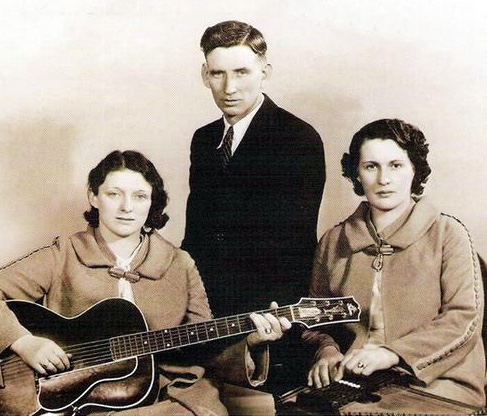
Starting around December of 1925, Sara and A.P. put together a trio with Sara’s young cousin and sister-in-law, Maybelle Addington Carter. Maybelle played guitar and sang, A.P. “bassed in” and played a little bit of guitar. Sara played autoharp, second guitar and was the lead vocalist. They called themselves “The Carter Family.”

That’s Sara on the right, A.P. in the middle and Maybelle on the left.

On July 31, 1927, The Carter Family drove the 26 miles from Maces Springs, VA to Bristol, TN. They had an audition on August 1st for Ralph Peer, the traveling talent scout for Victor Records. Peer had set up a “recording station” on “the second floor of the building formerly occupied by the Taylor-Christian Hat company” at 408 State Street in downtown Bristol.

In his later years, Peer would say: “As soon as I heard Sara’s voice, that was it. I knew it was going to be wonderful.”

The Carters recorded four songs at the August 1st session: “Bury Me Under The Weeping Willow,” “Little Old Log Cabin By The Sea,” “Poor Orphan Child” and “The Storms Are On The Ocean” Peer was so impressed that he invited them to come back the next day. Sara and Maybelle did and recorded two more songs: “Wandering Boy” and “Single Girl, Married Girl.” All of these performances featured Sara’s vocals.

On November 4, 1927, Victor Records released the first record by The Carter Family from those Bristol sessions. The song on one side was “Poor Orphan Child,” with vocals by Sara and A.P. The song on the other side was “Wandering Boy,” with Maybelle on guitar and  Sara singing and playing autoharp.

Listen.


By the 1930’s, The Carter Family had become “the most bankable Country music group in America, with total sales of more than a million records.”

Even though Sara and A.P. separated in 1933 and ultimately divorced in 1936, The Carter Family performed and recorded together into the next decade. They did their last recording session for RCA Victor in October, 1941 and finally disbanded in March of 1943.

The Carter Family was inducted into the Country Music Hall of Fame in 1970.

Sara Dougherty Carter passed away on January 8, 1979 in California.

The information and quotes in this post came from the wonderful book: Will You Miss Me When I’m Gone? by Mark Zwonitzer with Charles Hirshberg, 2002.

Posted in Posts with Video, This Historic Day In Music | Tagged , , , , , , , | 2 Comments

A Day In Boston, Highlights & Traditions – a no-str story

Boston, Massachusetts. Friday, June 22, 2018.

Morning: looking up from the deck of the U.S.S. Constitution.

Afternoon: looking down through a window at the top of the Bunker Hill Monument.

Snacking under a tree on the Rose Kennedy Greenway in the North End.

Listening from a bench in the Public Garden.

Evening: dining al fresco on Boylston Street.

“Catching” first pitch at Fenway Park, 7:11 pm.

And… three hours and thirty-four minutes of sitting, watching, groaning, believing, applauding, cheering, mooing, chanting, standing, waving, singing, dancing, whooping, laughing, high-fiving and reveling later…

14-10!!!

What a day!

(Thanks for that last picture, Jack.)

Posted in Random Topics | Tagged , , , , , , , , , , | Leave a comment

“There Are (Songs To Be Sung)”

5/9/93

That’s the date in the top right hand corner of page 273 of the first volume of my songwriting notebooks.

Page 273 also contains the finished lyrics – four verses and a chorus – of the song I eventually titled “There Are (Songs To Be Sung).”

Page 264 in the large, black notebook contains the first mention of this new song; the original idea for what would become the chorus:

“There are songs to be sung, stories to be told,

There are hearts to be won and smiles to unfold.

There are bridges to be built, lessons to be taught,

There’s a torch to be passed and a dream to carry on.”

I remember deciding to write verses that would sequentially build upon the individual phrases of the chorus; making a sort of “list song” that would expand on each statement. For instance, “Stories to be told”  grew into “There are stories from the past, stories from the heart; it’s the stories we tell that tell us apart.”

I made pretty good progress with the songs/stories and hearts/smiles verses, but (according to pages 270 and 271) I seem to have gotten bogged down in the “lessons” half of the third verse. I also couldn’t come up with a convincing “torch” half of the fourth verse.

Somewhere in the now-forgotten ether between pages 272 and 273 – including multiple pages in each of two travel notebooks, the smallest of which I still keep in my briefcase at work – “lessons to be taught” became “roads to be walked down.” “There’s a torch to be passed and a dream to carry on” was upgraded to “There are dreams to be shared and secrets still to be found.” The corresponding parts of the bridges/roads and dreams/secrets verses somehow manifested themselves in that gap as well.

Since that long ago day in 1993, I have sung that song… well, I really cannot begin to tell you how many times. I’ve sung it in bars, restaurants, coffee shops, concert halls (including The Music Hall in Portsmouth, NH), assembly halls, churches, chapels, meeting rooms, libraries, parks, parking lots, backyards, front yards, courtyards and porches.

I recorded “There Are (Songs To Be Sung)” at Fishtraks Recording Studios in Portsmouth, NH, in late-Fall, 1994. Joining me on the chorus were my friends, The Amity Singers, a gone-but-not-forgotten vocal group from Dover, NH, that I used to play guitar for.

“There Are (Songs To Be Sung)” became the opening track and title song of my first CD album, released in May, 1995.

I have embedded a link to that recording of “There Are (Songs To Be Sung)” twice here on sixstr stories: first in a piece entitled Many Thanks, Again posted on August 14, 2010 and then in the Theme Music & About section.

It’s time to give this song a post of its own.

“There are songs to be sung, stories to be told,

There are hearts to be won and smiles to unfold.

There are bridges to be built, roads to be walked down,

There are dreams to be shared and secrets still to be found.”

Give a listen and sing along!

JTLYK: There Are (Songs To Be Sung) was recorded and mixed by Jim Tierney and mastered by Jeff Landrock. The cover photo was taken by Frank Clarkson and the graphic design done by Kathryn deA. Klem.

Posted in EFS Music, Posts with Audio | Tagged , , , , , , | 1 Comment

Quotations Marked 7

“How do you calculate the influence of a song in your life?

We have songs that carry enormous meaning for us,

songs we want played at our weddings or at our funerals,

songs that every time we hear them, every single time,

we pause, we remember, we smile, we sing, we ignite.

And maybe even more than that.

Maybe we have music that has changed or saved our lives.”

Louis P. Masur

From: “Runaway Dream: Born To Run and Bruce Springsteen’s American Vision”

Every time I read that quote, my List of “influential” songs starts scrolling through my mind. I started putting The List on paper when I got the idea for writing this post. Just jotting down the title of each of these songs caused me to pause, remember, smile…

But wait!

In compiling The List of Songs, I came to realize that any serious attempt at a truly complete accounting of all the important music in my life would have to include The List of Albums.

Still interested?

Here you go!

(Keep in mind that these are partial lists. I didn’t want to get too carried away!)

Songs 

First off, two of the most important songs – “Thanksgiving Eve” by Bob Franke and “Mr. Tambourine Man” by Bob Dylan – have been with me quite a bit the past eight weeks or so as I listened, sang, played, and re-mastered them for performance.

Here, in no particular order, are a few of the other songs from The List.

“Spirit In The Night” by Bruce Springsteen.

“Christmas In The Trenches” by John McCutcheon.

“You Are So Beautiful” by Billy Preston & Bruce Fisher; as recorded by Joe Cocker.

“Sitting On Top Of The World” by Walter Vinson & Lonnie Chatmon; as recorded by Jim Ringer.

“Deep River Blues” by The Delmore Brothers; as recorded by Doc Watson.

“Like A Rolling Stone” by Bob Dylan.

“Rising Sun Blues/House of the Rising Sun” as recorded by Ashley & Foster, Georgia Turner, Bob Dylan, The Animals, Ramblin’ Jack Elliott, et all.

“Stuff That Works” by Guy Clark.

“Wooden Ships” by Paul Kantner, David Crosby and Stephen Stills; as recorded by Crosby, Stills & Nash and by Jefferson Airplane.

“These Days” by Jackson Browne; as recorded by Tom Rush and by Jackson Browne.

Albums 

A Hard Day’s Night (US), Beatles ’65, Something New, Rubber Soul (US)… and ultimately everything by The Beatles.

Big Hits: High Tide and Green Grass, Aftermath, Flowers, Their Satanic Majesties Request, Beggar’s Banquet and Let It Bleed by The Rolling Stones.

Greatest Hits – Vol.1, John Wesley Harding and Greatest Hits – Vol.2 by Bob Dylan.

Little Deuce Coupe by The Beach Boys.

Open by Julie Driscoll, Brian Auger & The Trinity.

Live & Well by B.B.King.

Live Wire/Blues Power by Albert King.

Jackson Browne by Jackson Browne.

Ladies of the Canyon by Joni Mitchell.

Sweet Baby James by James Taylor.

The Wild, The Innocent & The E Street Shuffle by Bruce Springsteen & The E Street Band.

Shoot Out The Lights by Richard & Linda Thompson.

March 6, 1925-June 15, 1968 by Wes Montgomery.

At The Montreux Jazz Festival by Bill Evans.

Circle ‘Round The Sun by Leo Kottke.

The New Possibility: John Fahey’s Guitar Soli Christmas Album.

Open All Nite by The Nighthawks.

Marshall Crenshaw by Marshall Crenshaw.

Finally, I have to include two crucial Songbooks:

Ramblin’ Boy and Other Songs by Tom Paxton and

Jerry Silverman’s Folk Song Encyclopedia, Volume 2.

That was fun!

If you’ve made it this far and actually read my lists, you must be starting to put together a list or two of your own. Care to share? Click on “Leave a comment” and pass on a title or two or three… please! I’d love to hear from you!

Posted in Quotations Marked | Tagged , | Leave a comment

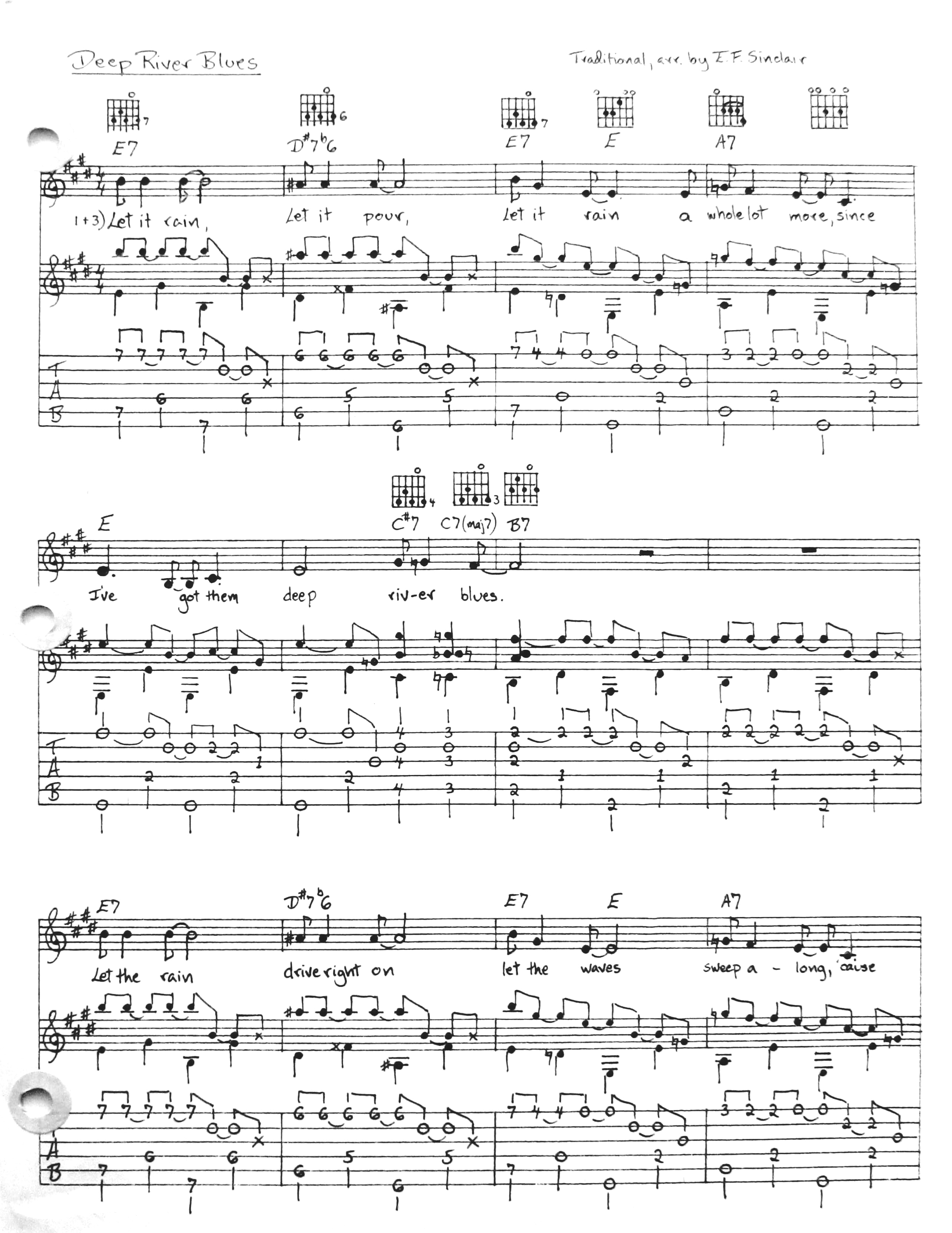
“Deep River Blues” – Page 1 & Page 2

(To see more Guitar TAB transcriptions, click on Guitar Music in the Categories list!)

On April 7, 2013, I wrote a post about the song “Deep River Blues.”

In that post, I included a transcription – in standard musical notation and guitar tablature – of my Doc Watson-inspired, finger-picking arrangement of “Deep River Blues.”

That post has become one of the most viewed posts ever on sixstr stories.

For some reason, however, I included only the first page of the original transcription in that post.

Well.

Operating on my theory that late (even 5 years late) is better than not at all, I would like to rectify the situation.

Here, at long last, for your guitar playing pleasure, is Page 1 and Page 2 of my transcription of my arrangement of “Deep River Blues.”


Ta da!

Don’t play guitar? Tell your friends who do!

If you would like to learn more about “Deep River Blues” and/or hear a recording of this arrangement, then check out that original post of April 7, 2013.

Posted in Guitar Music, Random Topics | Tagged , | Leave a comment

This Historic Day In Music: “Bull Frog Moan”

Lonnie Johnson and Eddie Lang needed another side.

How so?

Well…

In 1929, the standard format for the commercial release of recordings was a flat disc made of shellac resin and measuring 10 inches in diameter. The 78 RPM playback speed of these discs allowed for only about three minutes worth of music on a side. (The record industry was nineteen years away from “microgroove” technology.) The discs had music – one song or instrumental piece – on each side.

Lonnie and Eddie had cut three exceptional new guitar duets during their recording sessions on May 7 & 8, 1929: “Guitar Blues,” “A Handful Of Riffs” and “Blue Guitars.”

So, for OKeh Records to produce two more records by the increasingly popular Lonnie Johnson & Blind Willie Dunn, they needed a fourth recording. [The first OKeh record by Lonnie Johnson & Blind Willie Dunn/Eddie Lang contained the duets “Two Tone Stomp” and “Have To Change Keys (To Play These Blues).” Those sides were recorded on November 17, 1928.]

Lonnie and Eddie reconvened at OKeh’s New York City studio on May 15, 1929.

“Bull Frog Moan” was the result.

The piece starts with a repeated croaking low-note riff played by Eddie Lang. Lonnie Johnson enters with a responding melodic lick and the two are soon off at a swinging, mid-tempo pace for another delightful excursion through the Blues in the key of D.

Listen for yourself!


“Bull Frog Moan” was released with “A Handful Of Riffs” on OKeh Record #8695.

You can learn more about Lonnie Johnson and Eddie Lang , how their first recording session came about, the guitars they played and even listen to those first two duets in my This Historic Day In Music post of November 17, 2017!

Want more?

Scroll down to my This Historic Day In Music posts of May 8, 2018 and May 7, 2018.

Good music doesn’t get old.


Posted in Posts with Video, This Historic Day In Music | Tagged , , , , | 1 Comment

This Historic Day In Music: “A Handful Of Riffs” & “Blue Guitars”

On Wednesday, May 8, 1929, Blues guitarist Lonnie Johnson and Jazz guitarist Eddie Lang returned to the OKeh Records studio at 11 Union Square in New York City.

Having cut “Guitar Blues” – their third duet – the day before (see my This Historic Day In Music post from May 7, 2018), Eddie and Lonnie set about adding to their collection of duo recordings.

The results of their “jiving” on this day were “A Handful Of Riffs” and “Blue Guitars.”

Lonnie Johnson plays lead guitar on his Acosta 12-string acoustic from start to finish on “A Handful Of Riffs.” He strings together more than a handful of ever more dazzling riffs, licks and improvised melodic lines over Eddie Lang’s consistently rock-solid and highly inventive accompaniment. The duo dashes through fourteen choruses of Blues in the key of D at breakneck speed, with only a brief breakdown right in the middle (at 1:25).

Listen for yourself.


“Blue Guitars” is also a Blues in the key of D, but at a much slower tempo than “A Handful Of Riffs.” Eddie plays the languorous intro on his Gibson L-5 archtop acoustic and then settles into the 12-bar progression in accompaniment of Lonnie’s 12-string improvisations. At 1:12, Eddie steps out for a solo of his own and then returns to laying down the rhythm for Lonnie’s leads over the final three choruses.

Again, give a listen.


Jas Obrecht wrote in his fine book, Early Blues: The First Stars Of Blues Guitar (2015): “The improvisations capture the musician’s warmth, humor, and mutual admiration, and they’re as fresh-sounding today as they were on the day they were recorded.”

Yes, indeed.

“A Handful Of Riffs” b/w “Bull Frog Moan” was released on OKeh Records, #8695.

“Blue Guitars” b/w “Guitar Blues” was released on OKeh Records, #8711.

The artist’s credit line on both recordings reads: Lonnie Johnson & Blind Willie Dunn.

Posted in Posts with Video, This Historic Day In Music | Tagged , , , , , , , | 2 Comments

This Historic Day In Music: “Guitar Blues”

In the late 1920’s, Blues guitarist Lonnie Johnson and Jazz guitarist Eddie Lang recorded ten landmark duets.

Lonnie and Eddie recorded their first two duets – “Two Tone Stomp” and “Have To Change Keys (To Play These Blues)” – on November 17, 1928 in the recording studios of OKeh Records at 11 Union Square in New York City.

(You can learn about Lonnie and Eddie, how that first recording session came about, the guitars they played and even listen to those duets in my This Historic Day In Music post of November 17, 2017!)

“Guitar Blues” was the title of Lonnie and Eddie’s third duet. They recorded it on May 7, 1929 in the same OKeh Records studio in New York.

Eddie plays the brief introduction to “Guitar Blues” and then provides back-up to Lonnie’s 12-string lead guitar solos. At 1:06, after four 12-bar choruses, Lonnie seamlessly slips into the role of accompanist while Eddie solos on his six-string archtop twice through the form. At 1:38, the guitarists switch places again and Lonnie takes the lead for the remaining six choruses.

In The Guitar Players: One Instrument & Its Masters In American Music (1982), author James Sallis writes “These duets are infectious, provocative music, as fresh and vigorous today as when they were recorded.”

I completely agree.

Listen for yourself.


“Guitar Blues” b/w “Blue Guitars” was released on OKeh Records, #8711. The artist’s credit line on the label reads: Lonnie Johnson & Blind Willie Dunn.

If you enjoyed “Guitar Blues,” stay tuned!

Posted in Posts with Video, This Historic Day In Music | Tagged , , , , , , , | Leave a comment

A Belated Birthday Celebration

The Library of Congress was established on April 24, 1800.

On that day, “President John Adams signed an act of Congress providing for the transfer of the seat of government from Philadelphia to the new capital city of Washington. Part of the legislation appropriated $5,000 ‘for the purchase of such books as may be necessary for the use of Congress… and for fitting up a suitable apartment for containing them.’ Books were ordered from London, and the collection consisted of 740 books and 3 maps which were housed in the new United States Capitol.” (Wikipedia)

The Library of Congress today consists of three buildings on Capitol Hill in Washington, D.C. and one in Culpeper, Virginia.

The Thomas Jefferson Building, located on First Street SE in Washington, D.C., is the main building of The Library and my favorite place in the city. Construction of the Jefferson Building began in 1890 and was first opened to the public in 1897.

Here are a few photos from some of my visits to the Jefferson Building over the years.


Happy 218th Birthday, Library of Congress!

Posted in Random Topics | Tagged , | Leave a comment