“Little Martha” is a fingerstyle acoustic guitar instrumental piece created by Duane Allman. Duane recorded it as an acoustic guitar duet with Allman Brothers bandmate Dickey Betts in October, 1971. “Little Martha” was released on The Allman Brothers’ album Eat A Peach in 1972.
In his younger days, when fingerstyle guitarist Leo Kottke set out to learn “Little Martha,” he was not aware that the music he was hearing on The Allman Brothers’ recording was being performed by two guitarists.
I’d say that Leo Kottke worked out a pretty good rendition of “Little Martha” anyway.
Check it out for yourself.
This recording is from Leo’s 1995 album, Live. It was recorded in April, 1995 at the Fox Theatre in Boulder, Colorado.
If you’ve never heard Leo Kottke before, I highly recommend this CD. Live captures Leo Kottke on a very, very good night. That means that this collection is full from beginning to end with Leo’s simply mesmerizing fingerpicking virtuosity on six and twelve-string acoustic guitars. There are also several songs that feature his much-better-than-he-thinks-they-are vocals and a couple of tracks that contain examples of the kind of ramblingly hilarious and delightful stories that Leo regularly tells during his concerts.
Leo Kottke’s guitar music was first preserved in the grooves of a vinyl disc in 1969. That first album was called 12-String Blues. Leo’s superb, who-needs-two-guitars rendering of “Little Martha” first made it onto vinyl on his 18th LP, A Shout Toward Noon in 1986.
Leo Kottke was born this day, September 11, 1945, in Athens, Georgia.
Most recently, I found Christine Miller again, this time hanging on a wall.
On Sunday, August 24, 2014, my very good friend and cousin Jack and I spent a thoroughly enjoyable and, yes, enlightening day at the Thomas Edison National Historical Park, 211 Main Street in West Orange, NJ.
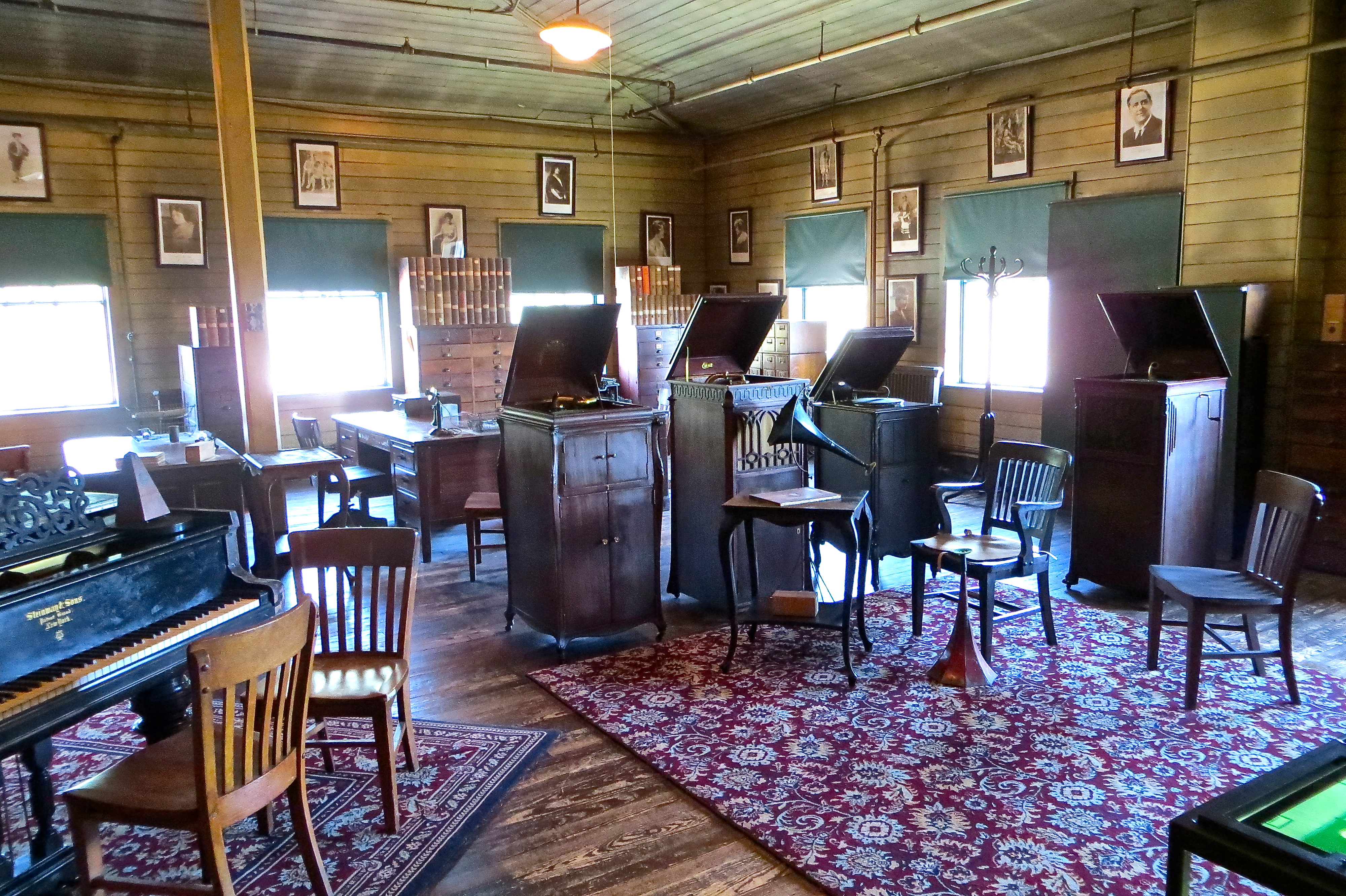
At the Park, the Main Laboratory Building of the Laboratory Complex is also known as “Building 5.” At the Main Street end of Building 5, on the top floor of this long, three story structure, we found Thomas Edison’s Music Room.
This very, very cool room was one of the first, if not the first, music recording studio.
Among the many fascinating and original artifacts in this room were several Edison Diamond Disc Phonographs like the ones used in the Tone Tests. The phonographs stood in the center and right hand side of the Music Room; the lids of their tall, boxy wooden cabinets lifted open, each one ready and waiting for someone to turn a crank and drop the needle on an old Edison Diamond Disc.
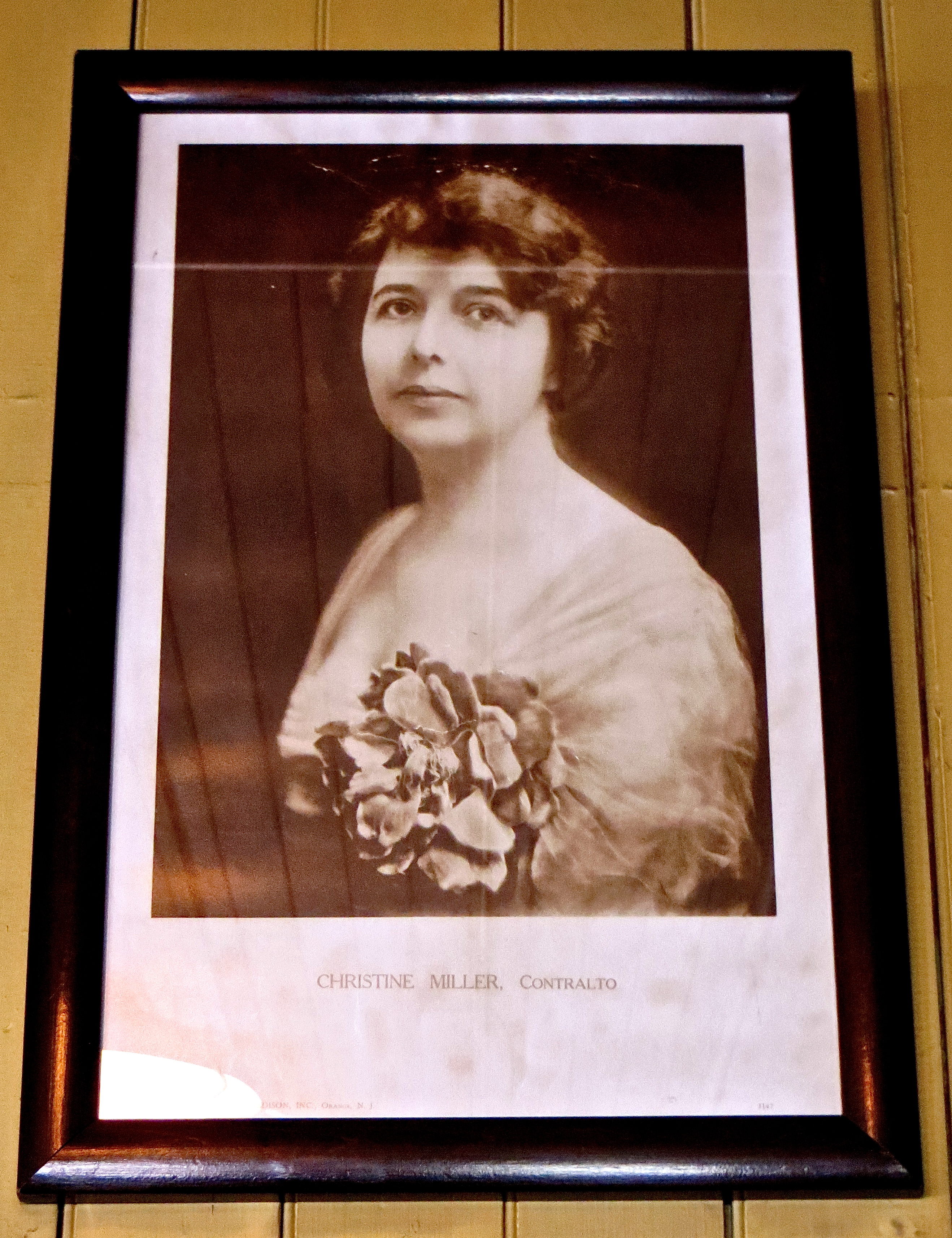
All around the Music Room the walls were decorated with a number of large, framed portraits of many of the artists who recorded for Edison Records.
After taking that photograph of the Music Room, I turned around, looked up and there, hanging on the wall, I found Christine Miller.
Christine Miller was born on February 11, 1877.
Her recording career lasted until 1918 when she married Daniel M. Clemson, a steel manufacturer from Pittsburgh, Pennsylvania.
The next place that I found Christine Miller was in a box.
Not long after reading Perfecting Sound Forever: An Aural History of Recorded Music by Greg Milner, I embarked on a little musical recordings shopping trip through an area known as “Antique Alley” along Rte. 4 in Northwood, NH. The first store I stopped at was called Eagle Antiques. When I asked Chuck, the owner, if he had any Edison cylinders, he suggested I see Jeff at Fern Eldridge & Friends Antiques a little ways further up the road.
At Fern Eldridge & Friends, Jeff answered my request with the presentation of two, medium-size cardboard boxes each containing about 35 – 40 Edison cylinders. All of the cylinders in each box were standing on end with the label edges pointing up.
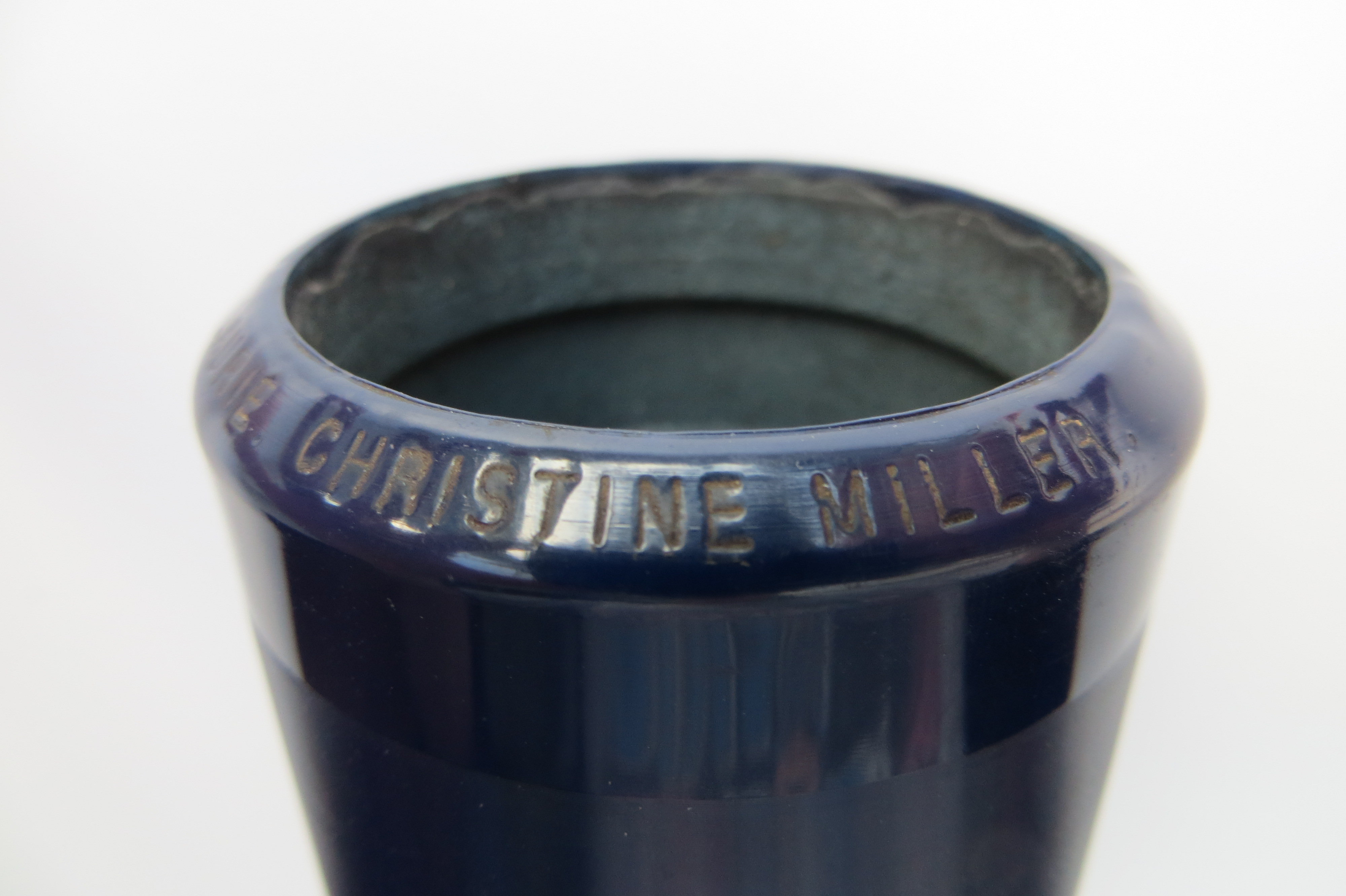
One of the first cylinders to catch my eye bore the name “Christine Miller.”
The recording on the cylinder – an Edison Blue Amberol Concert Record, #28166 – is of Christine Miller singing “Annie Laurie.” Miss Miller is accompanied on this recording by an orchestra. Edison Records released this cylinder in 1913.
“Annie Laurie” is an old Scottish ballad. Its lyrics were allegedly written by the poet William Douglas some time in the early 1700’s but not published until 1823. The poem was definitely set to music by Lady John Scott of Spottiswoode, Scotland and first published in 1835.
Thanks to the website of the Cylinder Preservation and Digitization Project, Department of Special Collections at the Donald C. Davidson Library, University of California, Santa Barbara, here is that recording!
If you would like to hear other performances by Christine Miller, the Cylinder Preservation and Digitization Project website (cylinders.library.ucsb.edu) has links to seventeen more Edison Records cylinder and disc recordings of Miss Miller made from 1912 to 1917. Among the selections in this collection are Christine Miller’s recordings of the songs “Abide With Me” and “The Old Folks At Home” as used in the September 17, 1915, Montclair, NJ, Tone Test.
And… The Library of Congress’ National Jukebox website (loc.gov/jukebox) has links to digitally preserved recordings of eight records by Christine Miller made for Victor Records from April to June of 1914.
Tomorrow, Part 3.
P.S.: If you would like to read more about the other treasures I found on my Antique Alley shopping trip, please visit the blog archives for September 2011 and scroll down to the blog post of September 2 called “78s & Cylinders.”
The first place I found Christine Miller was in a book.
The book was Perfecting Sound Forever: An Aural History of Recorded Music written by Greg Milner, published in 2009.
Mr. Milner introduces Miss Miller on page 4, in the second paragraph of his description of a concert that took place in Montclair, NJ on September 17, 1915. Christine Miller, a singer and Edison Records recording artist, was one of the featured performers in this concert.
The by-invitation-only Montclair event was sponsored by the Phonograph Sales Company, which, in the summer of 1914, had opened a phonograph shop on Main Street in nearby East Orange, NJ. The Phonograph Sales Company was operated by employees of Thomas Alva Edison, Inc., whose headquarters were in West Orange, NJ. The accompaniment for Christine Miller and the two other soloists at this concert was not provided by the usual orchestra, band or even a pianist, but by an Edison Diamond Disc Phonograph playing an Edison Records Diamond Disc.
This kind of concert was known as a “Tone Test.”
A Tone Test concert presented a live solo performer playing or singing along with an Edison Diamond Disc Phonograph playing an Edison Records Diamond Disc recording of that same performer playing or singing a particular piece. The live soloist would then, at various times, stop playing or singing along with the recording, hopefully leaving the attentively-listening audience unable to tell whether what they were hearing was the live performance or the Diamond Disc.
Mr. Milner explained that Thomas Edison believed that when an Edison Records Diamond Disc was played on an Edison Diamond Disc Phonograph, the recorded musical performance on the disc was not being “reproduced,” it was being “re-created.” Thomas Edison was convinced that his Diamond Disc Phonograph was as much a musical instrument as a violin, a piano, a flute or a singer’s voice.
The logo below was printed on the paper sleeves of Edison Records in the early 1900’s.
So, to prove to the ever-skeptical buying public that the Diamond Disc system produced the completely pure and life-like musical sound that Thomas Edison believed it did, Thomas Alva Edison, Inc. embarked on the “daring experiment” of staging live Tone Tests.
The first Tone Test was held in East Orange, NJ, in February, 1915 and featured vocalist Christine Miller.
On June 21, 1915, The Civic Committee of The Woman’s Club of the Oranges hosted a Tone Test concert featuring “Miss Christine Miller, The Celebrated Concert Contralto.”
At the September 17, 1915 event at The Montclair Club in Montclair, NJ, Christine Miller skillfully wove her live voice in and out of several Edison Diamond Disc recordings. Starting with an aria from Mendelssohn’s Elijah, Miss Miller continued with the Scottish hymn “Abide With Me” and then presented “The Old Folks at Home,” a song by Stephen Foster, for the grand finale.
In the words of Mr. Milner: “The crowd went wild.”
Thomas Alva Edison, Inc. continued conducting Tone Tests featuring Christine Miller across the country throughout the Fall of 1915, including a major event on October 21 – Thomas Edison Day – in San Francisco, CA. In April of 1916, Miss Miller appeared in a highly publicized Tone Test held at Symphony Hall in Boston, MA.
The last of the Tone Tests were held in 1925.
Tomorrow, Part 2.
P.S.: If you would like to read more about what I found in the pages of Perfecting SoundForever, please visit the blog archives for September 2011 and check out my post of September 30 called “The Power of Reading.”
If you’re a new visitor to this blog, the purpose of my Wrestling With The Angel series (or category) is to highlight and share individual songs that are on a list of mine entitled: Devastatingly Great Songs. The title phrase, “Wrestling With The Angel,” is my paraphrase of a line from a poem by Herman Melville called “Art.” You can read the complete poem in my archived post of November 4, 2011: “The Source.”
Some songs are like Lisa Gherardini del Giocondo.
Lisa sat to have her portrait painted by only one artist; but that artist, Leonardo da Vinci, produced a single work of art, his “Mona Lisa,” that is an endlessly fascinating and now, of course, iconic image of this young, 16th century woman.
Some songs are like Norma Jeane Mortenson.
For seventeen years, Norma Jean posed and acted before the cameras of dozens of photographers and movie directors. But from the thousands and thousands of photographs and twenty-seven feature-length films that these artists produced, not one single image paints a complete portrait of the young model and actress known as Marilyn Monroe.
“These Days” by Jackson Browne is a Norma Jeane Mortenson-kind of song.
Now, the first time I heard “These Days” I was listening to a Tom Rush album.
Singer-guitarist Tom Rush (born February 8, 1941 in Portsmouth, NH) recorded two Jackson Browne songs, “Colors Of The Sun” and “These Days,” for his first album for Columbia Records. Titled Tom Rush and released in March, 1970,this record was the musician’s seventh LP. Tom’s first album, the independently-produced Live At The Unicorn, came out in 1962. In 1965, his fourth album – and first on Elektra Records – was also titled Tom Rush.
On the Tom Rush Tom Rush album I was listening to, “These Days” was the first track on side 2.
Listen for yourself.
The musicians on that recording were: Tom Rush, acoustic guitar & vocals; Trevor Veitch, lead guitar; Duke Bardwell, bass; Warren Bernhardt, piano; and Herbie Lovelle, drums. The string arrangement was by Ed Freeman.
I fell in love with “These Days” and learned to play and sing it from Tom Rush’s recording. I could relate to the introspective observations of the lyric’s wise-beyond-his-years protagonist. I savored wrapping my voice around the curves and rhythms of such a finely crafted melody. I had, by that time, acquired enough fingerpicking guitar skills to be able to bring out all of the rich and emotive harmonies of the chord progression’s half dozen or more open-position chord fingerings. It was (and still is) a completely rewarding experience to be able to sit down and play and sing this song.
But, I would have to wait three and a half years to finally hear how Jackson Browne himself would play and sing “These Days.”
Songwriter, singer, guitarist and pianist Jackson Browne (born October 9, 1948 in Heidelberg, Germany, to an American serviceman father and Minnesota-born mother and raised in Los Angeles, California from the age of 3) recorded his self-titled first album in 1971 for Asylum records.
Jackson’s rendition of “These Days” appeared on his second album, ForEveryman, in October 1973. Accompanying Jackson’s lead vocals and acoustic guitar on the track are David Paich, piano; David Lindley, electric lap steel/slide guitar; Doug Hayward, bass & harmony vocals; and Jim Keltner, drums. The track notes on the back cover of the ForEveryman record jacket state that the arrangement of “These Days” contained within was “inspired by Gregg Allman.”
Listen to this one, too.
For all of the beauty and multi-faceted brilliance of the performances on each of those recordings (and the intriguing differences between them), I have found myself over the years returning time and time again to the Jackson Browne recording because of the truly dazzling contributions of David Lindley.
Maxi-instrumentalist David Lindley (born March 21, 1944 in San Marino, CA) was a member of the psychedelic Rock band Kaleidoscope from 1966-1970. In 1968, he started doing freelance session work, adding his talents to recordings by Leonard Cohen, The Youngbloods and Graham Nash.
David Lindley began performing with Jackson Browne around the time Jackson’s first album came out. When it was time for Jackson to go on tour in support of JacksonBrowne, he initially had a hard time reproducing the album’s full-band arrangements in a live, in-concert setting, mostly because of how well he and David worked together as a duo.
Jackson explained this dilemma in an interview by Derk Richardson that appeared in the February 2006 issue of Acoustic Guitar magazine.
“In putting together a band,” Jackson recalled, “no matter what I did, it wasn’t as cool as just me and David. I thought, ‘It’s going to take a lot longer to make a band do what we do together,’ and it did take a long time. That became my quest – to get a band to play as emotionally and truthfully as what happened with just me and David.”
To me, on that recording of “These Days,” the music that Jackson Browne and David Lindley create with one voice, an acoustic guitar and an electric lap steel/slide guitar does indeed render the accompaniment of the piano, bass and drums virtually irrelevant. From the way Jackson’s voice and David’s guitar meld in harmony on the first notes of the first verse to David’s epic 48-bar solo that is the song’s coda, all of that coolness and emotion and truthfulness commandingly radiates from every second of this performance.
Go back. Close your eyes and listen again.
Over the years, I’ve learned much about the song “These Days.”
Jackson Browne wrote “These Days” in its first form when he was 16 years old.
The first artist to record “These Days” was the one-time Velvet Underground vocalist and Andy Warhol protoge Nico (born Christa Paffgen, 1938-1988). Nico’s version was included on her 1967 solo album, Chelsea Girl, and featured Jackson Browne’s fingerpicked electric guitar accompaniment.
The Nitty Gritty Dirt Band, a band that Jackson Browne had briefly been a member of in 1966, released their rendition of “These Days” on their 1968 LP, Rare Junk.
Greg Allman’s inspirational version of “These Days” came out on his solo album, LaidBack, which was released almost simultaneously with For Everyman in October, 1973.
The Nico and Nitty Gritty Dirt Band recordings of “These Days” are four verses long, including a second verse that did not make it into the Tom Rush version or Jackson Browne’s For Everyman version.
In 2001, film director Wes Anderson included the Nico recording of “These Days” in the soundtrack of his film The Royal Tennenbaums. The popularity of the movie resulted in a resurgence of interest in the song and directly inspired Jackson Browne to re-learn and begin performing “These Days” in the style he used for Nico’s recording.
Jackson presented his “new” version of “These Days” on his 2005 live album, SoloAcoustic, Vol. 1.
If you’ve got the time and a little listening left in you, here’s that recording.
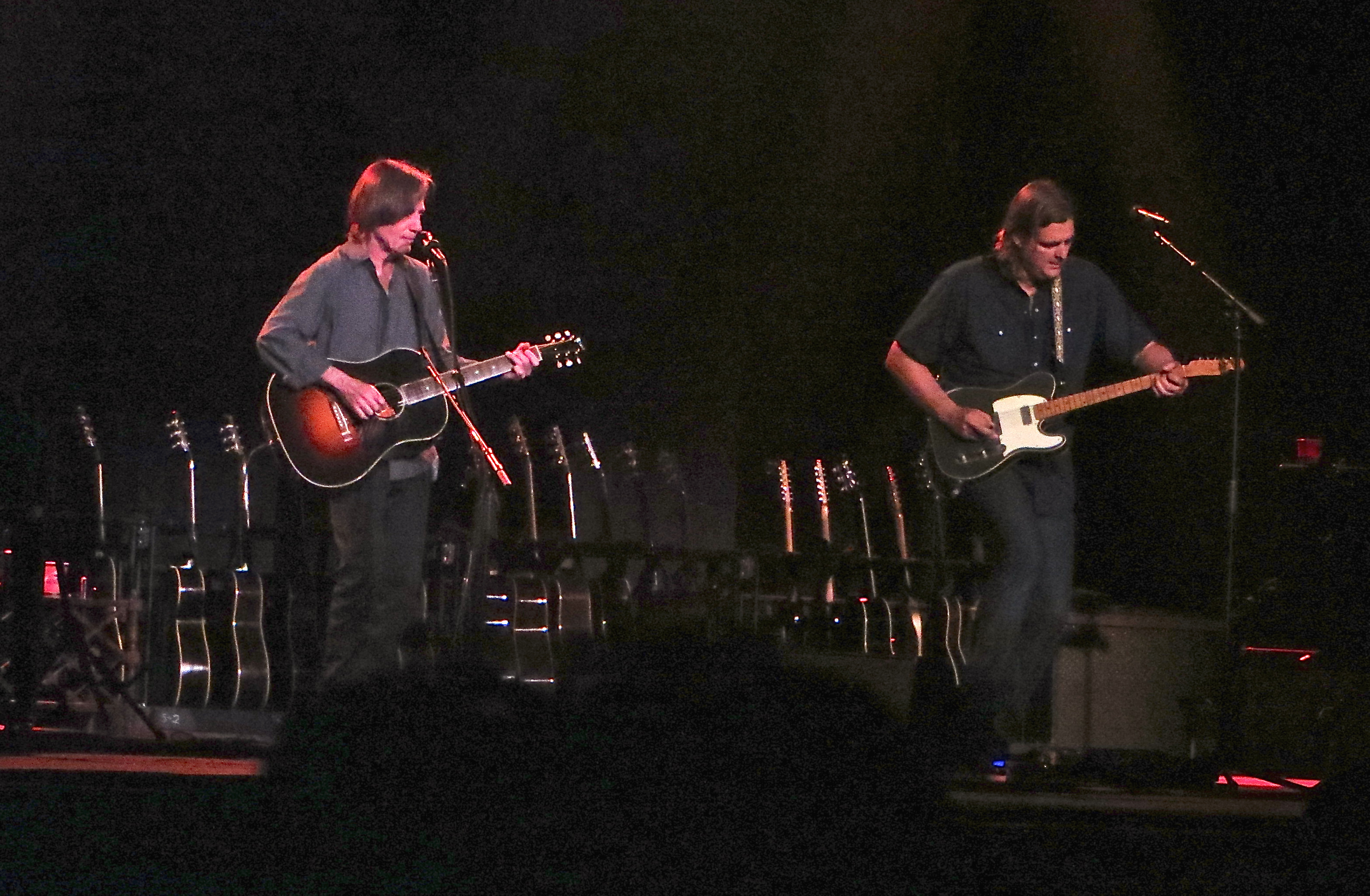
This summer, on Tuesday, August 19, my wife and I attended the Concord, New Hampshire stop of Jackson Browne’s “2014 Solo Acoustic Tour.” Not long into the second set, Jackson fingerpicked the distinctive introduction of “These Days” on a small body, sunburst Gibson acoustic guitar. (This was one of 23 guitars – and a piano – that Jackson had on stage with him for that evening’s concert.) The gorgeous performance of “These Days” that he gave for us that evening was almost exactly like the “Solo Acoustic, Vol. 1” recording above. One difference was the addition of the brilliant electric lead guitar work of Val McCallum, Jackson’s “surprise” accompanist for the evening. (Val brought 6 guitars.)
The other difference was that Jackson included the “missing” second verse of the 1967 Nico recording.
Here’s what it looked like.
Finally, according to the song’s Wikipedia page, since 1975, “These Days” has been recorded by an additional 21 different artists or bands.
This is a story about two Jazz musicians, two Country musicians and a Blues song.
On July 11, 1930, a headline in the Los Angeles, California newspaper – the California Eagle – proclaimed: “Louie Armstrong Famed Record Artist in City.”
The 28 year old New Orleans-born Jazz musician and entertainer had indeed made his first visit to the West coast, taking the train from New York City. Louis’ wife, Lil Hardin Armstrong (32 years old, Memphis, Tennessee-born and an accomplished Jazz pianist, recording artist, band leader and composer in her own right) had traveled with him to Los Angeles.
Louis Armstrong was scheduled to begin an extended engagement at The Cotton Club, one of the most popular Los Angeles-area nightclubs, located in the suburb of Culver City. He would be leading the New Sebastian Cotton Club Orchestra and the club was heralding Louis as “King of the Trumpet” and “The World’s Greatest Cornetist.”
On July 16, 1930 – the day before he opened at The Cotton Club – Louis and Lil Armstrong spent part of the day at Hollywood Recording Studios in Los Angeles. They went there to make a record with the reigning King of Country music – singer/guitarist Jimmie Rodgers.
Jimmie Rodgers (born September 8, 1897 in Pine Springs, Mississippi) had been recording at the Hollywood Studios since the 30th of June. The session on the 16th was the last of nine dates in July when Jimmie was in the studio. Jimmie Rodgers’ producer on all of these recording sessions was Victor Records’ Director of Artists & Repertoire, Mr. Ralph Peer.
Ralph Peer (born May 22, 1892 in Independence, Missouri) had first recorded the then-unknown Jimmie Rodgers on August 4, 1927 in Bristol, Tennessee. Peer was working as a talent scout doing field recordings for the Victor Talking Machine Company. Rodgers recorded two songs – “The Soldier’s Sweetheart” and “Sleep Baby, Sleep” – on the next-to-the-last day of 10 days of auditions and recording. These legendary sessions are now known simply as The Bristol Sessions.
Ralph Peer had known the Armstrongs even longer than he’d known Jimmie Rodgers.
In 1924, Ralph was working for OKeh Records. He met Louis and Lil in Chicago that year, probably around the time the couple got married. In 1925, Ralph Peer signed Louis Armstrong to his first recording contract while Louis was playing with the Fletcher Henderson band in New York. Peer then arranged for Louis to record with his own five-piece band, including Lil on piano, back in Chicago.
That band, Louis Armstrong & His Hot Five gathered for its first recording session on November 12, 1925. From then until December of 1927, Louis and Lil played together with either His Hot Five or His Hot Seven on forty-eight recordings for OKeh Records. Lil Hardin composed several of the pieces these groups recorded, including “My Heart” – the first number cut by the Hot Five.
[OKeh Records were marketed by The Otto Heinemann Phonograph Corporation starting in September, 1918. OKeh Records established a “race records” series in 1922. Louis and Lil Armstrong had first recorded for that branch of OKeh in April, 1923 when they were members of King Oliver’s Creole Jazz Band. OKeh Records was acquired by Columbia Records in November, 1926. “Race records” was a term that was used throughout the American record industry up to 1949.]
The song that Louis and Lil Armstrong would record with Jimmie Rodgers on July 16 was called “Blue Yodel No. 9 (Standin’ On The Corner).” Written by Rodgers himself, “Blue Yodel No. 9” bears a certain resemblance in some parts to two older songs: “Frankie And Johnny” and “The Bridwell Blues.”
There are some Folk music scholars who claim that the song “Frankie And Johnny” has been around since the Civil War or even earlier. On April 4, 1904, a song by Hughie Cannon called “He Done Me Wrong (The Death of Bill Bailey)” marked the first time that a melody similar to that of “Frankie and Johnny” appeared in print. The first time an actual song was published called “Frankie and Johnny” was on April 10, 1912. This song was credited to “Leighton Bros. and Ren Shields.” Jimmie Rodgers recorded his rendition of “Frankie and Johnny” under the title “Frankie And Johnnie” on August 10, 1929.
“The Bridwell Blues” was written by Nolan Welsh and Richard Jones. Baritone vocalist Welsh recorded the song in Chicago, Illinois for OKeh Records on June 16, 1926. Pianist Richard Jones and cornetist Louis Armstrong accompanied Welsh on the recording.
Here is “Blue Yodel No. 9” by Jimmie Rodgers with Lil Hardin Armstrong on piano and Louis Armstrong on trumpet.
When Victor Records released “Blue Yodel No. 9” on September 11, 1931, neither Lil or Louie were given credit on the record for their contributions. “Blue Yodel No. 9” would also be the last record that the not-so-happily married Armstrongs would make together.
It would not, however, be the last time Louis Armstrong would play “Blue Yodel No. 9.”
On October 28, 1970, 69-year-old Louis Armstrong was the special guest on that evening’s nationally televised broadcast of The Johnny Cash Show. For one of the numbers that he performed during the show, Louis sat down with the 37-year-old Cash (born February 26, 1932 in Kingsland, Arkansas) and put together a rousing re-creation of “Blue Yodel No. 9.” Lil Hardin Armstrong’s piano part was played off-camera by Bill Walker, The Johnny CashShow’s musical director.
[The Johnny Cash Show aired on ABC-TV starting on June 7, 1969. The fifty-eighth and final episode of this hour-long, prime time, music/variety program ran on March 31, 1971. Every show was taped before a live audience at the Ryman Auditorium, in Nashville, Tennessee.]
As you watch the video below and listen to this performance, keep these words of Louis Armstrong in mind: “When I pick up that horn, that’s all. The world’s behind me, and I don’t concentrate on nothin’ but it… That my livin’ and my life. I love them notes. That why I try to make ’em right.”
Louis Armstrong was born this day, August 4, 1901 in New Orleans, Louisiana. His mother was Mary Ann Albert, his father was William Armstrong.
John H. Daum was my wife’s maternal grandfather. To Andrea and her brothers and sisters he was their Opa.
One of the earliest memories that Andrea has of her Opa comes from when she was a very little girl and her family lived on Calvin Street in Washington Township, New Jersey.
Opa and Oma (Andrea’s grandmother, Ruth Sevester Daum) had just arrived for a Sunday afternoon visit. Andrea remembers that as she excitedly dashed across the lawn to greet them, Opa stepped out of the car pretending to play the guitar and singing, “You ain’t nothin’ but a hound dog…!” Then, after he swept her up in a big hug, still singing this silly song that Andrea had never heard before, her Opa told her about the man whose record of the song had been playing on the radio in the car, a man named Elvis Presley.
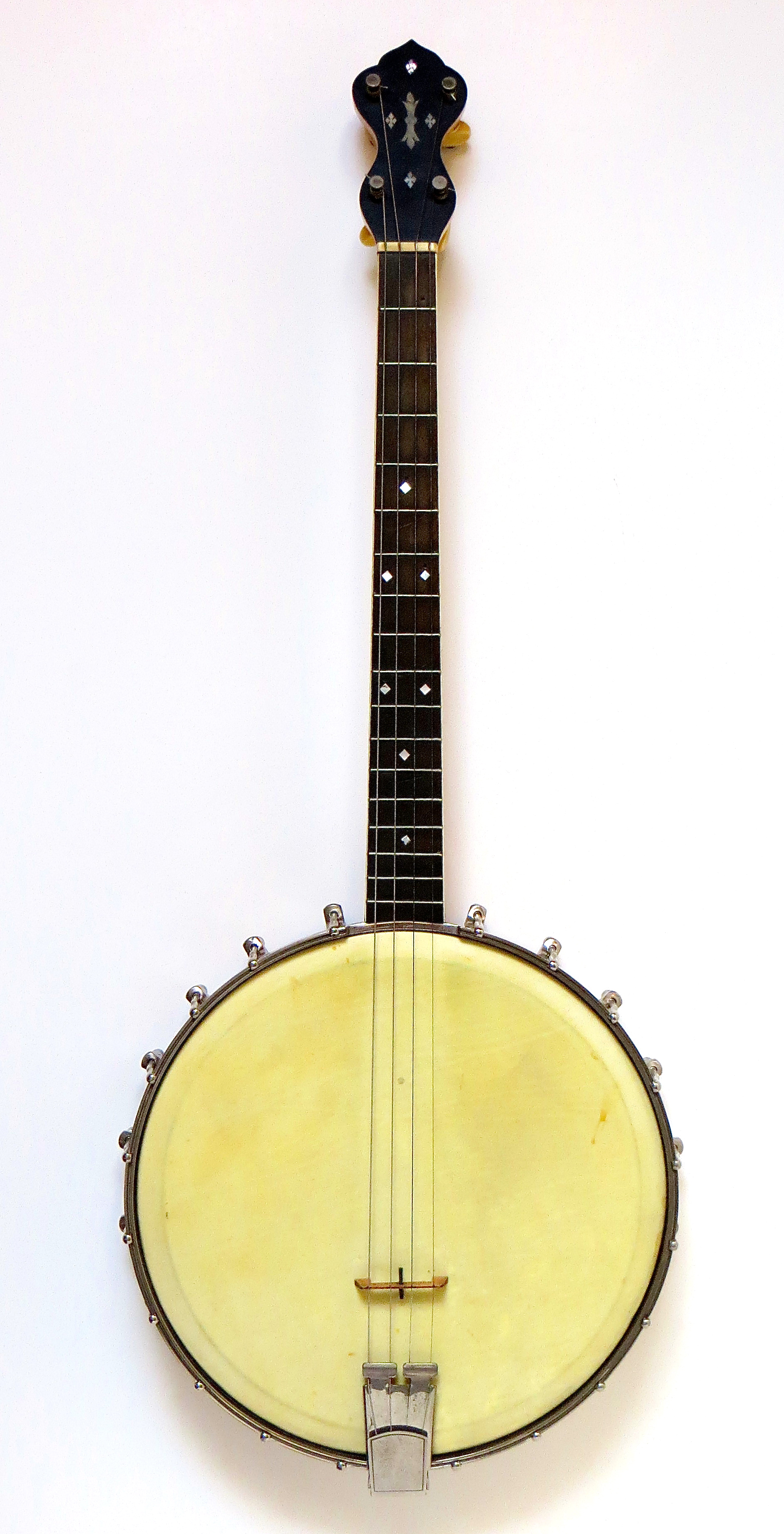
It seems that John – or Hank, as Ruth usually called him – had always been tuned in to the popular music of the day. When he was a young man, the banjo was the instrument of choice for anyone who liked to sing and wanted to accompany him/herself in style. As soon as he could afford to, John became the proud owner of a brand new Wurlitzer 4-string, tenor banjo. This handsome, open-back instrument sported friction-peg tuners with carved white (ivory?) knobs; a 17-fret, bound fingerboard; and a honey-colored, birds-eye maple rim.
For the past thirty years or so, Opa’s Banjo has lived at our house; handed down by Andrea’s mother. Every now and then I take the instrument off its shelf, carefully slide it out of its thick, black cardboard case, tune her up and plunk out an old Folk song or two from the tarnished but still lively strings.
One day in the future, Andrea and I will fulfill what we know would have been Opa’s wishes and pass the instrument on to the next generations of our/his music-loving family.
This banjo will always be Opa’s Banjo – a cherished and unique reminder of this fun-loving, warm-hearted, deeply loved and still greatly missed man.
John George Harold Daum was born in Cincinnati, Ohio on June 26, 1906. He was the first born child and only son of John and Laura (Weick) Daum. The photograph above was taken on his 75th birthday.
Opa passed away on October 26, 1990 in Stamford, Connecticut.
Woodrow Wilson Guthrie was born on this day, July 14, in 1912. He was the third of five children of Charley and Nora Guthrie of Okemah, OK. It wasn’t long before family and friends started calling him “Woody.”
Many years later, The Penguin Encyclopedia of Popular Music called songwriter, singer and guitarist Woody Guthrie: “The Dean of American Folk artists.”
Bob Dylan called him: “The true voice of the American spirit.”
In his Chronicles, Volume One (2004), Bob Dylan describes the first time he really listened to a Woody Guthrie record: “When the needle dropped, I was stunned – didn’t know if I was stoned or straight… It made me want to gasp. It was like the land parted… It was like the record player itself had just picked me up and flung me across the room…It was like I had been in the dark and someone had turned on the main switch of a lightning conductor.”
One of the Woody Guthrie records that was most likely among those that had such an impact on the young Bob Dylan was Dust Bowl Ballads.
Dust Bowl Ballads contained Woody Guthrie’s first commercial recordings. Made and released by Victor Records, the first recording session took place on April 26, 1940 in Camden, NJ. The second session was in New York City on May 3, 1940. Dust Bowl Ballads was released in July, 1940 as two, three-record albums – six, 78-rpm discs in all.
“Do Re Mi” was one of the songs on Dust Bowl Ballads. Written in 1937, Woody had previously recorded the song for Alan Lomax and The Library of Congress on March 21, 1940. He again recorded “Do Re Mi,” probably in late April, 1947 for Moses Asch and his Folkways Records. Folkways released it in 1956 on an album called Bound For Glory.
Here, in celebration of the anniversary of Woody Guthrie’s birthday, is his Asch recording of “Do Re Mi.”
On Saturday, August 18, 1962, at Hulme Hall in Port Sunlight, Birkenhead, England, Ringo Starr played his first official gig as the drummer for The Beatles.
Part of what made Ringo the perfect person for the job was his voice. Before long, John, Paul & George regularly turned the spotlight over to this very entertaining singer for a song during a show.
“Boys,” originally written by Luther Dixon & Wes Farrell for the American group, The Shirelles, became the “drummer’s number.” Ringo’s live performance of the song was so well-received in concert, that the band recorded it for their first album, “Please Please Me,” in February, 1963.
From then on, just about every Beatles album included a song – some written by John & Paul, some not – where Ringo sang the lead.
For instance…
“I Wanna Be Your Man” was “the drummer’s number” on With The Beatles.
Two songs by Carl Perkins, “Matchbox” and “Honey Don’t,” appeared respectively on the 1964 American LP, Something New and the 1964 British LP, Beatles For Sale.
Help (1965) included “Act Naturally,” a 1963 hit for American Country Music star, Buck Owens.
The second side of the British version of Rubber Soul (1965) started with “What Goes On.”
“Yellow Submarine” added some fun to Revolver in 1966.
Ringo sang as the fictional Billy Shears in “With A Little Help From My Friends” on Sgt. Peppers’ Lonely Hearts Club Band in 1967.
Finally, in 1968, Ringo added “songwriter” to his resume.
“Don’t Pass Me By,” Ringo’s first all-original song, was the sixth track on the second side of the two-LP set simply called TheBeatles.
Credited to Richard Starkey (Ringo’s real name), “Don’t Pass Me By” was recorded over four recording sessions starting on June 5, 1968 and concluding on July 22, 1968. The track features Ringo on vocals, drums, sleigh bell and piano – with Paul McCartney on piano and bass guitar and Jack Fallon on violin/fiddle.
“Don’t Pass Me By” is great fun to sing, play and listen to!
Here it is! (Feel free to sing along!)
Richard Starkey – he took on “Ringo Starr” as his stage name a couple of years before he became a Beatle -was born this day, July 7, 1940 in Liverpool, England.
Happy 74th Birthday wishes with Peace and Love to you Ringo!
This past Spring, two of my best guitar students, N and A, learned the song “Ain’t No Sunshine” by Bill Withers.
N, the singer/guitarist of this very talented duo was inspired to learn “Ain’t No Sunshine” from a YouTube video of John Mayer’s live 2010 cover version of the song. A, the lead guitarist, wanted to be able to play the melody of the first verse of this 1971 Grammy Award-winning “Best R&B Song” just the way Bill Withers sings it in this live performance from 1971.
Individually and together, I coached these two young musicians through the process of creating an acoustic guitar, vocals & electric guitar arrangement that combined the best of John Mayer’s and Bill Withers’ versions. In the end, N and A were the proud purveyors of a superb rendition of “Ain’t No Sunshine” that will stand as my favorite cover of this timeless R&B classic.
When I shared this story with my wife Andrea, I added that I’d forgotten not only what a good song “Ain’t No Sunshine” was but what a really fine singer Bill Withers was. Andrea readily agreed and went on to tell me how and why her all-time favorite Bill Withers song is “Lean On Me.”
Here, in this blog’s first ever contribution from a “Special Guest Writer” is Andrea’s own sixstr story:
“We all need somebody to lean on…”
Bill Withers sang those words to me over and over. And I sang along with him. Back and forth to high school graduation practice in my parents’ red Chrysler – the car radio blasting – 77 WABC – my favorite AM station for many years. Or driving to the Grand Union, Westwood Cleaners, running errands for my mother….bringing my brothers or sisters somewhere. At 18 I had many worries, but Bill Withers and his Top Ten hit “Lean On Me” kept me company – his words and smooth, smooth voice were soothing. The song begins with piano, then soft humming, then his voice wrapping you up in a hug with its messages of hope and help and friendship….and of course that gentle beat you can’t help but move with. The soft clapping. It was just what my 18 year old self needed to hear…over and over.
However, even now – all these years later – when I hear those first few notes, I am back there – in that old car with the radio on and the sense that my life is about to drastically change. And how I sure did need somebody to lean on.
Happy Birthday Mr. Withers. Your song made a difference in my life. I still remember every word.
After that dinnertime conversation, I discovered that the only Bill Withers recording that we owned was a vinyl copy of his 1977 LP, Menagerie. Andrea then did some online research and placed an order to Bull Moose Records in Portsmouth for a copy of the 2000 Columbia/Legacy compilation, The Best of Bill Withers: Lean On Me.
A few days later, we were savoring the luxurious sounds of “Lovely Day,” “Grandma’s Hands,” “Use Me,” “Just The Two Of Us,” “Ain’t No Sunshine,” “Lean On Me” and twelve other outstanding Bill Withers songs.
In the course of her research, Andrea learned that July 4 was Bill Withers’ birthday. “You’ll have to do a blog post,” she exclaimed.
“Good idea,” I replied.
William Harrison Withers, Jr. was born in Slab Fork, West Virginia on July 4, 1938. Bill was the youngest of six children.
Bill Withers recorded his first album, Just As I Am (containing “Ain’t No Sunshine”) in 1971. He went on to record seven more albums, the last being Watching You Watching Me, which came out in 1985.
“Lean On Me” was from Bill Withers’ second album, Still Bill, which was released in May of 1972. “Lean On Me” held the #1 spot on the Billboard Hot 100 singles chart for three weeks in a row, starting the week of July 8, 1972.





 sixstr stories