Hot Dog!

On June 15, 2010, I wrote and posted an essay called “Recent Discoveries.” In it, I relayed the story behind my exciting discovery of the very first use of an electric guitar – “Spanish,” not “Hawaiian” – on a commercially-released record!

I had found out that the first electric guitarist on record was not, as I’d thought, Charlie Christian. It was not Eddie Durham or George Barnes. (Those three had made their first recordings respectively on October 2, 1939; March 18, 1938; and March 1, 1938.)

The very first electric guitarist on record was Jim Boyd.

On September 28, 1935, in Dallas, Texas, Jim Boyd recorded three sides playing the electric guitar as a member of the Dallas/Fort Worth-based band known as Roy Newman and His Boys.

The pieces that Roy Newman and His Boys recorded that day were: “Corrine, Corrina,” “Shine On Harvest Moon” and “Hot Dog Stomp.” At the time of my writing in June, 2010, I was only able to find one of those recordings to hear and share with you and that was  “Corrine, Corrina.”

Well, guess what?!?

Just yesterday, I discovered videos on YouTube for both “Shine On Harvest Moon” and “Hot Dog Stomp!”

Really!!

I couldn’t hit “play” fast enough.

But… after carefully listening several times to both “Shine On Harvest Moon” and “Hot Dog Stomp,” I found that Jim Boyd’s electric guitar is prominently featured only on “Hot Dog Stomp.” The recording of “Shine On Harvest Moon” showcases the classic song in a most impressive rendering by the very fine vocalists in Roy Newman and His Boys. It is well worth listening to.

“Hot Dog Stomp” is a swinging, up-tempo little number featuring the instrumental and improvisatory skills of the members of the band. Clarinetist Holly Horton takes the lead on the opening statement of the main, rather humorous melody and continues through as the first soloist. Acoustic rhythm guitarist Buddy Neal and fiddler Thurman Neal step up, in that order, for the next two solos and finally, at 2:02, Jim Boyd takes the spotlight and more than holds his own on that electric guitar.

Check it out!

That video was produced and posted by Lloyd T on December 14, 2012. Lloyd T is also responsible for posting videos of the weekly Sunday services from the Utica Baptist Church in Utica, Mississippi.

Many thanks, Lloyd, for all of your good work!

Thanks as well to AllMusic.com for some biographical information about band leader Roy Newman.

Roy Newman (11/12/1899-2/23/1981) was a Texas born and based musician who played piano, accordian and guitar. Now considered to be one of the pioneers of Western Swing (music that merges elements of Jazz and Country), Roy and His Boys recorded 72 sides between 1934 and 1939 before disbanding in 1940. Several of those recordings are available for your listening pleasure on YouTube and a handful can also be purchased on iTunes.

However, in the humble opinion of yours truly, the most important two of those 72 recordings by Roy Newman and His Boys are: “Hot Dog Stomp” and “Corrine, Corrina,” recorded in Dallas, Texas on September 28, 1935 and featuring Jim Boyd on the electric guitar.

Good music doesn’t get old, and when it’s so historically important… it doesn’t get much better.

I just love this stuff!
Posted in Posts with Video, Random Topics | Tagged , , , , , , | Leave a comment

Wrestling With The Angel, Chapter 6

Joe Keone was a trumpet player and, as I remember it, like me, a Music Education major at the University of New Hampshire in the 1970’s.

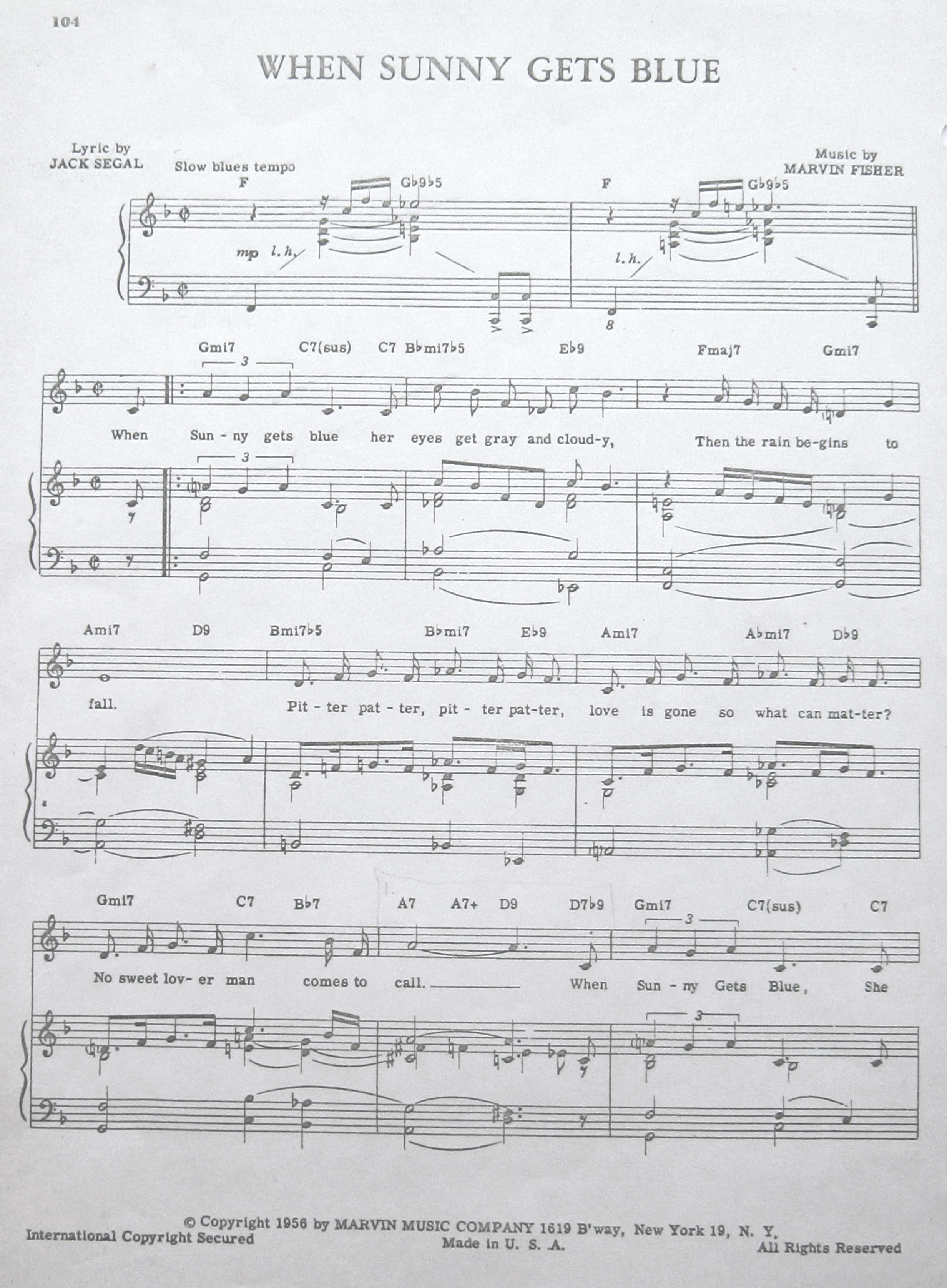
During the course of our college-days friendship, Joe introduced me to one of his favorite songs: “When Sunny Gets Blue.” Being always interested in learning a new song, I asked if he could get me a copy of the sheet music for it, and he did. Here’s page 1.

When Sunny Gets 2

Joe was right. “When Sunny Gets Blue” is an extraordinary song. It has wonderfully well-crafted lyrics, a sublime and superbly-singable melody and the kind of complex, constantly-shifting yet, in the end, totally-logical chord progression that I find to be so much fun to play on the guitar. 

Once I learned to play and sing it – and I have most enjoyably continued to play and sing it ever since – Joe and I got together and worked out a trumpet/guitar/vocal arrangement that we were both quite happy with. I was playing at The Loaf & Ladle in Exeter at the time and I invited Joe to come down and sit in one night. I don’t recall the audience’s response, but I can still picture Joe sporting a wide and satisfied smile as we wrapped up our rendition of “When Sunny Gets Blue.”

As the sheet music informs, “When Sunny Gets Blue” was copyrighted in 1956. The lyrics were written by Jack Segal, the music composed by Marvin Fisher.

Jack Segal (1918-2005) was born in Minneapolis, MN and is best known for writing the lyrics to the 1949 song “Scarlet Ribbons (For Her Hair).” With music by Evelyn Danzig, “Scarlet Ribbons” was a huge hit for Harry Belafonte in 1952.

Marvin Fisher (1916-1993) was born in New York, NY; the son of Fred Fisher, a Tin Pan Alley songwriter. Among the better known songs that Marvin wrote the music for were: “Destination Moon” and “That’s The Kind Of Girl I Dream Of.”

“When Sunny Gets Blue” was first recorded by vocalist Nat King Cole (1917-1965) in 1956. With an orchestral accompaniment arranged by Gordon Jenkins, “When Sunny Gets Blue” was included on Mr. Cole’s album Love Is The Thing.

Here it is.

I hope you enjoyed that.

Thanks, Joe. 

“When Sunny Gets Blue” has been recorded by many, many artists including several instrumentalists who forgo the lyrics and let Marvin Fisher’s melody tell the tale all by itself. A little searching on YouTube and/or iTunes will provide many fabulous versions well worth your time.

Let me know what you find!

Posted in Posts with Video, Wrestling With The Angel | Tagged , , , , | Leave a comment

“Dancin’ To The Beat (Of Your Heart)”

My love affair with Jazz has been long and memorable. From my teenage years as an avid reader and subscriber of Down Beat magazine, my first trip to a concert in Boston for a night of The Boston Globe Jazz Festival in 1969, to the purchase of the first of many Jazz albums – Blues Roots by the Dave Brubeck Trio featuring Gerry Mulligan – I have found Jazz to be a constant source of great joy and listening pleasure.

Eventually, when my Folk/Rock guitar skills were in need of a boost, I set about trying to learn a Jazz song. The first one I succeeded at being able to play and sing along with was “Swinging On A Star” by Johnny Burke & James Van Heusen.

Over the years, I added several other Jazz numbers to my repertoire, including: 

“When Sunny Gets Blue” by Jack Segal & Marvin Fisher

“Ain’t Misbehavin'” (inspired by Leon Redbone) by Fats Waller, Harry Brooks & Andy Razaf

“I Can’t Give You Anything But Love” by Dorothy Fields & Jimmy McHugh

“‘Tain’t Nobody’s Biz-Ness If I Do” (inspired by Taj Mahal) by Porter Grainger & Everett Robbins

“Take Love Easy” (inspired by Joe Pass & Ella Fitzgerald) by Duke Ellington & John LaTouche.

In the process of learning these extraordinary songs and performing them over and over – and I would gleefully slip one of these chestnuts in between the Van Morrison, James Taylor, Lennon & McCartney and Marshall Crenshaw songs that were the standards for a bar set back in the day – I became fluent with a new vocabulary of many decidedly not-Folkie-or-Rock & Roll-ish guitar chords. These new chords required the mastering of many challenging left-hand fingerings and then combining them in fascinating, harmonically-rich but difficult-to-memorize chord progressions.

Among the many glorious new chords were ones with names such as Gmaj7, C7sus4, Eb diminished 7 and, my personnal favorite, F#m7b5. (That reads: F sharp minor seven flat five.)

Before too long, I tried using some of these new harmonies in a song of my own. In January of 1985, I put the finishing touches to “Dancin’ To The Beat (Of Your Heart),” a swinging little love song that was, and still is, great fun to play and sing.

I recorded and released “Dancin’ To The Beat (Of Your Heart)” on my first, full-length, self-produced, cassette-tape-only album, Anytime, in 1988. (For more detailed information on Anytime, please visit the archives and read my post of April 1, 2012.)

For (I hope) your listening pleasure, and as part of my sporadic-but-continuing effort to eventually post all of the songs from Anytime, here it is!

Click on the blue link below and, as my son would say, “Wait for it!”

“Dancin’ To The Beat (Of Your Heart)” – Words, Music, Electric Guitar & Vocals by Eric Sinclair

Accompanying me on that track was Jim Howe, a friend, colleague and one of the best and most legendary Jazz bassists in New Hampshire, if not New England.

As Jim always used to sign off his letters and promotional material: “Jazz lives!”

Posted in EFS Music, Posts with Audio, Random Topics | Tagged , , | Leave a comment

This Historic Day In Music: Parlophone PMC 7027 (Mono LP), PCS 7027 (Stereo LP)

They’d decided.

The concert they gave on Monday, August 29, 1966 for 25,000 fans at Candlestick Park in San Francisco, California would be their last.

They were tired of touring and performing, “performing” for audiences whose incessant screaming and yelling surely drowned out every note they played.

The Beatles – John Lennon, Paul McCartney, George Harrison & Ringo Starr -wanted to devote their time to writing songs and recording.

So, on Thursday, November 24, 1966, when they gathered in Studio 2 of EMI Studios, Abbey Road, London, England, to begin recording their eighth album, John had a new song and Paul had an idea.

Paul proposed: since they were fed up with being Beatles, how about pretending they were another band. They could create alter egos and make a record as if they were this other band, a band of men, not “four little mop-top boys.” He even had a name for this pretend band: “Sergeant Pepper’s Lonely Hearts Club Band.” (Depending on which of Paul’s recollections you read, the basic details of the conception of the fictitious band’s name are: he was on a plane, flying back to London with long-time friend and Beatles’ road manager Mal Evans. They were having a meal and somehow “salt and pepper” became “Sergeant Pepper.”)

Rather bemused at first, eventually John, George and Ringo got into it. But whatever the concept, the four Beatles, along with producer George Martin and recording engineer Geoff Emerick, set about their work with one simple goal in mind: everything on the new album had to be different.

“Strawberry Fields Forever,” John’s new song, was the first song that The Beatles recorded for the new album.

Over the course of the next five months – the last session for Sgt. Pepper’s Lonely Hearts Club Band was on Friday, April 21, 1967 – The Beatles created and recorded fifteen more songs.

“Strawberry Fields Forever” and a new song from Paul, “Penny Lane” – which was recorded over the months of December 1966 and January 1967 – were released as a single – Parlophone R 5570 – on February 17, 1967. “Only A Northern Song,” recorded in February 1967, was not released until January 17, 1969 as part of the Yellow Submarine soundtrack LP.

“Strawberry Fields” and “Penny Lane” were released as a “double-A side” single at the request of The Beatles’ manager, Brian Epstein. Given that the last release of new music by The Beatles had been the LP Revolver on August 5, 1966, Brian was desperate for “a really great single.” He approached George Martin who said “I’ve got three tracks – and two of them are the best tracks they’ve ever made. We could put them together and make a smashing single.”  

The recording of the first of the thirteen songs that ended up on Sgt. Pepper was begun on December 6, 1966. That song, “When I’m Sixty-Four,” was not actually a new song, but one that had existed in some form or other in The Beatles’ repertoire since the days when they played The Cavern Club back in Liverpool.

The 12 other Sgt. Pepper songs that followed were, in the order in which the recording of each track was started: “A Day In The Life,” “Sgt. Pepper’s Lonely Hearts Club Band,” “Good Morning, Good Morning,” “Fixing a Hole,” “Being For The Benefit Of Mr, Kite,” “Lovely Rita,” “Lucy In The Sky With Diamonds,” “Getting Better,” “She’s Leaving Home,” “Within You Without You,” “With A Little Help From My Friends” and “Sgt. Pepper’s Lonely Hearts Club Band (Reprise).” 

The finished album, Sgt. Pepper’s Lonely Hearts Club Band, was released in England on this day, June 1, 1967. It was released on Capitol Records in the United States on June 2.

To quote Beatle historian Mark Lewisohn from the liner notes of the 1999 remastered CD edition of the album: “Nothing was ever the same again.” 

To quote the small print in the bottom right hand corner of the back of the 1967 LP’s famous gate-fold record jacket (the first record jacket to have all the lyrics of all the album’s songs printed on it): “A splendid time is guaranteed for all.”

When was the last time you listened to Sgt. Pepper’s Lonely Hearts Club Band?

Sources for the information found in this post were: The Beatles Recording Sessions (1988), The Complete Beatles Chronicle (1992) and the liner notes from the remastered CD of Sgt. Pepper’s Lonely Hearts Club Band (1999), all by Mark Lewisohn; Paul McCartney: Many Years From Now (1997) by Barry Miles; The Beatles Anthology (2000) by The Beatles.

Posted in This Historic Day In Music | Tagged , | 1 Comment

This Historic Day In Music: Bob Dylan

My 2010 post celebrating Bob Dylan’s birthday invited my readers to share their favorite Bob Dylan song. After missing the big day in 2011, I came back in 2012 and wrote a piece about some of the many outstanding (in my mind) cover versions of a Bob Dylan song and again invited my readers to share their choice for addition to that list.

For my third installment of what I probably should now think of as being a series, I would like to again extend those invitations.

Click on the blue leave a comment link at the bottom of this post and voice your choice (thanks NECN) for best Bob Dylan song and/or cover version of a Bob Dylan song. I’d love to hear from you!

I’ll get the party started by (again) sharing my all-time, hand’s-down favorite Bob Dylan song: “Mr. Tambourine Man.”

By all accounts, Bob wrote “Mr.Tambourine Man” during the months of February, March and April of 1964. The first live performance he gave of the song has been established as being at Royal Festival Hall in London, England on May 17, 1964.

The first time he tried recording the song was on June 9, 1964 in Columbia Records’ New York City studios as part of the sessions for his fourth album, Another Side of Bob Dylan. Fellow Folk singer Ramblin’ Jack Elliott joined him, singing harmony vocals on the chorus of the song. That version was not deemed suitable for inclusion on the Another Side… album.

Also in June of 1964, Bob made a demo recording of the song for his publishing company, M. Witmark & Sons. He accompanied himself on the piano.

On July 24, 1964, Bob performed “Mr. Tambourine Man” as one of two songs that he presented as part of an “afternoon workshop” concert at the Newport Folk Festival in Newport, RI.

Here, thanks to  BobDylan.com and YouTube, is that performance.

The “official” recording of “Mr Tambourine Man” that we all know and love was cut on January 15, 1965, again at Columbia Studios in NYC. It features Bob on acoustic guitar, singing and playing harmonica with the addition of a second guitar, played by Bruce Langhorne.

“Mr. Tambourine Man” was released on Bob’s fifth album for Columbia Records, Bringing It All Back Home, on March 22, 1965.

Here’s a bit of technical/musical information regarding how Bob played “Mr. Tambourine Man” in these recordings.

For the demo recording, Bob played his piano accompaniment in the key of D major.

In that video of his Newport performance, I’m pretty sure that Bob is playing a guitar that he’d borrowed from Joan Baez. He has the instrument capoed at the third fret, in the non-standard tuning known as dropped-D and the chords he’s fingering are basically D major, G major and A major. But since the music sounds (what’s called the “concert pitch”) in the key of E major, the instrument must have all six strings tuned one half step below standard pitch.

In the Bringing It All Back Home recording, Bob’s guitar is again in dropped-D tuning, it’s capoed at the third fret and he’s fingering the same basic chords. But since the concert pitch of this recording is in the key of F, that means his guitar is tuned up to standard pitch, not down one half step.

Bob Dylan was born Robert Zimmerman on this day, May 24, in 1941, in Duluth, Minnesota.

Happy Birthday, Bob!

Posted in Posts with Video, This Historic Day In Music | Tagged , , , | 1 Comment

Ladies and Gentlemen… The “Ba-Ba Song”

On April 21, 2013, I published the latest chapter in my Wrestling With An Angel series about the song/recording “Surf’s Up” by The Beach Boys.

On April 22, loyal reader ADS left the following comment to that post.

In the mid 1960′s, in the northeastern corner of NJ, there was also a department store where a music-obsessed (or more accurately, a top-40 77WABC radio-listening-music-obsessed) girl could buy records. Actually, being NJ, there was more than one place — Woolworth’s and Valley Fair – where I would go through racks or cubbyholes of 45′s. I still have those 45′s – (no big surprise to those who know me) and among them are two by The Beach Boys: “Good Vibrations” (b/w “Let’s Go Away For Awhile”) and “Barbara Ann” (b/w “Girl Don’t Tell Me”). I played them constantly on my phonograph; singing along……oblivious to those who may have had to listen to me. The soundtrack of our lives? Absolutely! Who knew that about 17 years later I would again be singing “Barbara Ann” – but this time to my infant daughter…..over and over….to her delight. She joined me with big smiles, waving of arms, kicking of feet and attempts to sing along (of course!). It was eventually nicknamed the “Ba-Ba Song” and the tradition continued 6 years later when our son was born. What a wonderful song….”a children’s song”….indeed!

Ah, yes, the “Ba-Ba Song.”

ADS’ excellent comment not only brought back many pleasant memories, but it got me wondering: what’s the story behind that one? Is there a story to be told about The Beach Boys’ “Barbara Ann?”

Well, indeed there is.

In late summer of 1965, The Beach Boys – Brian Wilson, Carl Wilson, Dennis Wilson, Al Jardine, Bruce Johnston & Mike Love – were riding high on the success of their ninth album (in three years), Summer Days (And Summer Nights!!), and the two hit singles from that album: “Help Me, Rhonda” and “California Girls.” But with the Christmas shopping season fast approaching, Capitol Records began getting after the band for even more new product.

So, the group came up with the idea to do a “party album.” They’d get a bunch of their friends together in the studio and record laid back, acoustic guitar-and-bongo drums, sing-along-’round-the-campfire arrangements of some of their favorite songs by other artists.

They held the sessions in Western Studios, their favorite, located in Hollywood, California. Starting on September 8, 1965 and finishing up on September 27, they cut a wide variety of songs including a Bob Dylan song and three by The Beatles! On September 23, they recorded “Barbara Ann.”

The album was called Beach Boys’ Party! and was released on November 8, 1965. “Barbara Ann” was chosen as the first single and came out on December 20 and went on to be a massive, international hit.

By the way: the single version of “Barbara Ann” clocks in at 2:05. On the album, where it resides as the last song on the second side, “Barbara Ann” runs for 3 minutes and 23 seconds!

Now, before I started doing my research for this sixstr story, I’d have surmised that “Barbara Ann” was a Beach Boys’ original. Any group that would write, record and release a song that started with the line: “She’s real fine, my 409” would most likely, to me, also be responsible for one that starts: “Ba -ba -baa, ba -baa-bra-ann.”

But, after reading in Richie Unterberger’s allmusic.com article that the Beach Boys Party! album was: “a set of covers, mostly of the 50’s Rock and R&B they had listened to as schoolboys,” I knew that I had more to learn.

“Barbara Ann” was originally recorded by The Regents, a New York, Doo-wop vocal group based in the Bronx. The members of the group: Chuck Fassert, Guy Villari, Sal Cuomo, Tony Gravagna and Donnie Jacobucci, named themselves, in part, after New York City’s Regent Sound Studios where, in 1958, they made a number of demo recordings. One of the songs they recorded was “Barbara Ann.”

In March of 1961, after hearing a new version of “Barbara Ann” by a group called The Consorts (one of the members was Don Jacobucci’s brother, Eddie), Cousins Records decided to release The Regents’ demo of “Barbara Ann” as a single. It was a big hit in New York City and was released nationally on the Roulette/Gee label, eventually reaching #13 on the Billboard charts.

In his 1989 book, The Heart of Rock & Soul: The 1001 Greatest Singles Ever Made,  author Dave Marsh places “Barbara Ann” by The Regents at #986.

By the way again: an original copy of the Cousins 7-inch, 45-rpm record of “Barbara Ann” is today worth close to $1,200!

Finally, the song “Barbara Ann” was written by Fred Fassert, brother of The Regents’ second tenor, Chuck Fassert. Fred wrote it for their little sister, Barbara Ann. Barbara Ann Fassert was 13 years old in 1961, when The Regents’ record was released and probably about 9 or 10 years old when Fred wrote the song.

To once again quote ADS: “a children’s song…. indeed!”

Posted in Posts with Video, Random Topics | Tagged , , , , | 2 Comments

This Historic Day… You

You know who you are.

Happy Birthday to you…

This is the 39th time I have celebrated May 10 as the birthday of the love of my life and the most incredible woman I know.

Happy Birthday to you…

This is the 35th time I have celebrated May 10 as the birthday of my cherished wife.

Happy Birthday, dear Andrea…

This is the 31st time I have celebrated May 10 as the birthday of the Mother of my Daughter and the 26th time I have celebrated May 10 as the birthday of the Mother of my Son.

Happy Birthday…

But, in the history of the world as we know it, this is and will be the only May 10, 2013. Therefore, the celebration of this day as your birthday – you: love of my life, incredible woman, cherished wife, amazing Mother of my children and the best friend I still can’t believe how I ever got so lucky to have by my side as I navigate these days of my life – should and will be unique and fantastic and unlike all the birthday celebrations that have come before.

…to you. 


Posted in Random Topics | Leave a comment

This Historic Day In Music: Robert Johnson

Robert Johnson, the King of the Delta Blues Singers (and Guitarists) was born in Hazelhurst, Mississippi, on this day, May 8, in 1911.

To again celebrate this day – please turn to the archives for November 2011 to read my first “It’s Robert Johnson’s birthday!!!” post – I can think of no better way than with a song from the man himself.

From his very first recording session, held on Monday, November 23, 1936 in San Antonio, Texas for the American Record Corporation and released on Vocalion Records in August of 1937, here is Robert Johnson playing and singing: “Sweet Home Chicago.”

If you’d like to learn more about Robert Johnson’s San Antonio recording sessions, check out my post of November 27, 2011. It contains a link to another Robert Johnson song: “Walking Blues.”

My post of June 20, 2012 about Robert Johnson’s last recording session held in June, 1937 in Dallas, Texas, contains two more recordings: “Hell Hound On My Trail” and “Love In Vain.”

Robert Johnson passed away on August 16, 1938 in Greenwood, Mississippi.

Long may his music live!

Posted in Posts with Video, This Historic Day In Music | Tagged , , | 1 Comment

Another Saturday Night

As I entered the room, I heard laughter from the TV.

Saturday Night Live,” Andrea informed me.

“Is that Jennifer Lawrence?” I asked.

“Mm hmm,” she confirmed. “The Lumineers are going to be on.”

And in a little while, there they were: Wesley Keith Schultz, Jeremiah Caleb Fraites & Neyla Pekarek singing and playing their hit song “Ho Hey.”

Turns out we had been watching an encore broadcast of the January 19, 2013 episode of Saturday Night Live.

I first heard of The Lumineers in August, 2012 in an email.

The email was from a student of mine, a gifted young guitarist and singer who I’d worked with over the course of the previous two school years.

He wrote: “Hey Mr. S! How’s your summer been going? Mine has been a bunch of ups and downs. Been playing a lot of music and making a lot of art for the most part… This band, The Lumineers, has been the main thing I’ve been listening to. My two favorite songs by them: “Stubborn Love” and “Slow It Down.” Keep a spot for me on your roster… See you soon!”

Come September, in his first guitar lesson of the school year, I helped my student figure out the guitar part to “Stubborn Love.” The following week, his lesson ended with both of us singing and playing “Slow It Down.”

Though I had no idea at the time, that would be the last time I’d work with him.

“Slow It Down” and The Lumineers, however, stayed with me.

I bought The Lumineers, their debut CD, at a Starbucks in Plymouth, MA, near the hotel Andrea and I stayed at during the late-September weekend of our daughter’s wedding.

I soon shared my student’s opinion from his August email that “The whole album is fantastic really.”

By year’s end, “Slow It Down” still stood out above the rest – haunted me, actually -and easily made it onto my personal list of The Best of 2012.

Here it is. I hope you’ll take a few minutes and listen. 

 
To my student: I thank you for sharing this song (and the many others!) with me. I wish you all the best and I hope that you are still – and will long continue to be – making a lot of music.

Posted in Posts with Video, Random Topics | Tagged , | Leave a comment

Staying Through The Credits

On a recent Saturday evening, my wife and I went to the movies. We saw 42, the excellent new movie about baseball legend Jackie Robinson.

JRCardbest

As is our habit, when the film was over, we stayed in our seats and watched – I can’t say “read” because they go by so fast it’s hard to catch more than a handful of names – the credits. Usually though, there’s some pretty good music playing over the credits, music that doesn’t appear anywhere else in the movie, and this time was no exception. Before the cast list was done, Count Basie and His Orchestra were throwing out the first pitch of their classic recording of “Did You See Jackie Robinson Hit That Ball?”

I first heard and learned to play “Did You See Jackie Robinson Hit That Ball?” from the 1997 Hungry for Music CD Diamond Cuts. The version of “Did You See…?” on this eclectic and very entertaining 25-track “compilation of baseball songs and poetry” was by children’s performer Kathy Kallick. The CD’s liner notes said that Ms. Kallick had recorded it in 1995 for her Use A Napkin (Not Your Mom) album but the song had originally been recorded by the Count Basie Orchestra in 1947.

That last bit of info was, may I say, way out of the strike zone.

Pianist Count Basie and his Orchestra, with vocalist Taps Miller on the mound, recorded “Did You See Jackie Robinson Hit That Ball?” at the Victor Records recording studios in New York City on July 13, 1949.

The song itself had been written earlier that year by Woodrow “Buddy” Johnson and submitted for copyright with the Library of Congress in June. Buddy Johnson (1915-1977) was, in 1949, an established New York-based Jazz and Blues pianist, singer, bandleader and songwriter, most well known for his 1945 song “Since I Fell For You.” Buddy Johnson & His Orchestra recorded their version of “Did You See…?” on June 7, 1949 for Decca Records. By August of 1949, their record had reached #13 on the charts.

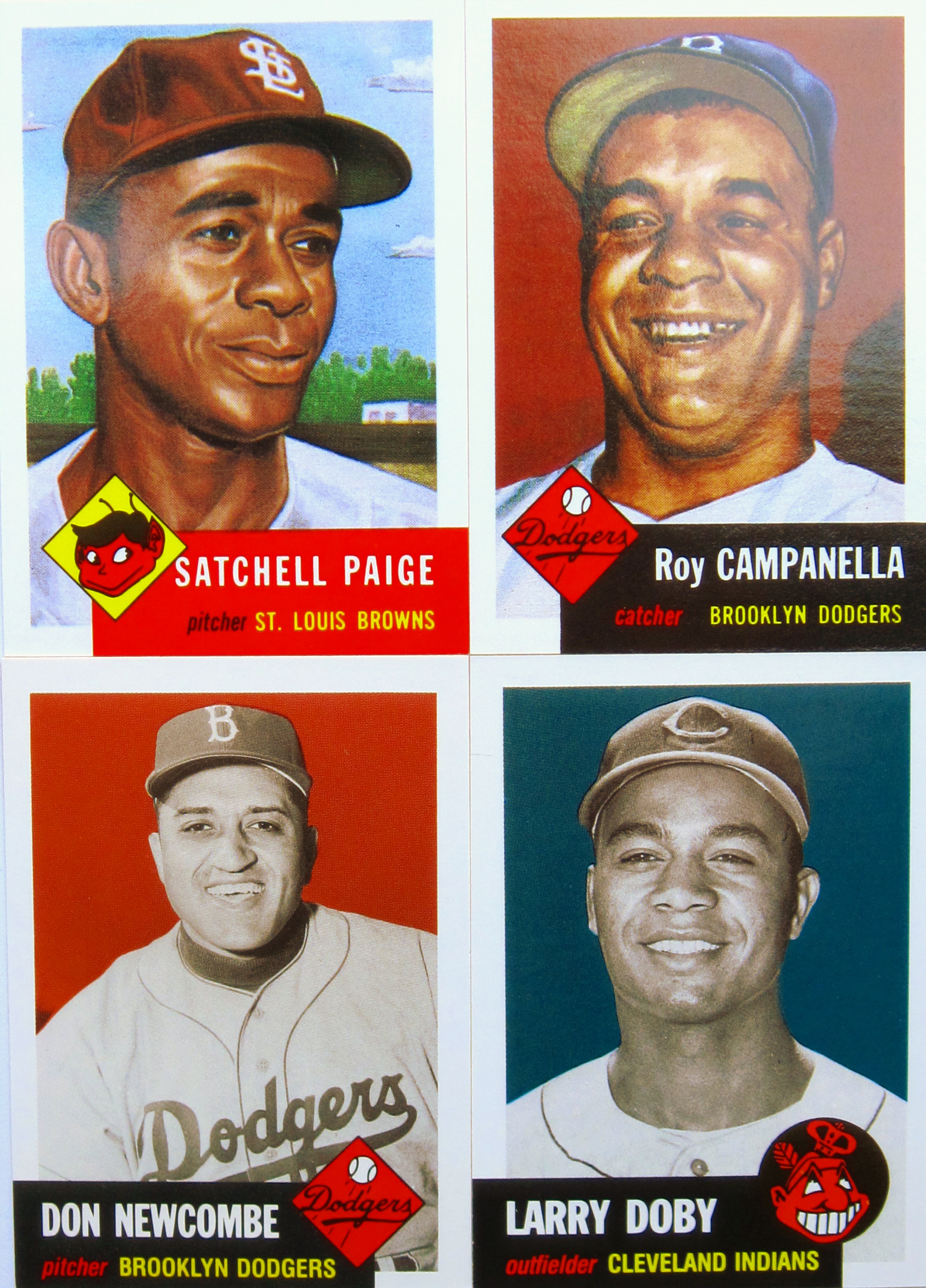
If you listen closely to the words of either version of the song, you’ll notice that Buddy Johnson very cleverly incorporates the names of four other Negro League Baseball stars who followed in Jackie Robinson’s footsteps as Major League Baseball continued to integrate its rosters.

4Cardsbest

It wasn’t until I’d located (on the 1989 Rhino Records CD Baseball’s Greatest Hits) and listened to the Count Basie recording that I realized that Kathy Kallick had made a change in Buddy Johnson’s original lyrics. In the first and second verses, Ms. Kallick sang – as I also always did – “Yeah, man! Yes, yes, Jackie hit that ball!”

P.S.: The five baseball cards shown in this post were issued in 1991 by the Topps Trading Card Company as part of a reissue set called: Topps Baseball Archives – The Ultimate 1953 Series. The Don Newcombe and Larry Doby cards were part of a subset of that series: “The Cards That Never Were.”

Posted in Posts with Video, Random Topics | Tagged , , , , , , | Leave a comment