Songbooks & Sheet Music

Maybe I’d borrowed a songbook too, but I do remember this much about the day in May, 1970, that I sat down and started teaching myself how to play the guitar.

Making music was nothing new. I’d been playing the drums for about five years, singing for several years longer than that and fooling around with a small, electric organ since the previous Christmas.

The acoustic guitar on my lap was on loan to me from my friend and band mate, Jim.

Somehow, the guitar was in-tune and my left hand managed to find the right combination of strings and the frets to finger them at so that my tentatively down-strumming right hand could produce a minor chord (E) and a major chord (D).

My ears recognized those two chords as being just like the two chords in the chorus of a song called “The End” from an album by The Doors that I’d listened to often.

By the end of the afternoon, my soul realized that strumming those two chords and singing that lyric – “This is the end, beautiful friend” – over and over and over had been the perfect salve for my 16-year-old, recently broken heart.

A month or two later, when I bought my own guitar, I bought a songbook to go with it.

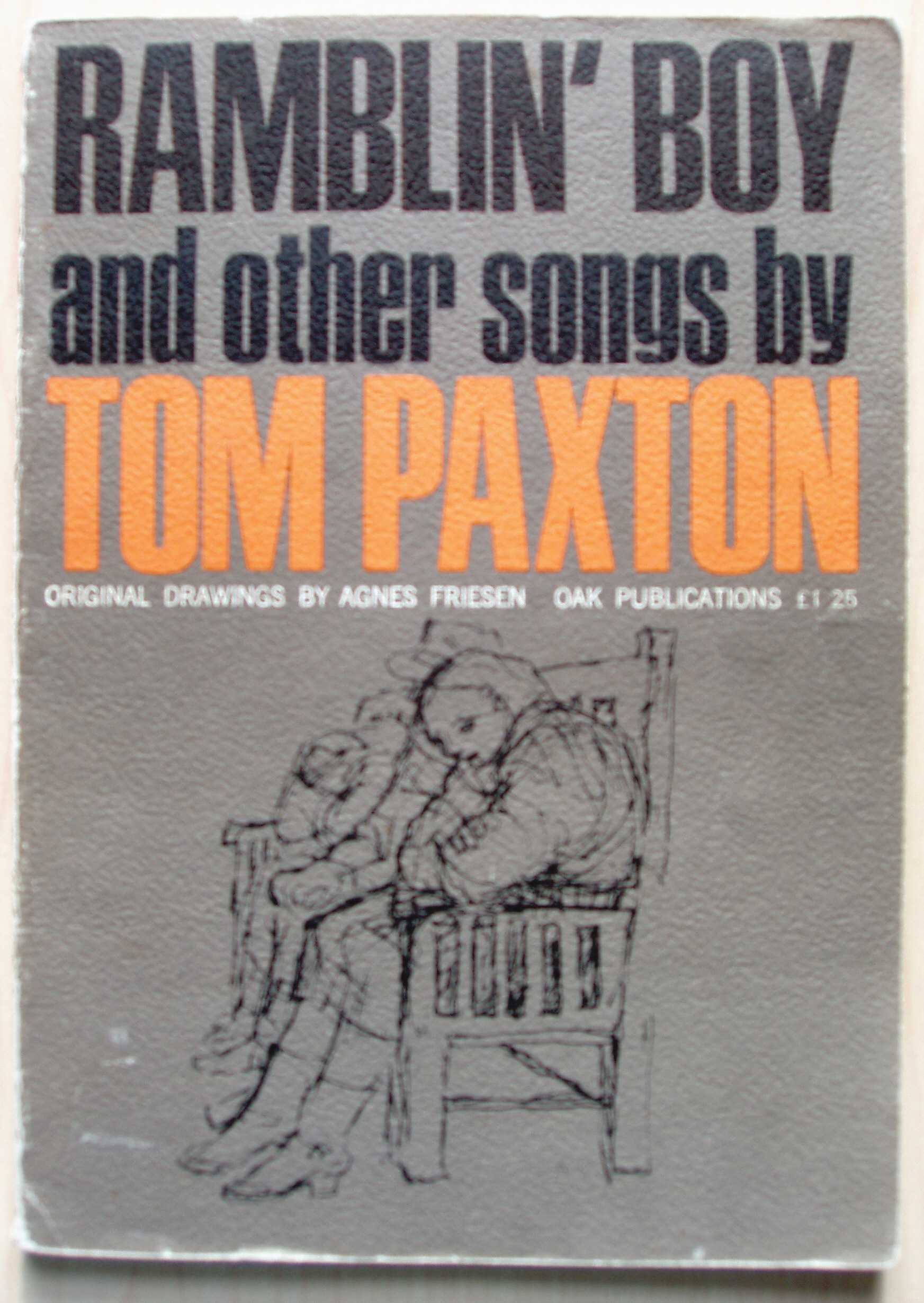
The publication I selected from the racks at Exeter Music was titled: Ramblin’ Boy and other songs by Tom Paxton.

OLYMPUS DIGITAL CAMERA

The folio contained 41 songs by the prolific and somewhat well known Greenwich Village songwriter. The ones I liked the most – “Deep Fork River Blues,” “I Can’t Help But Wonder (Where I’m Bound),” “The Marvelous Toy” and “The Last Thing On My Mind” – provided many hours of thoroughly enjoyable practice as I slowly got better at coaxing music from my brand-new, chocolate-brown, steel-string Harmony acoustic guitar.

Other songbooks soon followed.

Bob Dylan’s Greatest Hits – The matching 1967 LP contained 10 songs; the songbook had 12. Only seven songs were in each. But the songbook’s key-of-G transcription of “Don’t Think Twice, It’s All Right” (a song which later appeared on Greatest Hits, Vol.2) is the one I play to this day.

Beatles Complete – It wasn’t, but it contained enough transcriptions of their songs in keys different from the recordings (and thus using chords that a budding guitarist like me could actually play) for this book to be a gift from heaven. (My favorite: the oh-so-wonderfully-playable, also-in-the-key-of-G entry for “Eight Days A Week.”)

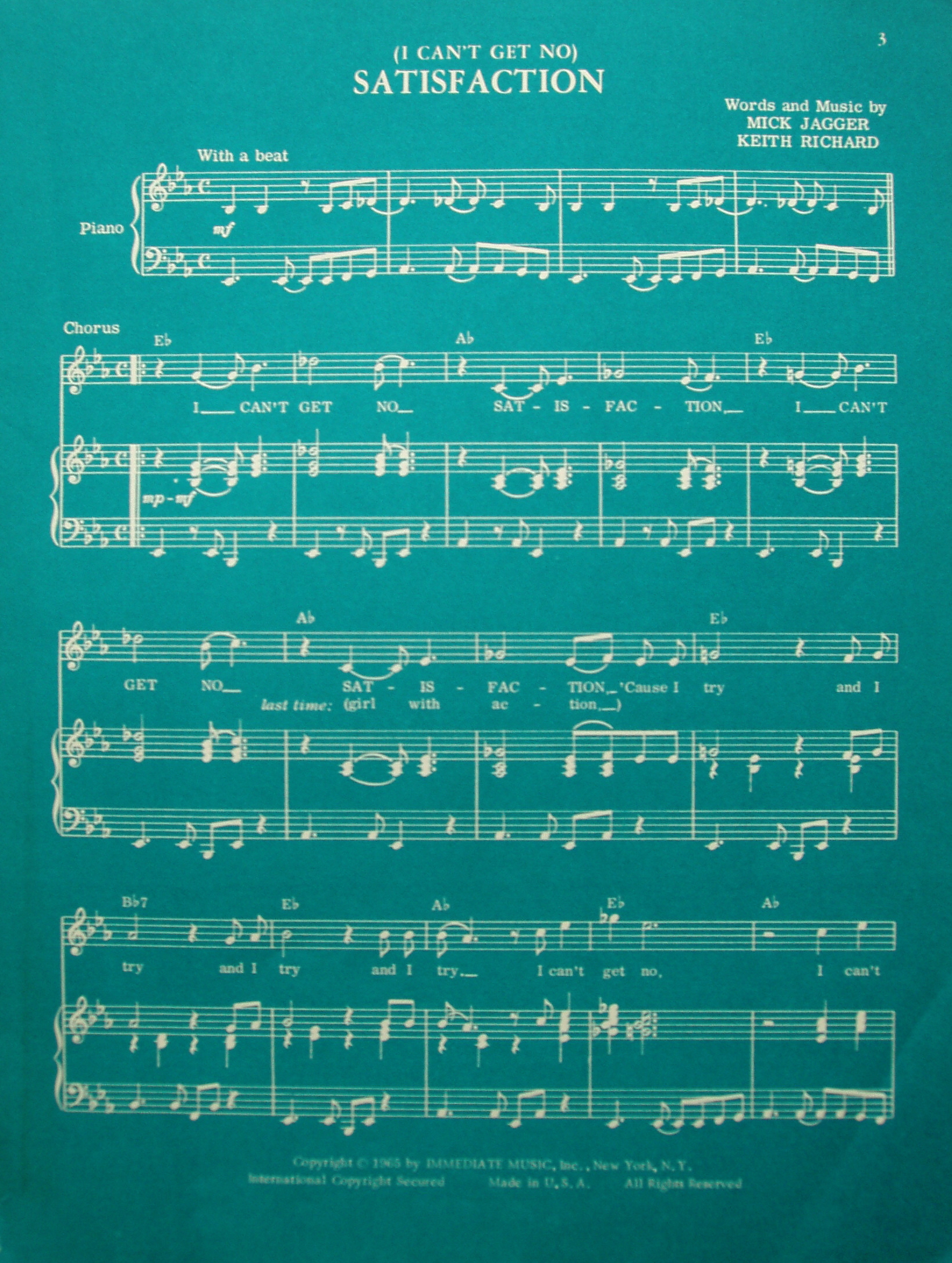
The Rolling Stones Anthology – I learned “Ruby Tuesday” and “Lady Jane” from this one, as well as the not-so-well known album tracks “Back Street Girl” and “Sittin’ On A Fence.” This is still the only music publication I’ve ever seen where the music is printed in white ink on deep, blue-green colored paper.
OLYMPUS DIGITAL CAMERA

The first Jazz song I bought the sheet music for (which I now know was not really a Jazz song) was “Swinging On A Star.” The song was written by Jimmy Van Heusen & Johnny Burke and sky-rocketed to Pop music fame (and an Academy Award) in 1944 thanks to it being recorded by Bing Crosby and included in the film “Going My Way.”

But the sheet music I purchased at a music store in Boston, a few doors down from Symphony Hall, contained chord fingerings and changes I’d never had to negotiate in a Tom Paxton, Bob Dylan or Rolling Stones song.
OLYMPUS DIGITAL CAMERA

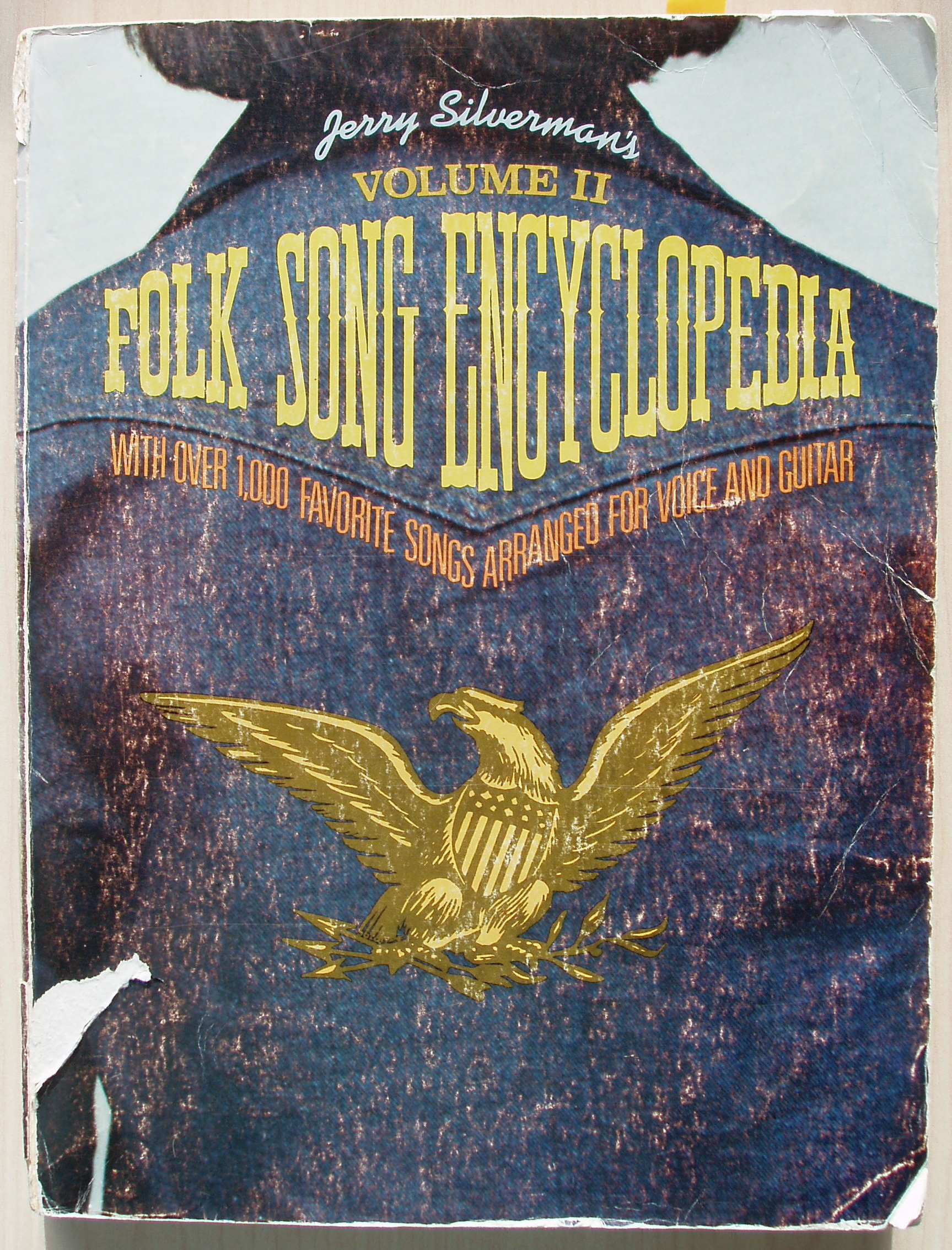
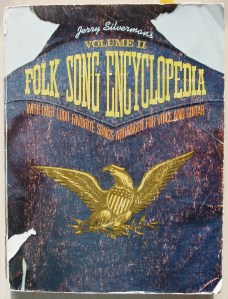
Sometime in the early 1980’s, while exploring Portland, Maine one day with my friend and fellow guitarist Paul, I came upon a copy of Jerry Silverman’s Folk Song Encyclopedia, Volume II in a head shoppe. (Remember those?)
OLYMPUS DIGITAL CAMERA

I learned dozens of songs from this priceless and inspirational 431-page collection including: “Deep River Blues,” “Stealin’, Stealin’,” “Jelly Roll Blues,” “Crawdad Song,” “Roll In My Sweet Baby’s Arms” and “Charlie Mopps.” I eventually found Volume I to complete the set.

Over the years, my library of songbooks and sheet music has grown impressively. The many volumes and binders fill a shelf over my desk, in the den of my house, as well as a long shelf on a bookcase down in the basement and an entire three-shelf-tall, homemade bookcase in my teaching studio.

My most recent purchase: a guitar-TAB songbook containing note-for-note transcriptions of the songs from Mumford & Sons very popular debut album Sigh No More. I bought it this past Labor Day weekend at a music store in Washington, D.C., not far from my son’s apartment.

Exploring, studying and learning from the printed music that fills those countless pages has been a huge and essential part of my musical education and my development as a guitarist and as a songwriter. Those songbooks and pieces of sheet music have also been a major source of the music that still brings great joy every single day to my life.
Posted in Random Topics | Tagged , , , , | 1 Comment

A Belated Birthday Celebration (Elizabeth Cotten – Take 2)

In the process of writing this post, I was feeling bad that I had not gotten my act together in time to have it be a “This Historic Day In Music” post. But then I was reminded that when my children were little (pre-school and kindergarten age), there were years when their birthdays would be celebrated three times and usually not on The Day itself! They’d have a party at school during the week, a “friends party” at home – usually on the weekend before or after The Day – and then a “family party” at home actually (and always) on The Day.

Well, I don’t feel bad anymore.

Here it is: a belated birthday celebration for one of my favorite guitarists: Elizabeth Cotten.

Ta da!

On January 5, 1895, in the town of Carrboro, North Carolina (right next to Chapel Hill), George and Louise Nevills welcomed their fifth child, Elizabeth, into the world.

When Elizabeth (or “Babe” or “Sis” as her family called her) was seven years old, she started playing around with her brother’s five-string banjo. When she was eleven, her brother moved out and took his banjo with him. Missing that banjo but now really wanting a guitar, she went to work doing household chores for a woman in Chapel Hill. Eventually, on a salary of $.75 to $1.00 a month, she saved up the $3.75 needed to buy herself her own guitar.

Right from the start, Elizabeth taught herself to play. She developed a unique style in which she held her guitar left-handed and upside down and she picked out her songs and tunes using just the thumb and first finger of her left hand. Before long, Elizabeth started writing her own songs, one of which she called “Freight Train.”

At the age of 15, Elizabeth married Frank Cotten. At the age of 16, she gave birth to their daughter and only child, Lillie. With her new life, responsibilities and pressure from her church to stop playing those “worldly songs,” guitar playing soon became a thing of the past.

Decades later, thanks to a miraculous string of events – see my post of January 5, 2011 – Elizabeth Cotten regained her guitar playing skills. An album of her songs and tunes – Folksongs And Instrumentals With Guitar – was released on Folkways Records in 1958. Elizabeth became a successful and highly-regarded recording and performing artist, working well into her 80’s. At the time, her unique style of guitar playing, which became known as “Cotten picking,” inspired countless guitarists around the world. It still does.

There are several videos of Elizabeth Cotten to be found on YouTube, though my favorites -which I own on VHS tapes and DVDs – are not.

Here is the best video I could find of Elizabeth playing “Freight Train.”

I just love her playing! If you’ve got a few more minutes, here’s another one of her playing two instrumentals. This is from 1969.

There you go! I hope you enjoyed this belated celebration of Elizabeth Cotten’s birthday.

Ta da, indeed!

Posted in Posts with Video | Tagged , , , | Leave a comment

One Of The Best

Once, we made mix-tapes on cassettes. (Compact Audio Cassettes, to be precise.)

Then, we burned mix-CDs.

Now, we assemble playlists.

Last year at this time, I put together a playlist that I called: The Best of 2011: Discoveries & Resurrections. The collection contained 17 tracks by 17 different artists/groups. Bob Dylan, The Decemberists, Gillian Welch, Joe Liggins & The Honeydrippers, Pat Metheny, Sierra Noble and Erma Franklin were among those who made the cut.

Being an “old school” kind of guy, I burned the playlist to a CD, printed out a label for the disc, typed up a track list and tucked it all into a new, clear jewel- box case. I made two additional copies of the finished package and gave one to each of my two children for Christmas.

This year, having listened often to the Best of 2011 CD and receiving positive reviews from my daughter and son, I assembled a new collection for 2012.

As in 2011, many of the year’s “resurrections” were a direct result of my writings in this blog. Many of my “discoveries” came about (again) thanks to my guitar students. One student in particular, A, introduced me to the music of Ben Howard and his wondrous song “Old Pine.”

In the Fall, A had first mentioned Ben Howard and I helped him try to learn to play a song of Ben’s called “The Fear.” In November, at the end of one of his guitar lessons, A asked if I’d like to hear another Ben Howard song. Plugging the patch cord from my stereo into A‘s smart phone, we sat and listened, smiling, as “Old Pine” danced around my teaching studio.

I was dazzled.

“As the old pine fell, we sang… just to bless the morning.”

(If I may suggest: don’t watch the video. Close your eyes and just listen.) 

Ben Howard is a 25-year-old singer/songwriter/guitarist from West London, England. He first released “Old Pine” on a self-produced EP in 2010 and then included it on his 2011 Island Records CD Every Kingdom.

“Old Pine” is high on my list of the Best of 2012.

Thanks, A.

Posted in Posts with Video | Tagged , , | 2 Comments

Season’s Greetings Again

Rock, Jazz, R&B.

“What, no Folk?!? No collection of Christmas music is complete without a Christmas Folk song!”

“You’re right. How about “Cry Of A Tiny Babe” by Bruce Cockburn?”

“Excellent choice.”

I hope you agree.

This is from Bruce’s 1991 album Nothing But A Burning Light.

Posted in Posts with Video, Random Topics | Tagged , | Leave a comment

One More Season’s Greetings

This has been fun.

First Rock, then Jazz. How about some Christmas Rhythm & Blues?

Here’s a favorite of mine. “Hey Santa Claus” was recorded by The Moonglows in 1953 – a very good year – for Chance Records. I discovered it on an album called Rockin’ Little Christmas put together by MCA Records in 1986.

Enjoy!

Posted in Posts with Video | Tagged , | Leave a comment

More Season’s Greetings

So, it’s the end of a busy day. You’ve decked the halls, jingled the bells and harked the herald angels. You’re about to settle down on the couch, enjoy the warm glow of the lights on the tree and a glass of your favorite beverage and you ask yourself: “What would make a more perfect soundtrack than a long cut from a 1981 Christmas Jazz LP featuring one of the world’s best tenor saxophonists and his legendary quartet gently swinging their way through a fabulous holiday classic?”

Well, nothing.

So, here it is: The Dexter Gordon Quartet – Dexter Gordon on tenor sax, Kirk Lightsey on acoustic piano, David Eubanks on acoustic bass and Eddie Gladden on drums – playing “Have Yourself A Merry Little Christmas.”

Sit back and enjoy.

That track was recorded in New York City on November 4, 1980 for Columbia Records. It was released in 1981 on an LP called God Rest Ye Merry Jazzmen.

“Have Yourself A Merry Little Christmas” was written by Hugh Martin and Ralph Blane in 1943. It was introduced by singer Judy Garland in the 1944 MGM musical Meet Me In St. Louis.

What’s your favorite Christmas Jazz recording?

Posted in Posts with Video | Tagged , , | Leave a comment

Season’s Greetings

Need a little somethin’ to get you rockin’ on this Friday before the last weekend before Christmas day?

I know just the thing.

Ladies and gentlemen, the one and only… 

Bruce Springsteen & The E Street Band!!!!!!!!!

(Turn it up!)

Merry Christmas from sixstr stories.

Posted in Posts with Video | Leave a comment

This Historic Day In Music: Jimi Hendrix

The book is called: History of the World in Nine Guitars.

It was written by Erik Orsenna, accompanied by Thierry Arnoult and published in 1996. The English edition was translated from the original French by Julia Shirek Smith and published in the United States in 1999. I bought my copy of the small hardcover at the gift store in the Museum of Fine Arts in Boston several years ago. It was one of those occasions where I felt like the book found me as much as I found the book.

In the chapter titled “Woodstock, 1969,” Mr. Orsenna writes in the voice of the young Jimi Hendrix.

My father’s name is James. He is a gardener. He doesn’t talk much. But when you ask him a question, he knows how to answer.

I have restless fingers. They won’t stay still. They tap on every surface they see. They beat time on the walls and the tables, on my desk at school. They live their own life, and I can’t do anything about it. It’s no good telling them to stop. They don’t hear me.

My father doesn’t just know how to answer. He knows how to look: ‘I’ve seen your fingers, son. Yours are waiting for something, you can depend on it. All the fidgeting, that’s their way of calling. Now I’ve brought you something. Do you think maybe it’s what they’ve been waiting for?’

I am eleven. My father has just taken the guitar from behind his back. A big brown box with strings. My fingers are happy. They have found their garden, their house, their promenade, a door to the world, a way to speak.”

Listen to the fingers of Jimi Hendrix speak.

“Little Wing” was written by Jimi Hendrix, recorded by The Jimi Hendrix Experience and released on their 1967 album Axis:Bold As Love.

On that recording, Jimi Hendrix sings and plays electric guitar, Noel Redding plays bass guitar and Mitch Mitchell plays drums.

Much has been said about Jimi Hendrix, but Richie Unterberger, writing in the All Music Guide to Rock, offers one of the best single sentences about Jimi: “In his brief four-year reign as a superstar, Jimi Hendrix expanded the vocabulary of electric rock guitar more than anyone before or since.”

Jimi Hendrix was born this day, November 27, in the year of 1942, in Seattle, Washington. His birth name was Johnny Allen Hendrix, but changed to James Marshall Hendrix by his parents in 1946.

Jimi passed away on September 18, 1970 in London, England.

I wrote my first post in honor of Jimi Hendrix’s birthday on November 27, 2010. You can find that post in the Archives by clicking on November 2010 and scrolling down through that month’s earlier entries.

Posted in Posts with Video, This Historic Day In Music | Tagged , , , , , , | Leave a comment

Joni & Neil

In my formative years as a singer, guitarist and songwriter, I learned much from the music of Joni Mitchell and Neil Young.

Joni Mitchell’s 1970 album Ladies Of The Canyon and Neil Young’s After The Gold Rush, also from 1970, provided countless hours of inspirational listening and several impeccable songs that soon became favorites of my performing repertoire.

In particular, Joni’s “For Free” and Neil’s “Birds” are songs that I still love to play and sing. But upon listening again to the original album tracks, I’ve been reminded that these were among the songs that Joni and Neil, both exceptional guitarists, played on the piano. I came to play them on the guitar thanks to a friend and a bootleg record.

Bob was a guitarist, singer and equally music-obsessed friend from my high school and college years. He turned me on back then to a guitar-based version of “For Free” that David Crosby (Bob’s most favorite musician in those days) had recorded on a reunion album with The Byrds. After I had learned to play it, Bob and I worked up a duo version of “For Free” with some of the best two-part harmony vocals I’ve ever been part of. (I so wish that I had a recording of us doing that song.) Every time I played that song solo, I wished the audience could hear his voice singing along, too.

Bootleg albums – illegal, mysterious and defiantly produced 12-inch vinyl records with minimal (if any) graphics, containing surreptitiously-procured recordings of live concert performances and/or studio work by well-known artists – were a somewhat rare and controversial delight back in those days. For a New Hampshire-based music fan, a trip to Boston was necessary to find a record store that carried a selection of these LPs. On one such excursion, I found a live Crosby, Stills, Nash and Young album that contained (as I found out when I got home and listened to it) one side of horribly-recorded full-band, “electric” songs and one side of gorgeously-recorded “acoustic” songs. One of the latter tracks was “Birds” with Neil Young accompanying himself on an acoustic guitar. That became the model for my rendition of the song.

Here, for your listening pleasure, are videos of these two songs. The Joni Mitchell video is a live performance recorded by the BBC on October 9, 1970. The Neil Young video contains the studio recording of “Birds” from the After The Gold Rush LP.

On November 7, Joni Mitchell (born Roberta Joan Anderson in Fort McLeod, Alberta, Canada) celebrated her 69th birthday.

On November 12, Neil Young (born in Toronto, Canada) will celebrate his 67th birthday.

I hope you enjoyed the music. I think I’ll go get my guitar and sing those songs.

Posted in Posts with Video | Tagged , , , , | 1 Comment

Politicians & Singers, Politics & Song

Here’s what I know, also knowing that a complete accounting of the subject would be much, much, much longer.

In 2012, Barack Obama has James Taylor, will.i.am and Bruce Springsteen.

Mitt Romney has Kid Rock.

In 2008, the folks running the campaign of Republican presidential candidate John McCain used songs by Heart (“Barracuda”) and Jackson Browne (“Running On Empty”) until the artists told them unequivocally to stop.

In his campaign for 2008 New Hampshire Presidential Primary, Democratic candidate John Edwards had Bonnie Raitt and Jackson Browne. I attended a rally for Edwards on December 19, 2007 in Portsmouth, N.H. that featured a live performance by this duo. Bonnie Raitt kicked off their five song set with her hit version of the John Hiatt song “Thing Called Love.”

Of course, there’s a video!

In 2004, Democratic presidential candidate John Kerry had Carole King.

On Tuesday, January 20, 2004, my wife and I saw Carole King perform at the Concord City Auditorium in Concord, N.H. in a “special FREE concert to welcome John Kerry back to Manchester for the 7-day countdown” to the New Hampshire Presidential Primary. Sen. Kerry opened the show, welcomed everyone, gave a brief campaign speech and, before introducing Ms. King, explained that he had to head back to his hotel room to watch President George W. Bush give his State of the Union address.

Carole King then came out on stage, sat down at a grand piano and treated the audience to an exquisite 45-minute, 9-song concert. Among the songs she played and sang were “Beautiful,” “I Feel The Earth Move,” “Love Makes The World” and, of course, “You’ve Got A Friend.”

In 2004, Democratic presidential candidate Al Gore had the Paul Simon song “You Can Call Me Al.”

In 1992, Democratic presidential candidate Bill Clinton had the Christine McVie/Fleetwood Mac song “Don’t Stop.” (“thinkin’ about tomorrow…”)

In his 1984 re-election campaign, President Ronald Reagan tried to co-opt Bruce Springsteen’s recently released and very successful song “Born In The U.S.A.” until Bruce said “No.”

In 1968, Democratic presidential candidate Robert F. Kennedy had John Stewart.

Singer/Guitarist/Songwriter John Stewart had been a member of the Kingston Trio from 1961-1967. He had also written the song “Daydream Believer” that The Monkees turned into a #1 hit in 1967.

In 1968, John Stewart “traveled with the (Kennedy) campaign and sang on the backs of trains, flat-bed trucks, town squares and high school auditoriums.” He wrote songs along the way and, in 1985, Stewart recorded and re-recorded many of them for an album he titled The Last Campaign. (The quote above is from Stewart’s liner notes to that album.)

In 1944, politician and singer Jimmie Davis had “You Are My Sunshine” – a song he’d recorded in 1940 and claimed authorship of – during his successful campaign for Governor of Louisiana. At campaign stops, Davis would frequently sing the song and even, on occasion, while riding his horse, whose name was “Sunshine.”

Finally, and on a lighter note, during the 2004 presidential campaign there was JibJab and JibJab had “This Land Is Your Land.”

JibJab was two brothers: Gregg and Evan Spiridellis. They wrote, directed and produced an animated musical video called “This Land!” The soundtrack was a parody of Woody Guthrie’s classic Folk song  “This Land Is Your Land.” It was a huge hit in the relatively new universe known as YouTube.

It’s still rather outrageous and hilarious.

That’s all from me. But please, dear reader, feel free to add to my list with anything you recall from your political past. Just leave a comment!

Posted in Posts with Video, Random Topics | Tagged , , , , , , , , , , , | Leave a comment