This Historic Day In Music: Judy Collins

Among the many music books that I made frequent use of in my musically formative years and that still fill my shelves, one of the most memorable is a collection of songs recorded by Judy Collins.

judyc

The Judy Collins Songbook was first published in October, 1969. It contains piano/vocal/guitar arrangements – arranged and edited by Herbert Haufrecht – to 55 songs from Ms. Collins’ first eight albums. Starting with “A Maid Of Constant Sorrow,” the traditional Folk classic and title song from her first album released in 1961, and finishing with “My Father,” an original composition from her 1968 album Who Knows Where The Time Goes, the thick volume also contains “comments, instructions and reminiscences by Judy Collins.”

The instructions accompany only a handful of songs but include such valuable (to a young guitarist) insights as: “I play this with a Travis style pick, in a regular tuning” (“A Maid Of Constant Sorrow”) and “If you want to do this like it is on my record, tune the sixth string to D, and capo up two frets. That puts your E chord in the D position” (“John Riley”).

The comments that accompany the songs are more frequent. With the Malvina Reynolds & Barbara Dane song, “It Isn’t Nice,” Ms. Collins writes: “I hope that when I am as old as Malvina is I am as young as she has been all her life.” With “My Ramblin’ Boy” by Tom Paxton, she relates: “One night in a Detroit theatre a stage hand told me this was the best song he had ever heard and made me write the words out on an unrolled paper cup.”

Of all her comments and reminiscences, the one that to me is the most memorable, is the one included with the music for the Bob Dylan song, “Mr. Tambourine Man.”

On page 104 of her songbook, Judy Collins wrote: “I slept in the attic of Bob’s house in Woodstock one night in 1965. From the little stone-walled writing room at three in the morning I heard this whole song for the first time, with the moon full and the house still except for his singing and guitar.”

Judy Collins’ recording of “Mr. Tambourine Man” can be found on her 5th Album, released in 1965.

Judy Collins was born on this day, May 1, in 1939 in Seattle, Washington.

Happy Birthday, Judy Collins!

P.S.: If you’d like to read another “This Historic Day In Music” post celebrating Judy Collins’ birthday, visit the archives for May, 2012. You’ll be glad you did!
Posted in Posts with Video, This Historic Day In Music | Tagged , , , , | Leave a comment

Richie Havens

Richie Havens, one of the most instantly identifiable singers, unique guitarists and creative Folk musicians to come from the 1960’s Greenwich Village music scene, passed away yesterday at the age of 72 at his home in Jersey City, New Jersey.

Most remembered for his performance as the opening act of the legendary 1969 Woodstock (N.Y.) Music & Art Fair, I’d like to, on this day, honor and pay tribute to this remarkable man with another of his many memorable performances.

On October 16, 1992, Richie Havens was part of the star-studded cast of musicians who gathered at New York’s Madison Square Garden to partake in Bob Dylan’s 30th Anniversary Concert Celebration. Richie’s contribution was a rendition of his already-classic interpretation of Dylan’s song, “Just Like A Woman.”

Take a few minutes, watch and listen.

Richie Havens, January 21, 1941 – April 22, 2013.

Posted in Posts with Video | Tagged , , | 2 Comments

Wrestling With The Angel, Chapter 5

If you’re a new visitor to this blog, the purpose of my Wrestling With The Angel series (or category) is to highlight and share individual songs that are on a list of mine entitled: Devastatingly Great Songs. The title phrase, “Wrestling With The Angel,” is my paraphrase of a line from a poem by Herman Melville called “Art.” You can read the complete poem in my archived post of November 4, 2011: “The Source.”

In 1965, in the Southeast corner of New Hampshire, a department store was about the only place a recently-music-obsessed boy could buy the latest hit records. So, one afternoon when my parents informed me that we were going over to Dover after dinner to do some shopping at Sawyer Mills (a sprawling,  smorgasbord of a store in an actual converted mill building), I knew that my chance had come again.

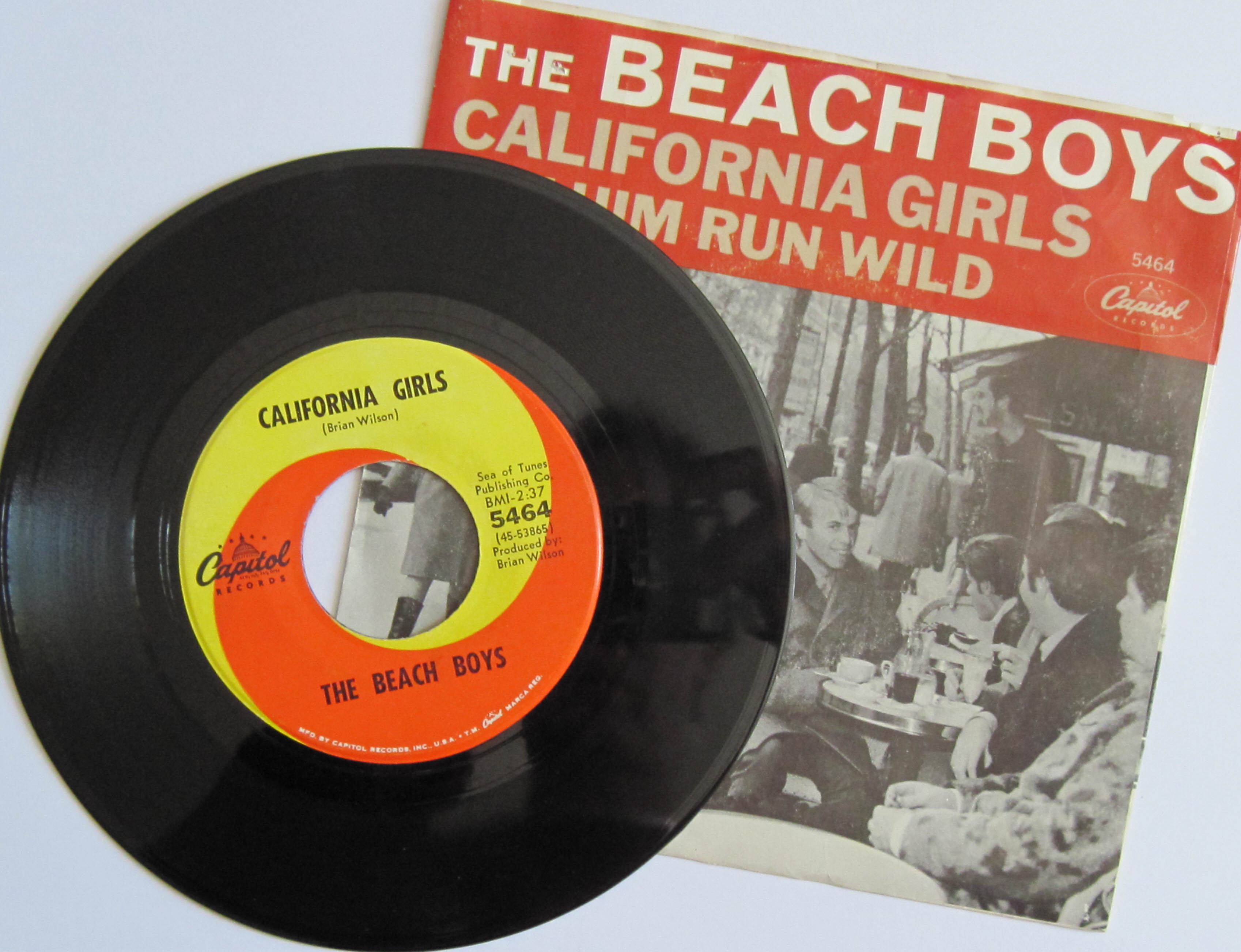
Upon arrival, I quickly located the record department on the second floor and carefully began searching the somewhat-meager singles selection. None the less, I soon found exactly what I was looking for: “Eve of Destruction” (b/w “What Exactly’s The Matter With Me”) by Barry McGuire and “California Girls” (b/w “Let Him Run Wild”) by The Beach Boys.

California Girls

 Driving home to Exeter that night along Rte.108, my mother asked me what records I had bought. Right after I’d finished telling her, the radio station we’d been listening to played “Eve of Destruction” and then… “California Girls.” Even my father was surprized.

“California Girls” was not the first or the last Beach Boys record I would add to my collection.

Little Deuce Coupe (1963), the fourth album by Brian Wilson, Dennis Wilson, Carl Wilson, Mike Love and Al Jardine had been getting and would continue to get a solid amount of playing time on my Magnavox record player.

                                       Little Deuce

It wasn’t until many years later that I came to realize just how much I must have listened to at least side 1 of that album. I’d picked up a CD copy of Little Deuce Coupe and listening to the first six songs – “Little Deuce Coupe,” “Ballad Of Ole’ Betsy,” “Be True To Your School,” “Car Crazy Cutie,” “Cherry, Cherry Coupe” and “409” – was like being at a reunion with a group of old friends. From “Shut Down,” the first song on side 2 of the LP, and on through the remaining five songs on the CD , I felt like I’d stepped into a room full of strangers.

In 1971, not long after my 18th birthday, I bought The Beach Boys’ newest album, Surf’s Up. I listened to this one all the way through both sides and it’s a very good thing I did. The last song on the second side, the title song, written by Brian Wilson and Van Dyke Parks, was and still is, to me, absolutely spectacular.

                                       Surfs up

With piano, bass guitar, slight percussion and a brief trumpet for accompaniment, the singer starts the first verse: “A diamond necklace played the pawn, hand in hand some drummed along to a handsome man and baton” and finishes: “Columnated ruins domino” in a pure, soaring falsetto.

This is not the land of “Little Deuce Coupe” and “California Girls” any more.

“Canvas the town and brush the backdrop. Are you sleeping?” (Sung twice. The chorus?)

The last verse, with only the piano: “Surf’s up, aboard a tidal wave. Come about hard and join the young and often spring you gave. I heard the word, wonderful thing, a children’s song.”

And finally, the coda: “The child is father of the man.”

Take four minutes and listen. (My apologies for the ugly video graphics.)

Just listen.

John Bush, writing in The All Music Guide To Rock calls that recording: “a masterpiece of baroque psychedelia.”

What do you call it?

Posted in Wrestling With The Angel | Tagged , , , | 2 Comments

3/200

Well.

As of today, April 18, 2013, sixstr stories is three years old.

The twos proved to be not so terrible after all: in the past year this blog was host to more than 3000 visitors/viewings, accepted over 40 comments and raucously woo-hooed! when each new folk signed on and joined the ranks of “followers.”

On behalf of everyone… um, “everyone?”… ok: me… here at sixstr stories, I thank you, one and all!

In preparation for the birthday celebrations, I recently did some “house cleaning” on the blog.

First of all, I went through the archives and made sure that each post was correctly categorized. I retitled one category: the posts once listed as “Uncategorized” are now being identified as “Random Topics.” (Does Rolling Stone magazine still have its “Random Notes” section?)

Then I set up a “widget” (that’s a WordPress term) so that you can now search the archives by category! Simply click on one of the seven category titles in the list at the top right hand corner of the home page and you will be sent to a page containing titles of, the opening sentence from and links to each post in that category. Way cool.

For instance, if you click on the category “EFS Music,” you will find all of the 25 posts that contain audio links to exclusive recordings of (who else?) me, singing and playing original songs and fingerpicking a few acoustic guitar instrumentals. Under the categories of “On This Day In Music History” and “This Historic Day In Music,” you’ll find a combined total of 93 posts, each one celebrating the anniversary of a significant musical event in the histories of Folk, Jazz, Blues, Country or Rock.

Also, in an attempt to spiffy things up a bit (and since I finally figured out how to actually do it), I have been including more photographic images in the posts. So far, I’ve done magazine & songbook covers and sheet music to go along with the embeded video links that I’ve been incorporating for a while. (Speaking of the video links, if you’re browsing through the archives and should find a post with a blank video screen or one that says “This video has been removed,” please leave a comment to let me know. I recently had to re-embed a video with Lead Belly singing “Goodnight, Irene”.)

So, what does the future hold for sixstr stories?

More of the same!

Specifically, I’m planning on expanding the “Wrestling With An Angel” series, finding more anniversaries and birthdays to celebrate and continuing to add recordings from the vaults of EFS Music.

And finally, as sixstr stories ventures forth into its fourth year, I have one last bit of information from the “site stats” page to share.

The next post will be my 201st.

Once more, many thanks. I hope you come back again soon and often in the months ahead. I’ll continue to do my best to make it worth the trip.

“Good music doesn’t get old.”

Posted in Random Topics | Tagged , , , | 2 Comments

Odds & Ends, Vol.2

Odds & Ends, Vol.1 appeared in this blog on September 30, 2010. I explained  the purpose of that post in its second paragraph: “Looking back over my more recent posts, I’ve realized that there are a few things I wished I’d mentioned in some of them.”

Well, that has happened again and thus given birth to – drum roll, please – Odds & Ends, Vol.2!

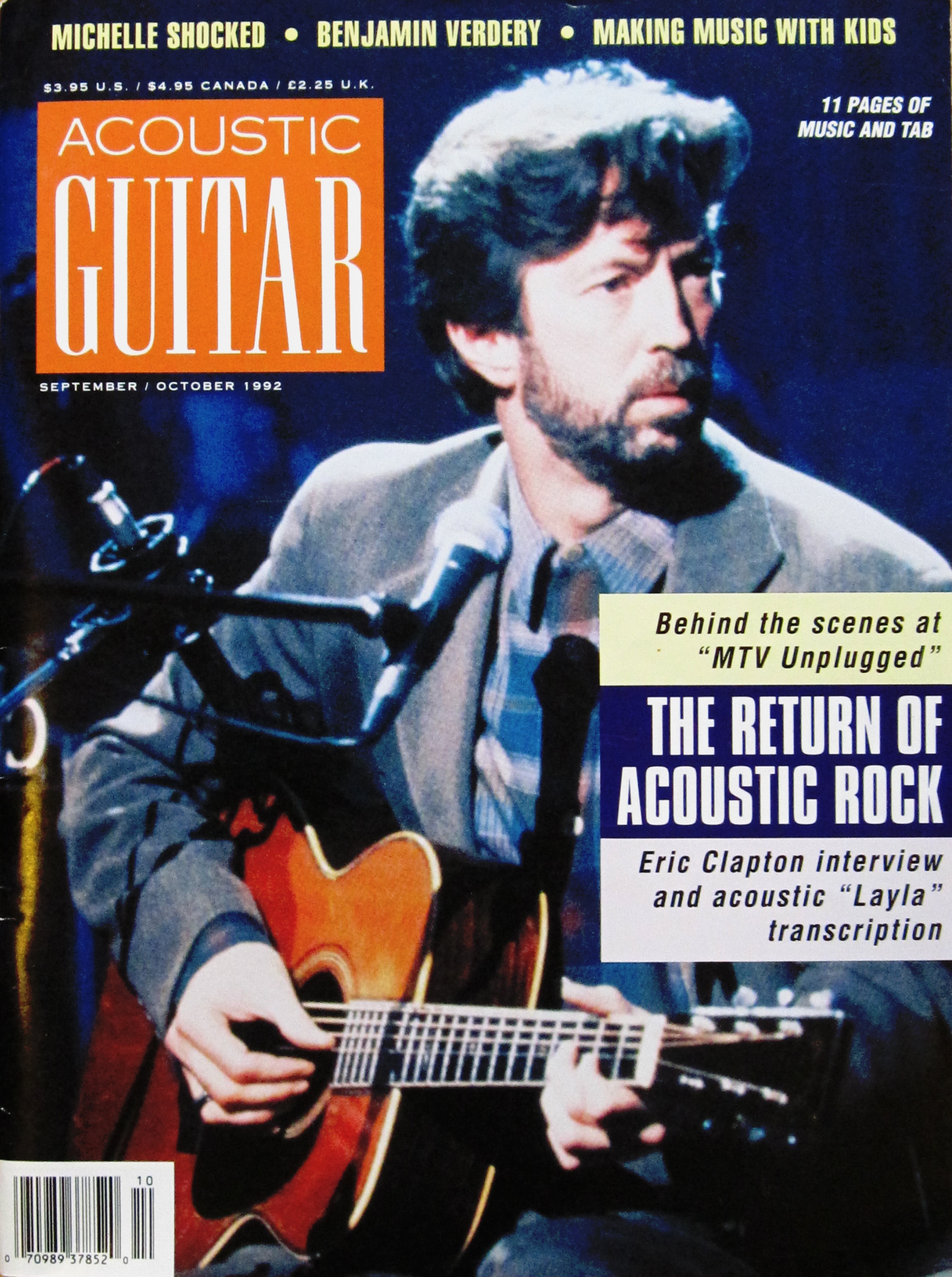
After writing my March 30 This Historic Day In Music post on Eric Clapton, I dug into my collection of back issues of Acoustic Guitar magazine and found the September/October 1992 edition with Mr. Clapton on the cover.

AGClapton

The cover story was an article entitled “Unplugging The Stars” by Dale Miller about the then-very-popular MTV series Unplugged. On page 47, I found a quote from Eric Clapton about his preparation for the concert that would become not only his episode of the show, but a multiple Grammy-winning CD as well.

He told Mr. Miller: “When I started playing, I played a lot of fingerstyle. I could never really find the right combination of flatpick, fingerpick or thumbpick, so really the easiest way, although it’s quite strenuous on the fingertips, is to play fingerstyle. There is beautiful sound to be gained from the finger actually touching the string, but I haven’t done it for a long time on the acoustic – it’s something I just started to work on again recently…. You need surgical spirits to harden the fingertips up and witch hazel to take the sting out.”

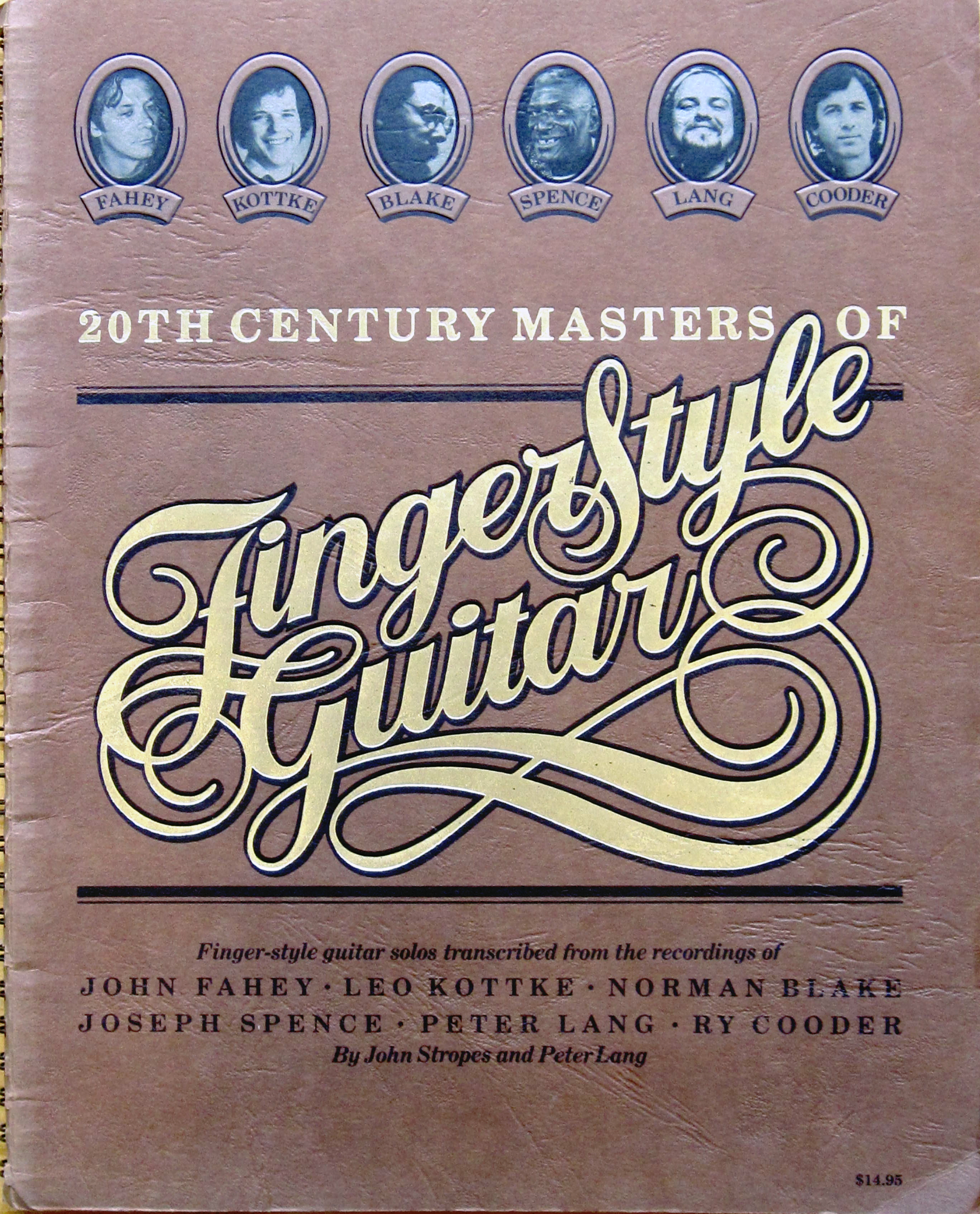
On Sunday, March 31, I didn’t have my copy of the 1982 songbook 20th Century Masters of Finger-Style Guitar handy when I wrote the post with a link to the holiday-appropriate (or so I thought) recording of “Easter And The Sargasso Sea” by Leo Kottke.

FingerstyleGtr

If I had, I would have included this quote from the study notes by John Stropes that accompanied the book’s transcription of Mr. Kottke’s haunting instrumental.

“The Sargasso Sea is an area of the North Atlantic noted for its abundance of floating seaweed and its still waters. Since Columbus sailed through the Sargasso Sea in 1492 there have been stories of doom-ridden waters with ships ensnared in masses of impenetrable, floating weeds. The Sargasso Sea was said to be a veritable graveyard of dead and dying ships carrying crazed sailors, gaunt from lack of food and mad from lack of water.”

Leo Kottke added: “I was pretty disturbed about that when I was a little boy. And it was fascinating – the idea of sailors staring at one another, surrounded by kelp, slowly going nuts or thinking the other guy was going nuts. It appealed to my sense of romance.”

Thanks, John and Leo.

Posted in Random Topics | Tagged , , , , , | Leave a comment

“Deep River Blues”

(To see more Guitar TAB transcriptions, click on Guitar Music in the Categories list.) 

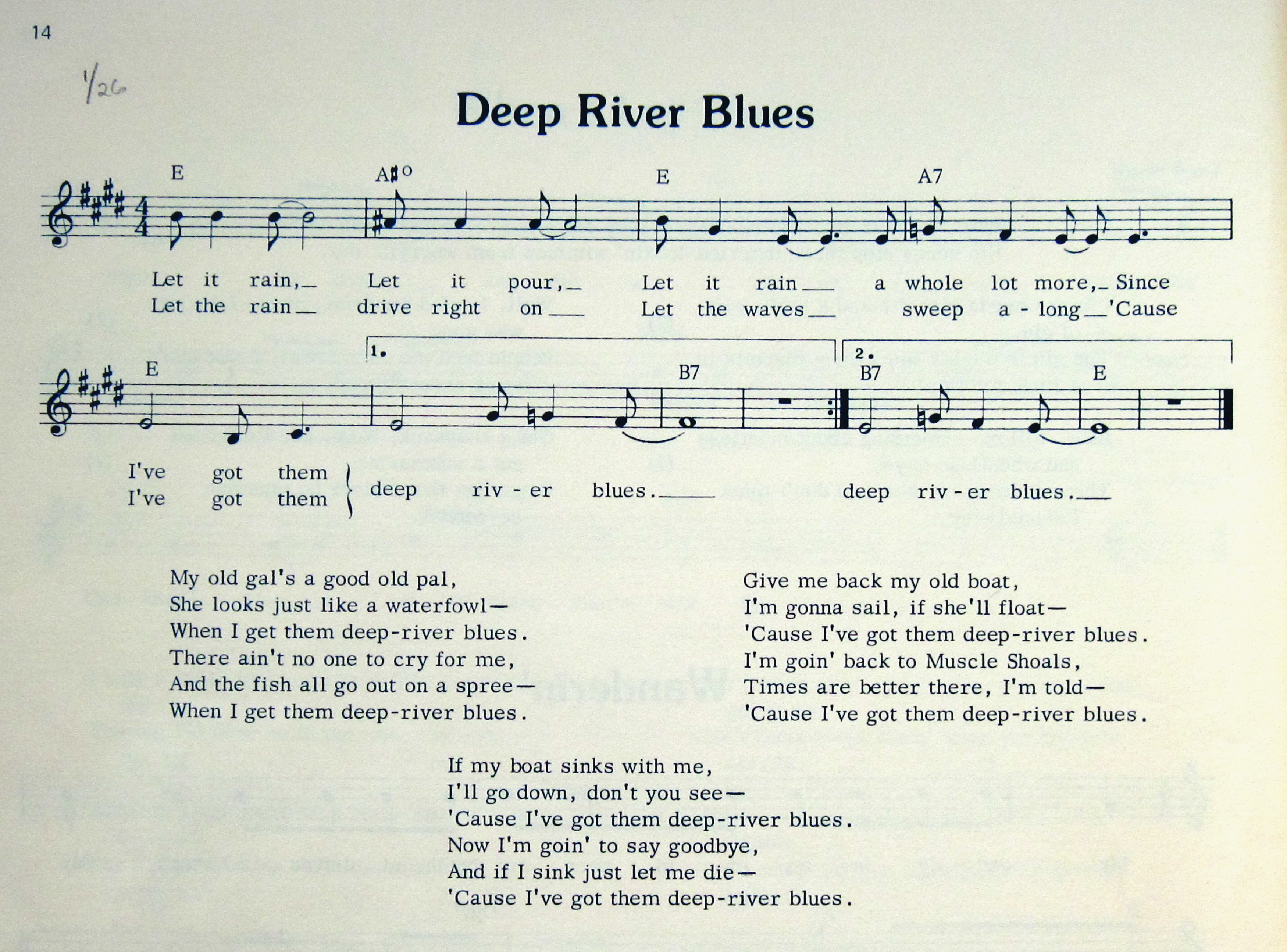
This past February, I wrote a post for this blog called “Songbooks & Sheet Music.” One of the songbooks I mentioned was Jerry Silverman’s Folk Song Encyclopedia, Volume 2,  a priceless publication that I purchased in Portland, Maine probably in the 1980’s. One of the many songs that I learned over the years from the pages of that collection was “Deep River Blues.”

Deep River Blues

I don’t remember how long it took, but with that lead sheet to follow and Doc Watson’s inspirational version of the song in my ears, I eventually came up with my own arrangement of this wonderful old song.

“Deep River Blues” – Guitar, Vocals & Arrangement by Eric Sinclair

(To hear my 2004 recording of the song, click on the blue link above. Wait for it!)

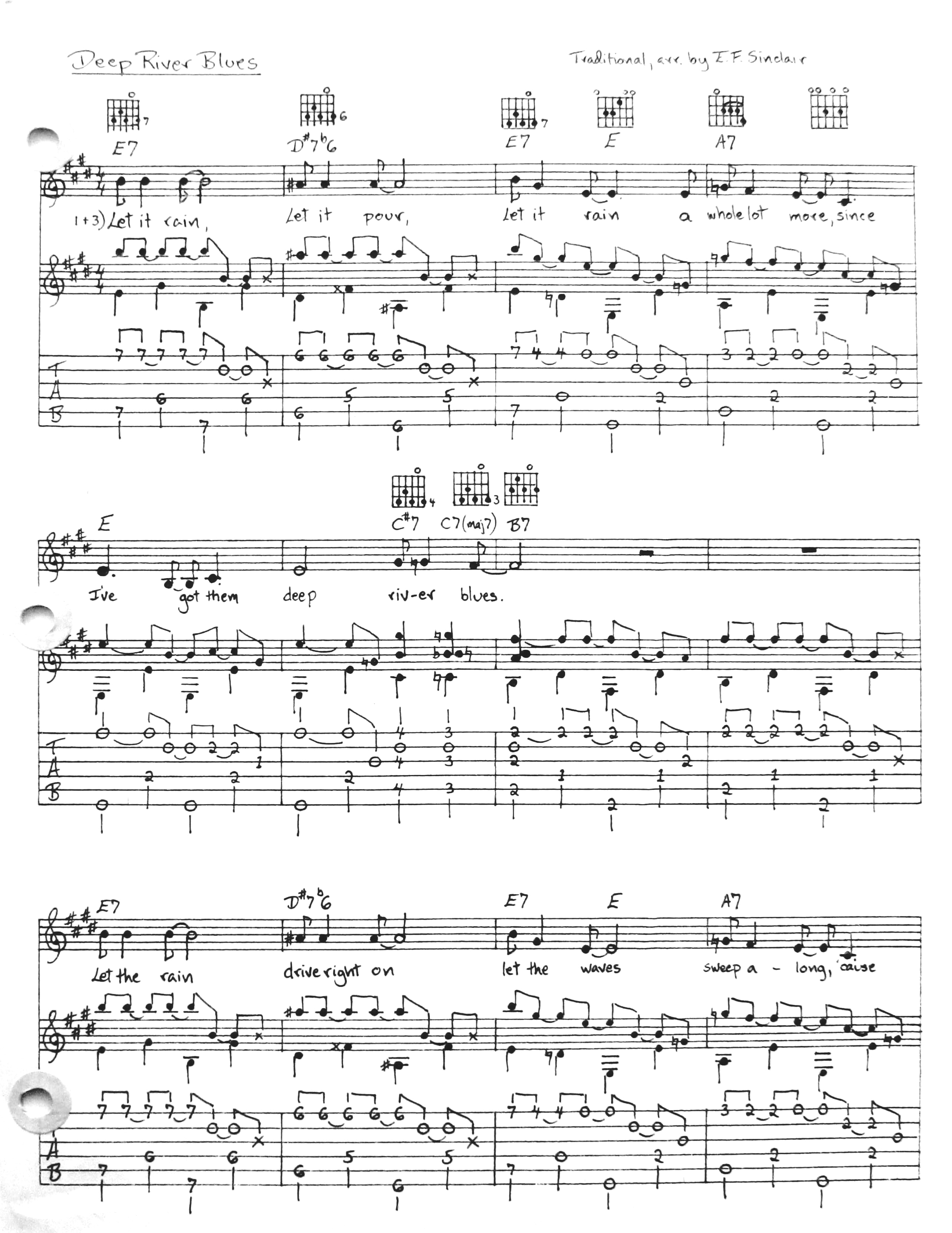
I even went so far as to write out a transcription of my arrangement, thinking that it would come in handy for use in my guitar teaching. (And it has!)

Deep River Blues TAB

(If you would like to see Page 2 of this transcription, see my post of May 19, 2018.)

As a matter of fact, a very talented young student of mine started learning my arrangement of “Deep River Blues” two weeks ago. In doing a bit of preparation for her lesson, I did some research on-line and in my home library and I learned a few things about “Deep River Blues” that I probably should have known all along.

“Deep River Blues” is based on a song recorded by The Delmore Brothers back in 1933 called “I’ve Got Them Big River Blues.” In the songbook The Songs of Doc Watson (1971, Oak Publications), Doc writes about “Deep River Blues”: “This blues was introduced to me in the late thirties by a Delmore Brothers recording. When I first began to hear the tune, I was fascinated by the sounds they got out of the little tenor guitar – the four string – and the regular flattop box. I never could figure a way to get even a resemblance of the sound that they got until I began to hear Merle Travis pick the guitar.”

Here is that Delmore Brothers recording.

If you haven’t had enough “Deep River Blues,” you can watch and listen to a 1991 video of Doc Watson himself playing and singing the song as part of my May 30, 2012 post “So Long, Doc.”

As always, my motto is: “Good music doesn’t get old.”

Posted in EFS Music, Guitar Music, Posts with Video | Tagged , , , , | 5 Comments

This Historic Day In Music: Muddy Waters

On April 4, 1915, McKinley Morganfield was born on the Kroger Plantation in Rolling Fork, Mississippi. He was the second son of Ollie Morganfield and Berta Jones. When, as a youngster, little McKinley showed a penchant for playing in mud puddles, his grandmother started calling him “Muddy.” His friends later added the “Waters.”

In August of 1941, Library of Congress song collector Alan Lomax and Fisk University scholar John Work visited the 26-year-old Muddy Waters’ cabin on the Stovall Plantation near Clarksdale, Mississippi. Lomax and Work had been told that Muddy played guitar and sang a lot like the late Blues musician Robert Johnson. They recorded Muddy playing and singing three songs. Years later, Muddy recounted what it was like hearing himself on those recordings that day: “I really HEARD myself for the first time. I’d never heard my voice. I used to sing; used to sing just how I felt, ’cause that’s the way we always sing in Mississippi. But when Mr. Lomax played me the record I thought, man, this boy can sing the Blues.”

In May of 1943, Muddy Waters took the train from Clarksdale to Chicago, Illinois, leaving the plantation far behind. He lived his new life working at various day jobs and playing his music all over Chicago’s South Side at night. Muddy  made his first commercial recordings for Columbia Records in 1946, but the record company decided not to release them.  

In 1947, Muddy Waters tried again, this time recording for Aristocrat Records. He had his first national R&B hit record in 1948: “I Can’t Be Satisfied” b/w “I Feel Like Going Home.”

Here it is.

That man can indeed sing and play the Blues.

After a long and illustrious performing and recording career, Muddy Waters passed away on April 30, 1983 in Westmont, Illinois.

Sources for this post were: Folk & Blues: The Encyclopedia (2001) by Irwin and Lyndon Stambler; Bill Dahl’s bio of Muddy Waters in The All Music Guide To The Blues (2003); and my blog post It Was The Last Week In August from August 29, 2010.

Posted in Posts with Video, This Historic Day In Music | Tagged , , | 1 Comment

Happy Easter (and the Sargasso Sea)

“Easter and the Sargasso Sea” is an acoustic guitar instrumental piece written and performed by Leo Kottke. He recorded and released it on the album Circle ‘Round The Sun in 1970. I bought my copy of the vinyl LP in the Fall of 1971 at a small record store somewhere in central Massachusetts.

For the guitar players out there, Leo is fingerpicking a 12-string guitar tuned to an open-G major tuning. But, like many 12-string players, Leo has his instrument tuned below standard pitch. To be precise, Leo’s guitar is tuned 4 half steps low, actually sounding in E-flat major.

Enjoy and again, Happy Easter!

Posted in Posts with Video | Tagged , | 1 Comment

This Historic Day In Music: Eric Clapton

Eric Patrick Clapton was born this day, March 30, in 1945 in Ripley, Surrey, England.

Starting with his first band, The Roosters, then with The Yardbirds in 1963, on through his time with John Mayall & The Bluesbreakers, Cream, Blind Faith and Derek & The Dominos and continuing over the course of a decades long solo career, the life blood that infuses every note that Eric Clapton has ever played is the Blues.

It was, after all, the Blues of American guitarists Josh White and Big Bill Broonzy that inspired the teen-aged Eric Clapton to spend countless hours painstakingly replicating the music he heard on their records.

It was the Blues of Willie Dixon, Skip James and Muddy Waters that Clapton with his Cream bandmates Jack Bruce, bass guitar & vocals and drummer Ginger Baker reworked into psychedelic Rock anthems for their first album, Fresh Cream, in 1966.

It is the Blues of Lead Belly and the more contemporary artists Taj Mahal and Gary Moore that are included in the tracks of Eric Clapton’s latest (and 20th) solo studio album, Old Sock.   

To be more specific, here are a few of my favorite examples of Eric Clapton playing the Blues.

“Before You Acuse Me” was written and recorded by Ellas McDaniel (aka Bo Diddley) in 1958. Clapton performed his acoustic version of it on January 16, 1992 at Bray Film Studios in Windsor, England, for his episode of the very popular and influential 1990’s MTV series Unplugged. The resulting album, also called Unplugged, won the 1992 Grammy Award for Album of the Year.

“Crossroads” was recorded by Cream in 1969. It was their take on the 1936 Robert Johnson song, “Cross Road Blues.” In the case of “Crossroads” and any old Blues song that Eric Clapton ever recorded a new version of, no matter how much he might have changed and reworked the original, he always gave songwriting credit to the original composer. (This was not common practice among other famous British bands of the time.) The performance below was part of Eric Clapton’s contribution to the 12-12-12 Concert for Sandy Relief broadcast live from Madison Square Garden in New York City in December, 2012. Performing with Clapton is drummer Steve Jordan and bassist Willie Weeks.

“Three O’Clock Blues” was written by Lowell Fulson and released on record in 1948. B.B. King recorded it in 1951. It became a hit and has endured as one of his signiture performance pieces.

In 2000, Eric Clapton and B.B. King collaborated on an album called Riding With The King and cut this version of “Three O’Clock Blues.” As you listen (and I hope you do, with headphones on, if possible), that’s Clapton playing the opening guitar solo (in your left ear) and singing the first verse. B.B. King’s guitar (in your right ear) fills in around Clapton’s vocal and then King sings the second verse. Clapton takes the first long solo in the middle of the track, followed by B.B., taking his solo on Lucille, his famous Gibson electric guitar. Keep listening through to the end to hear these masters trading licks over the last twelve bar progressions.

That’s just a small taste of the music of Eric Clapton. There’s so much more.

Happy Birthday, Eric Clapton.

Long may you play and sing the Blues.

Posted in Posts with Video, This Historic Day In Music | Tagged , , , , , | Leave a comment

Richard, Emmylou & Rodney

It’s a bit after 1:00 am and I just got back from a concert in Boston.

My friend, Chris and I went down this evening to see Richard Thompson with his “Electric Trio” and Emmylou Harris & Rodney Crowell with their band at the Orpheum Theatre.

It was a fabulous concert with Richard Thompson and his group – Taras Prodaniuk, bass guitar & the outstanding Michael Jerome on drums – doing an extraordinary opening set.

Here’s a video of this very same group doing a song I heard them play tonight: “Salford Sunday” from Richard’s latest CD: Electric.

And here’s another video of a song I heard tonight, this time of Emmylou & Rodney doing the title song from their new album: “Old Yellow Moon.”

I hope you enjoyed those. If you get a chance to catch either one of these artists performning live anytime, do so. They come highly recommended.

Posted in Posts with Video | Tagged , , , , | Leave a comment