A Song From A Holiday Past

Thanksgiving has come and gone.

Christmas lies ahead.

Most days we are two.

We were a family of three eating turkey.

We will be all four when opening presents.

I’ve never written a cautionary song.

This one is simply a reminder, from a holiday past.

“Cherish These Moments” – Words, Music, Guitar & Vocals by Eric Sinclair

Posted in EFS Music | Tagged , , , | 1 Comment

This Historic Day In Music: Merle Travis

In the world of guitar music, I know of only a few players who were respected and influential enough to have a style of playing the instrument named after them.

There was Maybelle Carter and the “Carter scratch,” Elizabeth Cotten and her “Cotten picking” and there was Merle Travis and his “Travis picking.”

Merle Travis was born on this day, November 29, in 1917, in Rosewood, Kentucky.

Every fingerstyle guitar player since the 1940’s has been directly or indirectly influenced by the playing of Merle Travis. Whether heard on the radio, back in the days when radio stations broadcast regular shows with musicians playing live “on the air” or heard on one of his many hit records and albums: Merle Travis has made countless guitar players the world over wish they could play like him.

If you are a fan of contemporary players like Tommy Emmanuel, Ed Gerhard and Randy McKee or of older players like Leo Kottke, John Fahey, Doc Watson (he named his son after Merle) and Chet Atkins, you really ought to listen to (and watch) Merle Travis.

By the way, keep an eye on his right hand thumb: that’s the stylistic foundation of Travis picking.

Here’s one where he sings, too.

My, oh my.

If you’d like to get an album of Merle Travis’ guitar music, I highly recommend Walkin’ The Strings. Originally released in 1960, Capitol Records put it out on a CD in 1996.

Merle Travis passed away on October 20, 1983 in Tahlequah, Oklahoma.

Posted in Posts with Video, This Historic Day In Music | Tagged , , , , | Leave a comment

This Historic Day In Music: November 27, 1936, The Gunter Hotel, Rm.414, San Antonio, Texas

Today, November 27, 1936, was the third recording session in five days for the 25-year-old Blues musician from Mississippi, Robert Johnson.

The first session, his first, had been on the previous Monday, November 23. It had been quite productive, with a master disc of each of eight songs recorded, and an equally-fine, alternate take “safety” disc made of most of those eight as well. 

Among the songs recorded on the 23rd in the San Antonio hotel room by the ARC recording crew of A & R man Don Law and engineer Art Satherley were: “Kind Hearted Woman Blues,” “Sweet Home Chicago,” “I Believe I’ll Dust My Broom” and “Terraplane Blues.”

On Thursday, November 26, Johnson recorded again, but cut only one master. The song was “32-20 Blues.”

November 26 was a busy day for the men from ARC, recording a white gospel group known as the Chuck Wagon Gang before Johnson and the Mexican musicians Andres Berlanga and Francisco Montalvo after.

On Friday, Novmber 27, Johnson got to go first in Rm.414.

He started off with two “hokum” tunes, “They’re Red Hot” and “Dead Shrimp Blues.”

Then Robert Johnson got down to business.

In this order, the singer/guitarist recorded “Cross Road Blues,” “Walkin’ Blues,” “Last Fair Deal Gone Down,” “Preachin’ Blues (Up Jumped The Devil)” and “If I Had Possesion Over Judgement Day.”

Years later, Don Law would remember Robert Johnson as being “slender, handsome, of medium height, with beautiful hands.” He also described him in the recording studio as “embarrassed and suffering from a bad case of stage fright, Johnson turned his face to the wall, his back to the Mexican musicians. Eventually he calmed down sufficiently to play, but he never faced his audience.”

In an article about Robert Johnson published in the September 1990 issue of Guitar Player Magazine,  author Jas Obrecht quotes guitarist Ry Cooder’s challenge to this account.

“Listen to Johnson’s singing and his forceful personality. This is a guy who was afraid of his audience? Hell, no! This is a ‘chew them up and spit them out’ kind of guy. I’ll tell you what he was doing. I think he was sitting in the corner to achieve a certain sound that he liked.”

“Find yourself a plaster corner,” Cooder goes on, “without wallpaper or curtains sometime – all those hotel rooms were plaster. Go and sit facing the corner with your guitar tight up against the corner, play, and see what it sounds like. What you get is something called ‘corner loading.’ It’s an acoustic principle that eliminates most of the top end and most of the bottom end and amplifies the middle, the same thing that a metal guitar or an electric guitar does. He wants to hear wang!”

Listen for yourself.

Thanks to the commercial success of the Vocalion 78-rpm record of “Terraplane Blues” (released in March of 1937), Robert Johnson recorded again for ARC, on June 19 & 20, 1937 in Dallas, Texas. The 13 recordings he made at these sessions brought his complete catalogue to a grand total of 29 songs.

29 songs.

Robert Johnson died of mysterious circumstances on August 16, 1938 near Greenwood, Mississippi.

In 1961, Columbia Records released an LP containing 16 of Robert Johnson’s songs, including five from the sessions of November 27, 1936.

The LP was entitled: The King of the Delta Blues Singers.

Posted in Posts with Video, This Historic Day In Music | Tagged , , , , | Leave a comment

Sitting On This Bank Of Sand, 40 Years Later

“What’s the matter with me? I don’t have much to say…”

That lyric has been running through my head for several days now. If you check how long it’s been since my last blog post, you’ll know why.

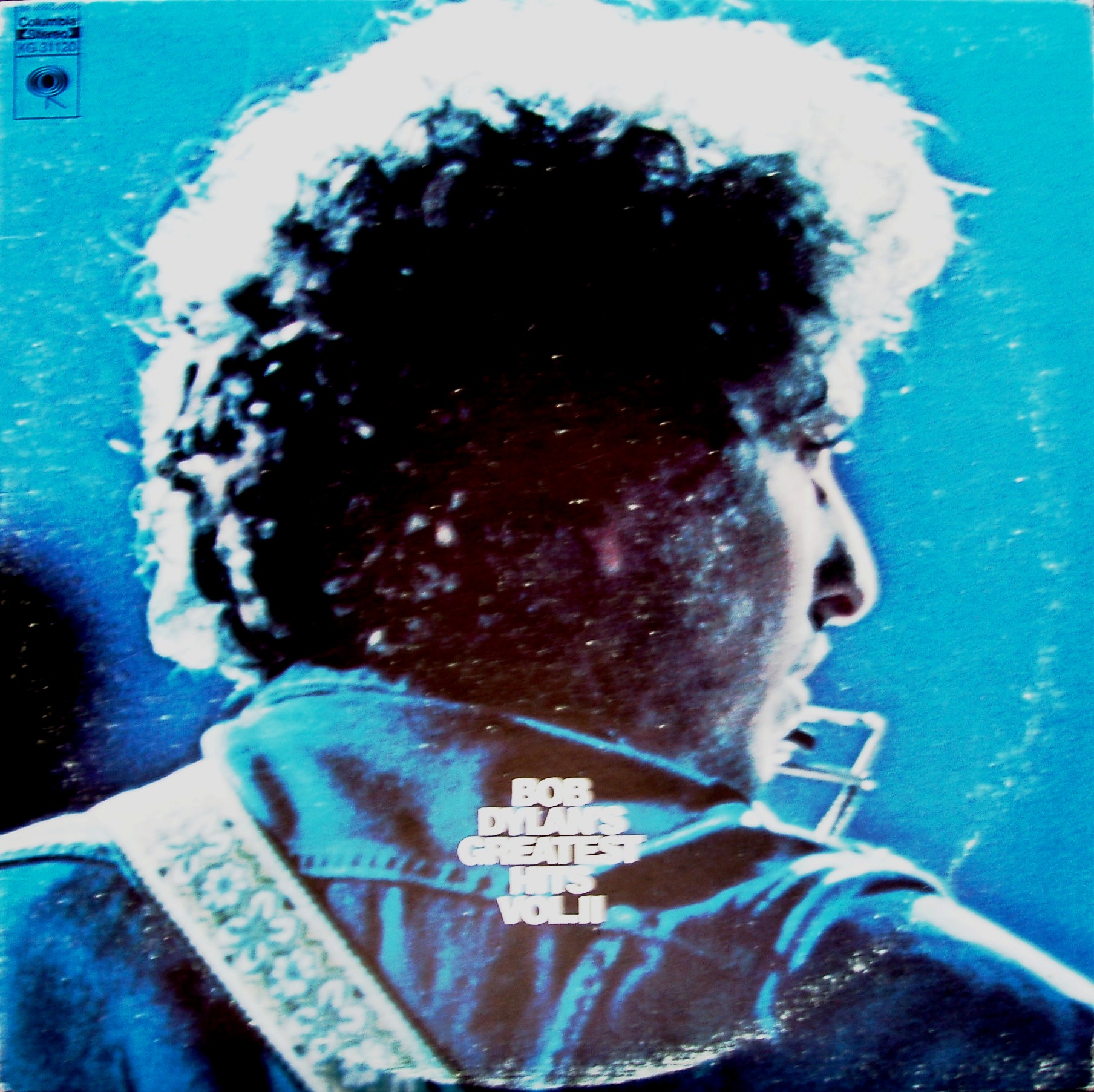
The line is from a Bob Dylan song, “Watching The River Flow.” Though it was released as a single in June of 1971, I’ve always known it as the opening track of the double LP set, Bob Dylan’s Greatest Hits, Vol.2.
Greatest Hits, Vol.2 reached record store shelves on November 17, 1971.

Seen by some at the time as being a “piece of product” whose release was perfectly timed for Christmas gift-giving, this compilation is something more.

According to Anthony Scaduto, in the 1973 paperback edition of his book Dylan: An Intimate Biography, Dylan told him: “I produced every bit of it.” Scaduto writes that Greatest Hits, Vol.2 was “Dylan’s concept from beginning to end, every single note of it, even including jacket photos. The album is as carefully structured as any Dylan concert ever was – and Bob always devoted an enormous amount of energy to planning the sequence of his songs so that he could create precisely the right amount of tension and response from his audiences. Dylan conceives an album the way a writer conceives a book of poetry, or a novel.”

In the 2002 All Music Guide To Rock, Stephen Thomas Erlewine describes the set as “largely comprised of album tracks which became classics, either through Dylan’s own version or through covers” and gives it a starred, “Essential Recordings” rating.

Here’s the track listing for side 1.

1) “Watching The River Flow”

2) “Don’t Think Twice, It’s All Right”

3) “Lay Lady Lay”

4) “Stuck Inside Of Mobile With The Memphis Blues Again”

“Watching The River Flow,” while not the newest recording in the set, sparks and sparkles right from the start with its bluesy, attention-grabbing electric slide guitar solo played by one of the best lead guitarists of the day, Jesse Ed Davis. (Some listings of the credits for this recording have him under the pseudonym “Joey Cooper.”)

Next comes vintage 1963 Dylan at his acoustic-guitar-fingerpicking, harmonica-blowing, Folk Singer/Songwriter best. Then comes slickly produced, almost crooning (is that voice really Bob???), recorded-in-Nashville Dylan from 1969 and finally: the newly-electric, 1966 Blonde On Blonde Dylan in all his image- laden, psychedelicized glory.

Whew.

Did I mention that this was a 2-record set?

The collection ends with four more “previously unreleased” recordings.

The first is Bob’s take on a song of his that the Band had recorded about a year earlier: “When I Paint My Masterpiece.” This vibrant track comes from the same March, 1971, Leon Russell-produced, New York City recording sessions that produced “Watching The River Flow.”

Side 4  finishes with re-recordings of three songs from Dylan and the Band’s yet-to-be-officially-released-but-already-legendary 1967 Basement Tapes sessions.

“You Ain’t Going Nowhere,” “I Shall Be Released” and “Down In The Flood” are presented here in joyous, acoustic renditions that make me think that I’m listening to Bob and his friend Happy Traum jamming away on someone’s back porch up in the hills of Woodstock, NY, or somewhere.

Recorded at Columbia Records’ Studio B in New York City, these performances were the result of a single afternoon session on September 24, 1971. Happy Traum contributes bass guitar, banjo, acoustic guitar and backing vocals to the tracks.

The album jacket photos, by the way, were all taken on August 1, 1971 at the Concert For Bangladesh, an all-star benefit concert organized by George Harrison and held at New York’s Madison Square Garden. Dylan was the “surprize” special guest and he performed with a back-up band consisting of  Harrison on electric guitar, Leon Russell on bass guitar and Ringo Starr on tambourine.

If I had to distill my CD/Record collection down to include only two Bob Dylan albums, I’d be quite happy for another forty years with Greatest Hits, Vol.2 and the first, single disc Greatest Hits

Music this good will never, ever get old.

Posted in Random Topics | Tagged , , , , | Leave a comment

The Source

In case you were wondering…

“Art”

In placid hours well-pleased we dream

Of many a brave unbodied scheme.

But form to lend, pulsed life create,

What unlike things must meet and mate:

A flame to melt — a wind to freeze;

Sad patience — joyous energies;

Humility – yet pride and scorn;

Instinct and study; love and hate;

Audacity — reverence. These must mate,

And fuse with Jacob’s mystic heart

To wrestle with the angel — Art.

Herman Melville, 1891.

Posted in Wrestling With The Angel | Tagged , , | 1 Comment

Wrestling With The Angel, Chapter 2

I first heard Linda Thompson sing on the album Shoot Out The Lights, recorded and released with her then-husband, Richard Thompson in 1982. The duo had been making music together since 1974’s I Want To See The Bright Lights Tonight and this was their sixth and, as it would turn out, final album.

Long time readers of this blog will know that I have remained a passionate Richard Thompson fan. My devotion is chronicled in my post of August 31, 2010 entitled: “Another Obsession On My List.”

I did not, I’m embarrassed to say, keep up with Linda’s career after she and Richard parted company and therefore missed her first solo album, One Clear Moment in 1985. I did most fortunately pick up her 2002 sophmore CD, Fashionably Late. That’s where I, and most of the rest of the world, discovered Linda’s song “No Telling.”

“No Telling” is another song that effected me on the first listen like Gillian Welch’s “Hard Times” did.

This was a song that I had to learn, that I had to be able to play and sing and savor and share.

This is the kind of song that I sing about in one of my own songs, “There Are (Songs To Be Sung),” in the first line of the first verse: “There are songs so good, songs that must be heard. There are songs that are more than melody and words.”

Please. Take a few minutes and hear for yourself.

There you go.

“No telling what a love song will do.”

That’s some song.

I hope you enjoyed that. I’d love to hear your thoughts. Maybe you’ll post a comment!

“No Telling” from the Linda Thompson 2002 CD, Fashionably Late.

Posted in Posts with Video, Wrestling With The Angel | Tagged , , , | Leave a comment

Wrestling With The Angel

The Harrow & The Harvest by Gillian Welch came out last summer, June 28 to be precise.

I’d known the release date and had been looking forward to this new CD for about a month. I’ve been a fan of Gillian Welch (see my post of October 2, 2010 on the occasion of Ms. Welch’s 43rd birthday) for some time and this album would be her first since Soul Journey came out in June of 2003.

Simply, the album was well worth the wait and I highly recommend it to you.

Of the ten excellent songs in the collection, however, one stood out from the beginning and continues to resonate with me. That song is track 8: “Hard Times.”

At the risk of getting analytical – to paraphrase writer Tom Piazza: “endless interpretation can make it harder to hear the song” – Ms. Welch and co-writer David Rawlings channel a few bits of Stephen Foster in their song. Besides the title, which immediately reminded me of Mr. Foster’s 1854 song “Hard Times Come Again No More,” the phrase “camptown man” from the first and third verse seems to be an obvious reference to one of Mr. Foster’s more well-known songs “De Camptown Races” from 1850.

But that’s enough of that. You’ve got to hear the song for yourself.

Please take a few minutes. If you’ve got headphones or the like, put them on. Close your eyes (the accompanying video can be distracting), sit back… and listen.

I can’t tell you how many times I’ve listened to that, how it feels to sing along while driving down the road or sitting with my guitar in a quiet, darkened corner of my house.

“Hard times ain’t gonna rule my mind.”

That’s some song.

I’d love to hear your thoughts, reactions, comments. At the least, I hope you enjoyed the song, the recording, and are glad you took the time to listen.

Maybe the song will in some way resonate with you and sometime soon, you’ll come back and listen to it again, or better yet, purchase the CD.

“Hard Times” by Gillian Welch & David Rawlings, from The Harrow & The Harvest.

Good music doesn’t get old.

Posted in Posts with Video, Wrestling With The Angel | Tagged , , , , | 1 Comment

Reading & Listening

I had a Barnes & Noble gift card that, as my father would have said, was “burning a hole in my pocket” and a B & N store coupon for 20%-off any one item.

It was summer, I was on vacation: I just had to go shopping!

During my careful-but-leisurely afternoon browsing through the racks, I came upon a brand new (copyright 2011, first edition) paperback. Devil Sent The Rain: Music and Writing in Desperate America by Tom Piazza.

If the thumbnail pictures of such artists as Jelly Roll Morton, Jimmie Rodgers, Charlie Patton and Bob Dylan on the cover were not enough, the one of Gillian Welch was the clincher. I bought the book (and one other and a video, too) and headed on home.

Devil Sent The Rain is a collection of essays by Mr. Piazza, divided into three sections. In the second section, where the author “turns his attention to literature, politics and post-Katrina America,” I read the piece titled “Going Back To New Orleans.”

Originally published in the 2006 Music Issue of the Oxford American, Mr. Piazza writes about a recording that he calls “one of the all-time best musical tributes to the Crescent City.” It was a song I’d never heard of by an artist I’d never heard of: “Going Back to New Orleans” by Joe Liggins.

Singer and pianist Joe Liggins (born July 9, 1915 in Guthrie, Oklahoma) led a popular, Los Angeles-based group that produced “smooth, tightly scripted, functional jukebox small-band dance music for black audiences” during the 1950’s. Back in 1945, Liggins had recorded his first hit, “The Honeydripper” and later named his band “The Honeydrippers.”

In his essay, Mr. Piazza so eloquently and passionately described the arrangement and recording of “Going Back To New Orleans” that I had to hear it for myself. I was not disappointed.

Check it out for yourself.

So, what do you think?

After listening to this track, I searched my shelves and dug out a fabulous CD set that I’d bought a few years back called The Roots of Rock ‘n’ Roll, 1946-1954 to see if it contained a Joe Liggins song. Sure enough, disc 2, track 14, was Joe’s other hit “Pink Champagne” from 1951.

After listening to that track, the CD player went on to play track 15 and its opening acoustic guitar lick took me totally by surprise. What was this? It was: “Eyesight To The Blind,” written by Aleck Miller, aka Sonny Boy Williamson 2, and recorded here by The Larks.

Well, if you’ve come this far, you’ve got to hear this one, too.

Isn’t that amazing?

There you go. Thanks to reading an essay in a new book, I discovered a wonderful new recording and re-discovered an equally-wonderful recording I already had.

And thanks to this blog, I get to share them with you.

Life is good.

P.S.: Devil Sent The Rain by Tom Piazza is full of excellent essays and superb writing. Very Highly Recommended.

Posted in Posts with Video | Tagged , , , , , | Leave a comment

The Power of Reading

A year or so ago, I started casually searching on-line for a book about the history of recording.

Last June, in a spur-of-the-moment, while-I’m-in-the-neighborhood visit to Kramerbooks (1517 Connecticut Ave., NW, Washington, D.C.), I found exactly what I was looking for: Perfecting Sound Forever: An Aural History Of Recorded Music by Greg Milner.

The 2010 trade-size paperback has a very graphic, pink, light blue and white front cover and the usual array of excerpts from good reviews that appeared in high-profile publications on the back cover. One of these quotes though was attributed just to “Jarvis Cocker” and reads like a challenge as much as a recommendation. (Jarvis, I have discovered, is a British musician, former frontman for the band Pulp, host of the BBC Radio 6 Music show: Jarvis’s Sunday Service and not the son of one of my favorite singers, Joe Cocker.)

Jarvis said: “Very, very, very few books will change the way you listen to music. This is one such book. Read it.”

Really?

Well, I did read Perfecting Sound Forever and I have to admit that Jarvis was right. This book did indeed change the way I listen to music.

How so?

Well, here’s some of what I learned from Perfecting Sound Forever.

In the history of recording there have essentially been only two “systems” for recording sound: analog and digital.

Analog recordings are everything from the wax cylinders that were played on the original Edison phonograph (introduced commercially in 1888) to 78-rpm shellac discs to magnetic tape (as found in cassettes and 8-tracks) to vinyl LP’s (1948) and 45’s (1949). Digital recordings are CD’s (first produced commercially in 1982) and MP3’s, the latter being the usual format for digital downloads.

In an analog recording, sound waves are “captured” in one of two ways.

The first way is in an uninterrupted, variable-width (or depth) groove etched into the surface of a rapidly spinning cylinder or flat disc.

The other way is in an uninterrupted stream of “patterns of varying magnetic polarity” electronically created in a layer of highly magnetic material – such as tiny particles of iron or nickel – that has been adhered to one side of a thin and flexible ribbon, or tape.

In the 1950’s, terms like “high fidelity” and “audiophile” were preeminent in the blossoming commercial world of analog recorded music. “Presence” was the ultimate goal of the best music recordings and most sought after by those audiophiles.

Presence is defined by Mr. Milner with a quote from John Urban who said that it is: “the aural illusion of being in the same room with the performers.” In Mr. Milners words: “A recorded sound with presence did more than just capture the music perfectly. It captured the sound of music made in a specific space.”

In other words from Mr. Milner, in the early years of analog recording “the fundamental ethic governing recorded music” was “to document reality.” The word “presence” implies “capturing everything.”

S0, in 1982, when CBS/Sony released Billy Joel’s album 52nd Street in Japan as the first commercial CD, they were hoping that listeners would find that this new digital format captured everything of Mr. Joel’s music even better than the vinyl and tape analog versions did.

However, can the idea of “capturing everything” ever apply to a digital recording?

Here’s Mr Milner again: “A digital system is the ultimate negation of this idea. The system begins with an idea of perfection and works backwards. The CD system ‘knows’ that the entire world of sound can be accurately depicted using a set of 65,000 building blocks, as long as 44,100 of them are used each second.”

Mr. Milner quotes Ivan Davis saying “Analog is about ‘approximating perfection,’ while digital is about ‘perfecting approximation.'”

Hmm?

In the process of recording music digitally, the music or sound waves are translated into a “binary language” and stored as “information.” Binary language uses “binary code” as its alphabet. Each letter of this alphabet is a number with 16 places, or “bits.” Each place or bit in this long number can be either a 0 or a 1. (Binary is defined as “consisting of two things or parts.”)

This is what one of those 16-bit numbers would look like: 1001101011001101.

There is a total of 65,536 possible variations on this number, starting with all 0’s, which would be silence.

A digital recorder analyzes or samples an incoming signal and starts translating it into binary language using one of those 65,536 numbers. The digital recorder repeats this process another 44,099 times during the first one second of signal or music. So, if my math is accurate, a 3 minute song would eventually become a dominoes-like row of 7,938,000 16-bit numbers.

Whew.

What then, did this sound like? Could enough of everything be captured? Did the recorded music in this new format have presence?

Mr. Milner quotes musician Neil Young: “Listening to a CD is like looking at the world through a screen window. If you get right up next to a screen window, you can see all kinds of colors through each hole. Well, imagine if all that color had to be reduced to one color per hole. That is what digital recording does to sound.”

Regardless of how they sounded to Neil and many others, CD’s soon took over the world of commercially recorded music and rewarded that world with great financial success for many years.

Personally, I found some of the first CD’s that I bought back in the late-1980’s to be nearly unlistenable, “A Hard Day’s Night” from the Beatles being particularly annoying. But in recent years, I think that the sound of many re-released and “remastered” albums – such as those from the Rolling Stones, Bob Dylan and the Beatles – has been simply spectacular.

Well, in all things technological and commercial, there eventually has to be something new. 

On October 23, 2001, Apple introduced the iPod.

The iPod allowed music listeners to pack all of the music on all of those rack-filling, space-hogging CD’s into a pocket-sized, battery-powered, completely portable and very cool… device. With this device, and a computer, music consumers could also now purchase recordings on-line, from the comfort of their homes, “downloading” their tunes in the formats of “MP3” and “AAC” digital audio files.

How does this work?

Mr. Milner explains: “When music on a CD is converted to MP3 or AAC (the iPod format), between 80 and 90 percent of the music is simply discarded.” This compression is the only way “to really shrink music enough to stuff thousands of songs on an iPod.”

And how does this sound?

Here are two thoughts.

Drew G., a friend and colleague of mine, compares the sound of an MP3 recording to a dry sponge.

To me, an MP3 recording is like a fresh rain puddle on the street: it’s all shiny and pretty on the surface and fun to splash around in. It’s just not a sound that you can immerse yourself in. 

Finally, I will leave you with one more quote from Greg Milner and Perfecting Sound Forever.

“High fidelity barely exists today, not so much because recordings don’t attempt to document reality anymore but because the fundamental ethic governing recorded music has been reversed. Presence implies capturing everything. Today, we try to capture as little as possible while fostering the illusion of everything. We don’t want everything. We want just enough.”

There you go.

All of that (and more – I’ve gone on long enough) is why reading this book changed the way I listen to music.

Forever.

Perfecting Sound Forever: An Aural History of Recorded Music by Greg Milner. Highly Recommended.

Posted in Random Topics | Tagged , , | 2 Comments

This Historic Day In Music: B.B.King

Last year, I missed B.B.King’s birthday and ended up writing about it belatedly on Sept. 20, 2010. I entitled that post “One That Got Away.”

This year, I vowed to not miss this very important and historic day in music.

In “One That Got Away,” I wrote:

B.B.King was born Riley B. King on September 16, 1925 in a house on the shores of Blue Lake, midway between Itta Bena and Indianola, Mississippi.

B.B. made his first recordings in 1949 for soon-to-be-out-of-business Bullet Records. His first hit record was “Three O’Clock Blues” on the RPM label. It reached #1 on the R&B charts in 1951 and stayed at #1 for 18 weeks. Between then and 1985, B.B. King put 74 recordings on the Billboard magazine R&B charts.

B.B.King has long been revered as the undisputed “King of the Blues.”

Back in 2010, I also wrote about one of my favorite videos of B.B.King. It came from a performance given on May 11, 1985 in Austin, Texas.

The event was a tribute concert held to honor the late Stevie Ray Vaughn. Organized and directed by Jimmie Vaughn, Stevie’s brother, the nationally-broadcast show brought together a stellar line-up of Blues musicians, including B.B.King, and gave each artist a chance to pay and play their respects to Stevie.

At the end, all of the artists joined together to play “SRV Shuffle,” an instrumental written by Jimmie for the occasion.

To be honest, back in 2010, I hadn’t figured out how to imbed video into my blog posts. But now, I know how!

So, here it is. I hope you’ve got nine minutes and eight seconds to watch and listen to this extraordinary Blues jam session. It is a master class in electric Blues guitar and features the incredible playing of Mr. B.B.King.

Now, if you don’t have nine minutes and eight seconds, here’s a shorter video of just B.B. that I recently discovered. It is from the “extras” of the DVD of the film “The Road To Memphis.” This was one of the films in the 2003 series “Martin Scorsese Presents The Blues.”

Isn’t that amazing?

Happy 86th Birthday, B.B.King.

Thanks for working so hard and so long to keep the Blues alive and well.

Where would the Blues be now if not for you?

Posted in Posts with Video, This Historic Day In Music | Tagged , , , | 2 Comments