Everything Changed

It had not been the best of summers.

On Sunday, August 5th, 2001, my mother, Avis Louise Foss Sinclair, died. She was 87 years old. Her passing was not sudden. August 8th, my 48th birthday, had been the day of her funeral and burial.

On September 8th, I’d finished writing a new song: “Round And Round.”

Now it was Tuesday, September 11th, in the morning.

I was at home, in the den, working at the computer. I had the house to myself and was absorbed in proof-reading and putting the finishing touches on the more-than-year-long project of writing my own guitar method book to use in my teaching.

The telephone rang.

There was no greeting. The voice on the other end just asked a question.

“Have you got the news on?”

I barely recognized the voice. It was my father-in-law, calling from Connecticut.

“No,” I replied.

“Turn it on. Any channel.”

“What’s up?”

“They’re flying planes into the World Trade Towers.”

Click.

At the beginning and end of two long journal entries that I wrote on the following Saturday, September 15th, I wrote the words: “Everything has changed.”

Now, as we all know all too well, everything here in America was changed that day. Those of us who lived through September 11th, 2001 will never go back to the way we thought, the way we lived, to the same kind of future that we looked forward to before that day. Never.

We did however, carry on. But as I look back, it seems that we did so at a very slow pace.

Two weeks into the following October, I finally finished my guitar method book. Without fail, every time I hand a brand new copy to a student, I hear the sound of my father-in-law’s voice when I answered the phone that morning.

That new song, even though it was written “before,” soon became my post-9/11 performance piece.

Somehow the words and the melody and the arrangement all seemed to fit how I felt then and still fit, these ten years later, how I feel now.

I hope that in some way, large or small, they will fit for you, too.

“Round And Round” – words, music, guitar and vocals by Eric Sinclair

Everything changed.

Posted in EFS Music | Tagged , , | 1 Comment

Revisiting “Rising Sun Blues”

Sometimes, in my teaching, one of my guitar students will ask if I can teach him/her how to play a favorite song that he/she has recently been listening to. Sometimes that song is so new or obscure that there is no transcription available either in a songbook, guitar magazine or on the internet. Often, it is a song I’ve never heard before.

 All the student has is a recording of the song and a good bit of faith in my ears and expertise to be able, in about 45 minutes, to unlock the mysteries of exactly what is going on musically and guitaristically (?) in this piece of music that he/she is dying to be able to play.

No pressure. 

Every now and then there is a song that I want to learn how to play and, again, only have the recording to work with.

Recently, that song was the 1933 Ashley & Foster recording of “Rising Sun Blues.”

Having often listened to, read much and written once (see my September 6, 2010 blog post) about this recording, I started my detective work based on the assumption that on the record, Clarence Ashley played guitar and sang and Gwen Foster played harmonica.

But listening to a piece of music when trying to figure out how to play it is much different from listening to a piece of music for the simple, pure enjoyment of it.

Active listening, as I call it, reveals details that passive listening does not. Active listening requires repeated listenings. What I heard as an active listener of “Rising Sun Blues” told me something that was contrary to my initial assumption:  it sounded like there was more than one guitar being played behind the vocal and the harmonica.

Listen for yourself. (Click on the link.)

“Rising Sun Blues” by Ashley & Foster

That opening guitar lick is played on one guitar. But at the very end of it, just before the vocal starts, there is the hint of a low bass note that sounds like it is coming from another guitar.

In the accompaniment to the first verse, right at the word “God,” another low bass note appears.

Then, the instrumental break between the first and second verse clinches the deal. Guitar 1 repeats that opening lick and is obviously accompanied by another guitar, playing Carter-style. Guitar 2 then hits the lowest bass note of all on the first beat of the measure where the second verse begins: “Just fill the glass up to the brim…”

Go back. Listen again, closely.

Did you hear those bass notes?

Well. Who is playing the other guitar?

Foster?

My detective work took a non-musical turn.

In my library, I have a book: Country Music Originals: The Legends and The Lost by Tony Russell. (Great book!) In the book, there is a chapter on the “Carolina Twins,” a duo that recorded for Victor Records from 1928-1929. The members of the duo were David Fletcher and Gwin Foster. (His recordings always use the spelling “Gwen” but his gravestone has it as “Gwin,” according to Mr. Russell.)

And there is a picture.

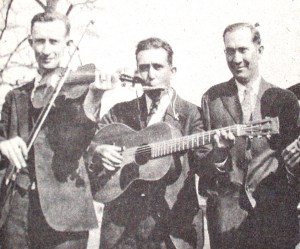
In between fiddler Gordon Buford and singer Avery Keefer, that is Gwin Foster himself, playing a C chord on his guitar while (thanks to what looks like a homemade, round-the-neck rack) blowing into a harmonica at the same time! Shades of Bob Dylan!

(The photo dates to around 1926 and is credited as being from the “Wayne Martin collection.” Robert Zimmerman was 15 years away from even being born.)

So, that solves the two guitar question.

But it raises another: why didn’t, or couldn’t, the player of Guitar 1 hit that bass note on his guitar?

Well, once upon a time, in my formative years, I had seen a film (probably on PBS) of the sixties Folk trio Peter, Paul & Mary in concert. I noticed that while accompanying Mary, Peter and Paul rarely played the same thing on their respective guitars. One of them would be playing with his guitar capoed up the neck while the other wasn’t using a capo and was playing different but harmonically equivalent chord voicings down in open position.

By the way… 

A capo is a device made up of a bar of some sort (covered in hard rubber or slightly soft plastic) that uses the pressure provided by elastic bands or a spring to simultaneously press all six guitar strings against the same fret, as chosen by the player. The vibrating strings are now shorter and thus sound notes of a higher pitch. 

So, for instance, a guitar player can put a capo at the fourth fret and finger a C major chord and have it sound like an E major chord. If this first guitarist is playing with another guitarist, this second guitarist can forego the capo and play an E major chord using the open-position fingering. When the guitarists play together, one gets a voicing of the C major chord containing high notes and the other gets a voicing that contains that low, open-sixth-string E bass note. The overall sound is gorgeous.

Now, Ashley & Foster play “Rising Sun Blues” in the key of E major.

Could it be???

Back to the book.

Two pages before the chapter on the Carolina Twins, is the chapter on the “Carolina Tar Heels.”

Guess who was in the Carolina Tar Heels?

And… there’s a picture!

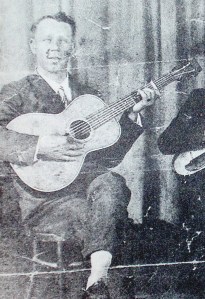
That’s Clarence Ashley, from 1928, thanks to Mr. Russell’s photo collection.  

See his left hand? See that white line across the guitar’s fingerboard just above his fingers? 

That’s a capo.

And he’s fingering a C major chord!

Mystery solved.

The 1933 recording of “Rising Sun Blues” features the guitar and harmonica work of Gwen/Gwin Foster and the vocals and guitar work of Clarence Ashley.

In 3/4 time and the key of E major.

In case you were wondering.

If you’ve got the time, scroll back up to the link and listen to it again.

Actively.

Posted in Posts with Audio | Tagged , , , , | 1 Comment

78s & Cylinders

One of the items on my summer to-do list was to add a couple of 78-rpm records to my collection of 45s, EPs, LPs, reel-to-reel tapes, cassette tapes, CDs and digital downloads.

You can’t have too much music, I always say.

Late last spring, my colleague and friend, Randy, had given me the name of an antique store – Eagle Antiques – on Rte.4 in Northwood, NH that carried 78s and a few of the “Victrola”-style record players as well. It took me until July, but I finally got around to paying Eagle Antiques a visit.

The guy behind the counter, Chuck, took my request and directed me to three dusty wooden boxes tucked in under a hutch on the wall to the right of the front door. One box was filled front to back with the thick black records, none of them in jackets or paper sleeves. The other two boxes held what looked like several very old photo albums; but these turned out to be collections of 78-rpm records, each album containing 8 -10 records, each record in its own protective page. 

There were many records to go through and examine, but after much careful consideration I selected three: one for the artist, one for the musical content and one for the record label. At $2.00 apiece, I was thrilled.

Here they are.

At the top of the picture is “Lester Leaps In” b/w (backed with) “Dickie’s Dream” by the Count Basie Kansas City Seven. This is the one I picked for the Vocalion label – I do like Count Basie, too – which is the label that Robert Johnson’s records were released on. This record dates from 1937.

On the bottom left is “Death of Floyd Collins” b/w “Dream of a Miner’s Child” by Vernon Dalhart on the Victor record label. Vernon started his recording career in 1916. In 1924, he recorded his first Country song – “The Wreck of the Old ’97” – and went on to sell an estimated career total of 75,000,000 records! “Death of Floyd Collins” was based on an actual event and was one of Vernon’s hits. This record dates to 1925.

On the bottom right is “My Old Kentucky Home” by Columbia Stellar Quartette b/w “Uncle Josh at a Meeting of the School House Directors” by Cal Stewart. I purchased this one because of the Stephen Foster song. This is the oldest record of the three, dating to 1918.

Judging by the scratches on the label around the center hole, whoever owned this record was more of a fan of Cal Stewart than of Columbia Stellar Quartette.

So, what about the music on these antiques? Well, I don’t own a record player that will play a 78, but thanks to the wonders of the internet, I was able to find and download most of the music my new treasures contained.

If your interested, give a listen to this:

“Dream of a Miner’s Child” by Vernon Dalhart

While going through the 78s, I felt lucky and asked Chuck if he had any Edison cylinders. He said that he didn’t; but after making a phone call, he recommended a place right up the road, run by a friend of his, that did.

So, next stop on Rte.4, west: Fern Eldridge & Friends Antiques, right next door to the Northwood town hall.

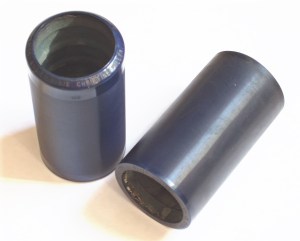
Jeff presented two medium-sized covered cardboard boxes, each containing about 35-40 Edison cylinders. All of the cylinders were standing on end, with the label edges pointing up. This made it easy to see the title of the piece and the name of the artist whose performance was etched in the grooves around the circumference of the dark blue, 4 & 1/8″ tall tube.

Again, going by my random criteria from before, I selected two cylinders and paid Jeff his asking price of $5.00 each. More treasures!

Here they are.

The one standing is an Edison Blue Amberol Cylinder with the song “Annie Laurie” as performed by Christine Miller. This cylinder dates to 1913. Christine Miller was a well-known soprano in her time, and a friend of Thomas Edison. I’d been reading about her, Edison and the phonograph (Edison’s invention that cylinders were – and still are – played on) in a fabulous book: Perfecting Sound Forever: An Aural History of Recorded Music by Greg Milner. 

The one lying down is an Edison Concert Blue Amberol Cylinder with the Stephen Foster song “Old Folks At Home” as performed by Margaret Keyes. This cylinder dates to 1912.

Again, thanks to the internet, here is Ms. Keyes.

“Old Folks At Home” by Margaret Keyes 

Three 78s and two cylinders added to my music collection and one item scratched off my summer to-do list.

That’s what I call a pretty good day.

P.S.: What did you think of those old recordings/performances?

Posted in Posts with Audio | Tagged , , , | 1 Comment

Irene

Not the hurricane, the song!

The recording you just listened to – you did click on the link and listen to it, didn’t you?!? – was recorded in New York City, circa August 1943, by Moe Asch. It features Lead Belly singing and playing his 12-string guitar with harmonica accompaniment by Sonny Terry.

This recording of “Irene” was the first commercial release of the song, originally issued in a 78 rpm album entitled Songs by Lead Belly on Asch Records.

It is currently available on the CD Where Did You Sleep Last Night? from Smithsonian/Folkways. This collection is volume 1 of the 3 volume Lead Belly Legacy series of reissues of the Lead Belly/Moe Asch recordings.

Posted in Posts with Video | Tagged | 2 Comments

Discovery

The “Premiere Issue” of Acoustic Guitar magazine arrived in my mailbox in July of 1990.

With a black & white photo of classical guitarist Sharon Isbin on the cover, the feature article was called “My First Guitar” and subtitled “Tales of Childhood Passion.” In the article, author and editor Jeffrey Pepper Rogers presented stories gathered from master guitarists Doc Watson, Ms. Isbin, Michael Hedges, Ferron, Norman Blake and others about their “life-changing moments of passion, pain and magic with their first instruments.”

In the twenty-one years since then, I have been a loyal subscriber and avid reader of Acoustic Guitar. From the pages of that magazine, I have learned much about the music, history, construction, recordings and players of my favorite instrument. I have discovered “new” artists such as Guy Clark and Gillian Welch and made many trips to the music store in search of a CD recommended by a reviewer or author writing in those happily-received monthly issues. 

The September 2010 issue was a good example of this.

The cover proclaimed this issue as being the “Blues Guitar Special!” and the featured artist was “Nashville’s Roots Guitar Genius” Buddy Miller. (If you’ve never heard Buddy Miller, you should definitely check him out. Besides his prodigious talents as a guitarist, singer and songwriter, his version of “With God On Our Side” from the album Universal United House of Prayer is, in my mind, one of the best covers of a Bob Dylan song ever. The 2009 CD Written In Chalk by Buddy and [his wife] Julie Miller is quite amazing as well.)

On page 28, there was an article entitled “The Mississippi Sheiks Rediscovered” by Kenny Berkowitz.

Berkowitz wrote about the ideas behind and the making of the recently released CD Things About Comin’ My Way: A Tribute to the Music of the Mississippi Sheiks. The collection was the brain child of multi-instrumentalist and producer Steve Dawson. Over one and a half years of work, Dawson colaborated with an international array of stellar acoustic musicians. Each artist/group recorded a cover version or interpretation of  a favorite number from the large catalogue of songs written and recorded by the Mississippi Sheiks, the highly-influential 1930’s string band.

Being a fan of the Sheiks, their songs and of several of the musicians who contributed to the album, I was definitely intrigued. I added Things About Comin’ My Way to my mental list of “CDs to find.” And finally, this summer, thanks to a chance visit to the Newbury Comics on Newbury Street in Boston, I found it. (See my post of June 4, 2011: “Summer’s Here… Again” for more about that eventful day.)

(I can hear the questions: “Why not iTunes? Why not Amazon? The internet, the internet…!” Simply, I enjoy the hunt and making the catch.)

The CD is well worth the search. Among the artists I knew before, Bruce Cockburn, Bob Brozman, John Hammond and Kelly Joe Phelps all do themselves proud. The producer, Steve Dawson  contributes his outstanding talents on slide guitar to many tracks and, in turn, adds a flow and cohesiveness that compilations of this type often lack.

Among the artists who were new to me, Oh Susanna, aka Suzie Underleider, recorded the song “Bootlegger’s Blues” with arrangement help from the legendary Van Dyke Parks. This is my favorite cut on the album. Besides introducing me to an exceptional vocalist, I’d never heard this great song before either. The lyric: “you’ve got to make it to the woods, if you can” has been ringing in and out of my head all summer.

Discovering new music, however old it may be, is for me, one of the great joys of life.

Thanks to Acoustic Guitar magazine, I’ve had many years of making wonderful discoveries. Who knows what’s to come?! 

I’ll be checking the mailbox.

P.S.: I wish I could post a link to this recording so that you can listen to it, but my youtube search came up empty.

Posted in Random Topics | Tagged , , , | 1 Comment

Three Days In August

The first day was Friday, August 12th.

It was, as you readers know, my wedding anniversary and, after a delicious and leisurely dinner at the Blue Latitudes restaurant in downtown Dover, my wife and I strolled over to Henry Law Park for the Cochecho Arts Festival’s final concert of their 25th season.

The Spectras were the act performing that night and they are among our favorites. A local, nine-piece (including a horn section) classic rock cover band that has been around since the 1960’s, I could tell this was going to be a good night by the way they launched into their opening number,  Chicago’s “25 of 6 to 4.” 

Having not seen them in a couple of years though, we were quite surprised when, half way through the first set, on came four young women (three in matching glittery black dresses) introduced as the “Spectrelles.” Well, well, the Spectrelles (Meghann, Brenda, Jess and Sajin) were really something. With the addition of these outstanding vocalists the now-13-piece ensemble really kicked into high gear and delivered a wide array of songs including superb renditions of the Aretha Franklin version of “You Make Me Feel Like A Natural Woman,” the B-52’s “Love Shack” and Journey’s “Don’t Stop Believing.”

The second day was Saturday, August 13th. 

My wife and I love to dance and a few years ago we discoverd a fabulous local band called “Soulmate.” This hard working, six-piece cover band does Motown, Soul, Disco and Funk and is fronted by Mona Lisa Comeau, a dynamic vocalist and exuberant performer.

We knew they were playing at the temporary pavilion on (literally) Hampton Beach, NH, that night and, after a busy day around the house, we mustered the energy for the the 40-minute drive down to the seacoast.

Well, we were very glad we did. Through two 50-minute sets, we danced and danced and danced some more as this incredible band poured out song after song of rocking, good-time, party-all-night energy. The weather was perfect, the crowd on the dance floor was into it as much as we were and we didn’t stop until the very end. “Respect,” “My Girl,” “I Heard It Through The Grapevine,” “Love Train,” “Brick House” and many more. Soulmate has never let us down and they were awesome once again.

The third day was Sunday, August 14th.

The Prescott Park Arts Festival in Portsmouth, NH, gets better and better every year.

Starting in early July, they have a mid-week “Concert Series,” each show featuring an individual act. On the weekends, they have their “festivals.” First was the Showcase Music Festival, then the Tommy Gallant Jazz Festival, the Americanna Festival, the Folk Festival and on the 14th, the last one: the Roots & Rhythm Festival.

The announced acts were: Dala, Catie Curtis and Redhorse. I went because of Dala.

Dala had performed at the Newport Folk Festival in 2009. I saw them there on Sunday, August 2nd. Because of the success of their small-stage, morning show, they were invited to do a “tweener” on the main stage, in between afternoon sets by Neko Case and Arlo Guthrie. I remember that suddenly they appeared on stage, sang their hit song “Levi Blues” to the 10,000-or-so of us and were gone.

“Levi Blues” is one of those stick-in-your-head kind of songs, but I love it and find it irresistible to sing along with in the car, or anywhere.

Dala is a duo: songwriters Sheila Carabine (vocals, guitar, ukulele and piano) & Amanda Walther (vocals, guitar and piano). They have beautiful voices individually, but they blend and harmonize those perfectly-complementary voices together into a sound that is nothing short of breathtaking.

They sang “Levi Blues” in Portsmouth on Sunday in a stunning set that also included their songs “Marilyn Monroe” and “Sunday Dress” along with a gorgeous, slowed down version of “Both Sides Now” written by their fellow Canadian musician, Joni Mitchell.

I bought their latest CD, a live-in-concert recording called “Girls From The North Country” (it contains all the songs mentioned above) and waited in line to get them to autograph it. Pretty cool.

The other “highlight” of the afternoon came when Redhorse, the Folk super-group trio of Eliza Gilkyson, Lucy Kaplansky and John Gorka, were playing the traditional classic “Wayfaring Stranger” at the end of their set. During the song, the air exploded with the roar of fighter jets (in town for an air show at the Pease International Tradeport) flying in formation overhead. It was one of the oddest juxtapositions of sounds I’ve ever heard.

Three music-filled days in August: Friday the 12th, Saturday the 13th and Sunday the 14th, 2011.

P.S.: On this day, August 15, in 1969, a series of four music-filled August days got started: the Woodstock Music and Art Fair in Bethel, NY. “We are stardust, we are golden…”

Posted in Random Topics | Tagged , , | 1 Comment

33 Years

Late in the afternoon

Of Saturday, August 12, 1978,

In the sanctuary of the First Congregational Church of Park Ridge, NJ,

The Reverend Herbert B. Yeager officiating,

In front of family and friends,

I sang this song

To my bride.

“Tell You Very Simply (Wedding Song)” words, music, guitar & vocal by Eric Sinclair

Happy Anniversary to Us.

Posted in EFS Music | Tagged , | 2 Comments

70/14/58/100

This past May, Bob Dylan celebrated his 70th birthday.

In the May 23rd edition of The New York Times, author and educator David Hajdu had an essay published entitled “Forever Young? In Some Ways, Yes.” Mr. Hajdu puts forth the suggestion that although 70 is a significant milestone for Bob, it is his 14th birthday that was “the truly historic” one.

Mr. Hajdu quotes Daniel J. Levitin, professor of psychology at McGill University: “Fourteen is a sort of magic age for the development of musical tastes. Pubertal growth hormones make everything we’re experiencing, including music, seem very important. We’re just reaching a point in our cognitive development when we’re developing our own tastes. And musical tastes become a badge of identity.” 

When Bob was 14, he was a freshman at Hibbing (Minnesota) High School. It was 1955. That year Elvis Presley released his records “Baby, Let’s Play House” and “Mystery Train.” Mr. Hajdu quotes Dylan as remembering about Elvis: “Hearing him for the first time was like busting out of jail.”

Mr. Hajdu goes on to list other musicians with 70th birthdays in the year around Bob’s including Joan Baez and Paul Simon. He also mentions the soon-to-be-septuagenarians Brian Wilson, Aretha Franklin, Carole King and Paul McCartney. (Paul is quoted as once saying about first hearing Elvis Presley: “When I heard ‘Heartbreak Hotel,’ I thought, this is it.” That was 1956 and Paul was 14.)

The article’s list of those who would have turned 70 around this time includes John Lennon, Jimi Hendrix and Jerry Garcia. 

I’ve been sitting on Mr. Hajdu’s essay and this topic, waiting for today, my birthday. I may not be turning 70, only 58, but the article did get me thinking back on what I was doing musically and what music I was listening to when I was the obviously-important age of 14.

My year of being 14 ran from August 1967 to July 1968. That was my freshman year at Exeter (NH) High School.

I had been playing the drums for a couple of years and had procured a full set, with the bass drum, tom-tom and floor tom sporting blue sparkle shells. I entered high school still playing with guitarists Gerry and Ricky in the trio we’d started at the end of the seventh grade. But I soon moved up to a full, four-piece rock band with Alan on bass guitar and vocals, Danny on lead guitar and Jim on rhythm guitar.

The only song I can remember that we played was a rock version of “Born Free.” (Yes, from the movie.) I used model car tires and strips of terrycloth to turn two drum sticks into a pair of tympani sticks for this number. During a performance of this piece at a “Battle of the Bands” in Exeter High School’s Talbot Gym, the amplifier of our rented PA system stared to smoke, bringing the song, and our set, to a complete halt.

Some musical badge of identity. 

During my 14th year, my record collection grew substantially. The top hits of that time included the singles: “Windy” and “Never My Love” by the Association; “I Can See For Miles” by the Who; “Incense and Peppermints” by the Strawberry Alarm Clock; “Hello, I Love You” by the Doors; “Hello Goodbye” by the Beatles; and “Jumpin’ Jack Flash” by the Rolling Stones.

Among the albums I purchased that year, three still stand out: “Their Satanic Majesties Request” (Nov. 1967) by the Rolling Stones, “The Beat Goes On” (Feb. 1968) by Vanilla Fudge and “Live At The Village Vanguard” (Oct. 1967) featuring Dizzy Gillespie. (The last one I received as a bonus for renewing my subscription to Down Beat magazine.)

Listening to the radio was a big part of my 14-year-old life and I can remember the two stations, both from Boston, that were my favorites: WBZ-AM 1030 and WBCN-FM 104.1. 

I remember one night, lying in bed and listening to WBZ on my black, boxy Philco and hearing Dave Maynard play the first music I’d heard by this oddly-named San Francisco band called “The Grateful Dead.” I also first heard a cut from that Vanilla Fudge album on Mr. Maynard’s show.

WBCN, which started broadcasting on March 15, 1968, played anything and everything, each DJ having their own tastes and style. I can remember hearing one DJ play different versions of the same song back-to-back (“Corrine, Corrina,” I think) in what my pubertal growth hormones thought was a rather cool attempt to both entertain and educate his listeners.

Finally, I’m pretty sure that the first concert I ever went to was during that year: Judy Collins with a band at the University of New Hampshire Field House.

So, I guess 14 was a pretty good year.

I was a year or so away from starting to listen to Bob Dylan. Led Zeppelin, the blues (according to Albert King and B.B.King) and the jazz of the Dave Brubeck Trio with Gerry Mulligan were yet to enter my life.

Seeing B.B.King, Nina Simone and the Sun Ra Arkestra at the Boston Globe Jazz Festival with bandmate Alan and his dad was coming up in January of 1969. 

Borrowing an acoustic guitar from bandmate Jim wouldn’t happen until May of 1970. 

As music evolves, so does a musical life. Playing, singing, listening, collecting, writing: there’s always something new and old to discover. On and joyously on it goes.

What were you listening to when you were 14?

P.S.: This is my 100th blog post.

Posted in This Historic Day In Music | 3 Comments

This Historic Day In Music: Mick Jagger

A few years after Ringo Starr inspired me to learn to play the drums (see my post of July 9, 2011: “Belated Birthday Wishes”), my young infatuation with the Beatles began to fade.

By the time I entered high school, I was a Rolling Stones fan.

Mick Jagger, Keith Richards, Brian Jones, Charlie Watts and Bill Wyman were fascinating, mysterious and, or so it seemed to this small-town-New-Hampshire boy, rather dangerous characters. And though I somehow sensed even then that Keith and Charlie were the glue that kept this band musically together, Mick was, quite clearly, the Man.

As a growing guitar player in the early 1970’s, my most-turned-to song book was a Rolling Stones collection which featured the music printed in white ink on deep blue paper. I built my left-hand fingertip calluses mastering the chord progressions to many Jagger & Richards creations including: “Play With Fire,” “Paint It Black,” “Lady Jane” and “Mother’s Little Helper.” 

One of my favorite listening albums in those days was the Rolling Stones’ 1966 release Big Hits: High Tides and Green Grass. But the 1967 Stones LP Flowers, an American compilation of British-released B-sides and album tracks,  delivered more songs (“Back Street Girl” and “Sittin’ On A Fence”) that I just had to learn how to play.

Many years later, taking my cue from how the Byrds transformed Bob Dylan’s “My Back Pages,” I re-arranged “Ruby Tuesday” into an up-tempo waltz. In performance, I would introduce the song by proposing that, if the Stones had been a Folk band, this is what “Ruby Tuesday” might have sounded like.

I could go on.

(The Rolling Stones at Boston Garden, November 29, 1969, 2nd show? I was there.)

The instigation for all of this reminiscing was my amazing wife who asked me last night: “Do you know that tomorrow is Mick Jagger’s birthday?”

“No!” said I.

Mick Jagger was born Michael Philip Jagger on this day, July 26, in 1943, in Dartford, Kent, England.

The Rolling Stones did their first gig on July 12, 1962, in London, England and released their first album, The Rolling Stones (England’s Newest Hitmakers), on May 30, 1964.

They were, and still are, The World’s Greatest Rock & Roll Band.

If you don’t believe me, watch (and listen to) the DVD of  “Shine A Light,” the 2008 Martin Scorsese-directed film of the Stones’ 2006 concert at the Beacon Theatre in New York City.

Very Highly Recommended.

Happy 68th Birthday, Mick.

Posted in This Historic Day In Music | Tagged | Leave a comment

This Historic Day In Music: Johnny Hartman

This story has nothing to do with the guitar.

It is about my very most favorite Jazz vocal recording ever.

It is: “Lush Life” by vocalist Johnny Hartman and the John Coltrane Quartet.

When I learned, thanks to my good friend and colleague, Charlie Jennison, (a fabulous Jazz musician in his own right), that today was the anniversary of Johnny Hartman’s birthday, I knew that I simply had to write this post.

Johnny Hartman was born on July 13, 1923 in Chicago, Illinois.

He started singing in high school with his school’s jazz orchestra.

On March 7, 1963, Johnny recorded an album for Impuse Records with John Coltrane and his now-classic quartet: John on tenor saxophone, McCoy Tyner on piano, Jimmy Garrison on bass and Elvin Jones on drums.

The album was released later that year as: “John Coltrane & Johnny Hartman”

The first song on the second side was the Billy Strayhorn ballad “Lush Life.”

This recording of this song by these musicians is, in my how-humble-can-you-be-if-you-have-a-blog opinion, one of the most devastatingly gorgeous pieces of music ever. Period.

Listen to it.

It is five minutes and thirty seconds of shear beauty, start to finish.

Yes? Wasn’t I right?

Truely awesome.

Johnny Hartman passed away on September 15, 1983.

Posted in This Historic Day In Music | Tagged | 2 Comments