What’s the first thing that comes to mind when you hear the name “Woody Guthrie?”
I’m guessing that it’s not “children’s songs.”
(I would really like to know your answer to that question!)
Well, Woody Guthrie was a dad. He fathered eight children – starting with Gwendolyn Gail, born in 1935 and lastly Lorinna Lynn, born in 1954 – and reportedly wrote songs for all of them. Woody was, however, especially inspired by his daughter Cathy Ann, born in 1943; his first child with Marjorie Mazia, his second wife.
The first collection of Woody Guthrie’s children’s songs to appear on record came out in 1946. Titled: Songs To Grow On: Nursery Days, it was released as a set of three, 78-rpm discs by Moses Asch on his Disc Recordings label.
A second collection of six songs came out on Disc Recordings in 1947. This set was titled: Songs To Grow On: Work Songs for Nursery Days.
Woody wrote most of the songs for the second collection in late September, 1946, while Marjorie, Cathy and he were vacationing with Alan Lomax and his family in the Pocono Mountains of Pennsylvania.*
The first song on Songs To Grow On: Work Songs for Nursery Days is called “Build My House.”
I learned this exceptionally fun tune from a 1990 Smithsonian Folkways cassette album called “a fish that’s A song: 19 songs and stories for children.”
Give a listen!
Here’s the chorus, if you want to sing along:
“Bling blang, hammer with my hammer / Zingo zango, cutting with my saw.”
I hope you enjoyed that!
“Build My House” was retitled “Bling-Blang” when Moses Asch included it on the 1956 Folkways Records LP Songs To Grow On For Mother And Child.
Woody Guthrie wrote the liner notes for that album and offered these “instructions” for how he hoped the songs would be used by parents and children alike.
“Watch the kids. Do like they do. Act like they act. Yell like they yell. Dance the ways you see them dance. Sing like they sing. Work and rest the way kids do.
You’ll be healthier. You’ll feel wealthier. You’ll talk wiser. You’ll go higher, do better and live longer here amongst us if you’ll just only jump in here and swim around in these songs and do like the kids do.
I don’t want the kids to be grownup. I want to see the grown folks be kids.”
Woodrow Wilson Guthrie was born this day, July 14, 1912 in Okemah, Oklahoma.
*From the liner notes with the Smithsonian Folkways CD Woody Guthrie – Hard Travelin’: The Asch Recordings, Vol.3, by Guy Logsdon & Jeff Place.
“Good music doesn’t get old.” – Ferdinand Joseph “Jelly Roll Morton” LaMothe
“All valuable stories need to be told over and over again.” – Bruce Springsteen
Therefore, this post.
Also, quite sadly, this song is more relevant today than it ever was.
As the story goes…
Bob Dylan wrote “Blowin’ In The Wind” sometime in late March/(most likely) early April, 1962.
The first person he sang it for was his friend, Gil Tuner. Turner was a folksinger, political activist, editor of Broadside Folk music magazine and host of the hootenannies at Gerde’s Folk City in New York City’s Greenwich Village.
Gil’s response to Dylan’s new song was: “Jesus Christ, I’ve never heard anything like that in my entire life! That’s the most incredible song!”
Bob Dylan debuted “Blowin’ In The Wind” on stage at Gerde’s Folk City on April 16, 1962.
From that point on, Dylan performed “Blowin’ In The Wind” every chance he got.
Todd Harvey explains in his excellent 2001 book, The Formative Dylan: Transmission and Stylistic Influences, 1961-1963 that: “By the end of 1963 the song had become (Dylan’s) signature piece and had taken on a life of its own, working its way into the American psyche as a Civil rights and counterculture standard.”
On Monday, July 9, 1962, 21 year old Bob Dylan recorded “Blowin’ In The Wind” in Columbia Record’s Studio A in New York City. It was released on May 27, 1963 as the first track on his second album, The Freewheelin’ Bob Dylan.
(Peter, Paul & Mary released their recording of “Blowin’ In The Wind” as a single on June 18, 1963. It went on to be a Top-10 million selling record and won the Grammy Award in 1964 for Best Folk Recording.)
Music journalist Paul Williams observed in his 1994 book, Bob Dylan: Performing Artist 1960-1973 that Dylan’s rendition that day “…has a presence, a magic, as if (he) took a deep breath and thought, ‘Okay, this one’s for posterity.'”
Listen for yourself.
(I know. You’ve heard it a thousand times. But go ahead, listen again.)
According to The Official Bob Dylan Website, Dylan has performed “Blowin’ In The Wind” one thousand five hundred and eighty four times since April 16, 1962. (The last time was on July 14, 2019.)
If you add in all of the times Peter, Paul & Mary performed it along with the performances of all of the other Folk singers (myself included) around the world who proudly included the song in their repertoire…
…why, oh why, are the answers to all of those questions still so elusive?
P.S.: This Historic Day In Music: “Blowin’ In The Wind” – Take 1 posted on July 9, 2015.
Richard Starkey was born on July 7, 1940 in Liverpool, England. He was the only child of Richard and Elsie (Gleave) Starkey.
Richard was thirteen years old when he contracted pleurisy and then developed tuberculosis. He was hospitalized for well over a year. In 1954, thanks to a music program the hospital had to educate and entertain the younger patients, Richard started playing the drums.
“I never wanted anything else from then on,” he later recalled.
In 1959, Richard was the drummer with Rory Storm & The Hurricanes, a very popular Liverpool band. While working a three month engagement at the Butlins holiday camp that year, everyone in the band picked stage names for themselves. Richard created his by combining his penchant for wearing a lot of rings and a re-spelling of his last name.
Thus, he became: Ringo Starr.
Ringo continued playing with Rory Storm & The Hurricanes for the next few years. He was widely considered to be the best drummer in Liverpool. He became the first-call fill-in drummer for an up-and-coming Liverpool band called The Beatles when their regular drummer, Pete Best, couldn’t make a gig.
Eventually, the three other members of The Beatles – George Harrison, John Lennon and Paul McCartney – decided that they should get Ringo in the band full time.
Ringo Starr played his first gig as an official member of The Beatles on Saturday, August 18, 1962, at Hulme Hall, in Port Sunlight, Birkenhead, England.
Ringo often said, looking back over his years with The Beatles, that the song “Rain” featured one his favorite performances among all of their records.
“Rain” was written by John Lennon & Paul McCartney. It was recorded at Abbey Road studios during sessions held on April 14 and 16, 1966. It was released in the United Kingdom by Parlophone Records on June 10, 1966 as the B-side of a 45-rpm single. (“Paperback Writer” was the A-side)
Give a listen!
To put it all simply:
Ringo was my favorite Beatle.
He inspired me to learn how to play the drums.
Playing drums led to my learning how to play the guitar.
The birthday of singer/guitarist Mississippi John Hurt has always been celebrated here at sixstr stories as having been on July 3, 1893.
The first post commemorating the day appeared on July 3, 2010 under the heading “On This Day In Music History.” Each of the next 3 years saw “This Historic Day In Music” posts on July 3 continuing the festivities.
In preparing to launch another toast to this extraordinary musician from Teoc, Mississippi, I found out that July 3, 1893 is no longer considered to be his birthday!
My source in 2010 was the All Music Guide to The Blues (3rd Edition), published in 2003.
Today, the definitive source for all-things Mississippi John Hurt seems to be a book I was not familiar with: Mississippi John Hurt: His Life, His Times, His Blues – the 2011 biography by Phillip Ratcliffe.
In his book, Mr. Ratcliffe distills four possible birthdates from various sources – March 8, 1892, March 16, 1892, May 7, 1893 & May 8, 1895 – down to March 8, 1892. This is the date that is inscribed on Mr. Hurt’s gravestone and the date that his grandnephew, Fred Bolden, remembers as being when the family celebrated his uncle’s birthday.
The only explanation for the July 3, 1893 date can be found on the Mississippi John Hurt commemorative historic marker erected in February, 2008 by the Mississippi Blues Commission along the Mississippi Blues Trail in Avalon, Mississippi. The text on the marker states that: “According to a family bible, Hurt was born on July 3, 1893.”
Well, for all of us here at sixstr stories, anytime is a good time to celebrate the irresistible music of Mississippi John Hurt. So here’s a video of the man himself from his November 1966 appearance on Pete Seeger’s Rainbow Quest television series.
I hope you enjoyed that!
I also hope you’ll stay tuned for my post of March 8, 2021, when I promise to extensively and more-accurately celebrate the birthday of John Smith Hurt.
However old it might be… “Good music doesn’t get old.”
Some Kind Of Smelling Salts features songs from my personal playlist of musical stimulants and audio caffeine delivery systems; a distinct selection of creations and performances that I find to be deliciously intoxicating, undeniably invigorating and unapologetically addictive.
Listening not for the faint of heart.
The title comes from the second verse of the song “Recovery” by Frank Turner. (See the introductory post of …Smelling Salts published on February 17, 2019.)
Today’s dose is “Little Blue Number,” a song by Richard Thompson.
It is the third song on the second side of his 1985 solo LP, Across A Crowded Room.
Long time readers of this blog might remember that another song from Across A Crowded Room was a previous selection in this category. The song was “Fire In The Engine Room.”
As I always say, “One high-octane Richard Thompson song certainly deserves another!”
But don’t just take my word for it. Give a listen for yourself!
See what I mean? Whew!
“Little Blue Number” was performed by:
Richard Thompson – Lead Vocals & Lead Electric Guitar
Simon Nicol – 12-string Rickenbacker Rhythm Guitar
Bruce Lynch – Bass
Dave Mattucks – Drums, Percussion & Keyboards
Alan Dunn – Accordion
Pete Thomas – Tenor Saxophone
Dave Bitelli – Baritone Saxophone
Philip Pickett – Shawm & Crumhorn
Christine Collister, Clive Gregson & Phil Barnes – Backing Vocals
Across A Crowded Room was recorded during September & October, 1984 at RAK Studios in London, England. Joe Boyd was the producer. The album was released in April 1985 on Polydor Records.
The Penguin Encyclopedia of Popular Music (Second Edition, 1989, edited by Donald Clarke) defines a tribute album as an album “of various artists paying tribute to another artist.”
Given my fondness for a good cover, you’d think I would have more tribute albums in my music collection. I do have a few, but there’s really only one that I take down off the shelf and listen to with any frequency.
That album is Things About Comin’ My Way: A Tribute to the Music of the Mississippi Sheiks.
The idea for this album was formulated one day by Steve and Alice Dawson while sitting in their kitchen listening to The Mississippi Sheiks. Steve is an award-winning record producer and truly extraordinary guitarist from Vancouver, Canada. About a year and half after conception, the couple released Things About Comin’ My Way on October 20, 2009, through their now Nashville-based record company, Black Hen Music.
Who or what was The Mississippi Sheiks?
The Mississippi Sheiks was the most prominent and successful African-American string band of the 1930s. They have proven to be the most important and influential string band from that era – Black or White – as well.
During the course of their five year recording career, The Sheiks recorded in the neighborhood of 70 original tunes. Their biggest hit was “Sitting on Top of the World.” This commonly “borrowed from” and frequently covered song is a certified American Roots Music classic and was a 2008 inductee into the Grammy Hall of Fame.
None other than Muddy Waters once said: “I knowed the Mississippi Sheiks. Yessir. Walked ten miles to see them play. They was high-time… making’ them good records, man.”
The performing version of the band was made up from the various members of the Chatmon Family from Bolton, Mississippi: siblings Sam, Lonnie, Edgar, Harry, Fred, Josie, Willie, Bert, Laurie and Armenter, along with their father, Henderson and mother, Eliza.
On record, however, The Mississippi Sheiks were most often just violinist Lonnie Chatmon and singer/guitarist Walter Vinson. The first time this duo recorded was on February 17, 1930, in Shreveport, Louisiana for OKeh Records.
On June 12, 1930, Lonnie and Walter recorded again for OKeh, this time in San Antonio, Texas. One of the songs they cut was called “Bootlegger’s Blues.”
On Things About Comin’ My Way, one of the best of the 17 totally outstanding tracks is a rousing and robust rendering of “Bootlegger’s Blues” by Oh Susanna.
Here’s that recording. Give a listen. You’ll be glad you did!
Oh Susanna is the stage name of Canadian singer/songwriter Suzie Ungerleider. Ms. Ungerleider launched her career in 1996 with the release of a self-produced 7-song cassette album. Eight full-length albums later, she is a multiple award-winning and internationally-acclaimed performer and recording artist.
Accompanying Oh Susanna on “Bootlegger’s Blues” were:
Steve Dawson – National Tricone Guitar, Weissenborn Guitar
Keith Lowe – Bass
Matt Chamberlain – Drums
Jesse Zubot – Violins and Violas
Peggy Lee – Cellos
Cam Giroux – Backup Vocals
Van Dyke Parks – String Arrangement
(Bonus points to whoever thought of adding backup vocals and making the chorus call-and-response!)
Finally, for comparison purposes and your listening pleasure, here is the original 1930 recording of “Bootlegger’s Blues” by The Mississippi Sheiks. It comes from the 2004 Columbia Records CD Honey Babe Let The Deal Go Down: The Best Of The Mississippi Sheiks.
The musicians on that recording were:
Walter Vinson – Guitar & Vocals
Lonnie Chatmon – Violin
As I always say, “Good music doesn’t get old.”
As The Mississippi Sheiks said, “You got to make it to the woods, if you can.”
“I want to tell you all about the way they treated me.”
From: “If I Had Possession Over Judgement Day” by Robert Johnson
I’ve written about Robert Johnson before.
I’ve written about the Mississippi Blues musician’s first recording session twice.
That’s the session that took place on November 23, 1936, in Rm.414 of the Gunter Hotel in San Antonio, Texas, for Vocalion/ARC records. (My first post was in November, 2010 and Take 2 was in November, 2019.)
Well, what about the day before that first recording session?
Robert Johnson arrived in San Antonio, Texas, on Sunday, November 22, 1936, ready to make his dreams come true.
However, according to the liner notes on the 1961 Columbia Records LP Robert Johnson/King Of The Delta Blues Singers, the 25-year-old “country boy… found trouble within hours after he arrived.”
Those liner notes were written by Frank Driggs, the album’s producer.
Frank tells how Don Law – the British ARC record producer and “roving A&R man” in charge of the company’s satellite recording studio set up in the Gunter Hotel – had “considered himself responsible for Johnson, found him a room in a boarding house and told him to get some sleep so he would be ready to record at ten the following morning.”
Frank relates how Don Law then settled down with his wife and a few friends for dinner in the Gunter Hotel’s dining room.
“(Law) had scarcely begun dinner,” Driggs continued, “when he was summoned to the phone. A policeman was calling from the city jail. Johnson had been picked up on a vagrancy charge. Law rushed down to the jail, found Johnson beaten up, his guitar smashed; the cops had not only picked him up but had worked him over.”
I remember reading that: “…beaten up, his guitar smashed.” “The cops… worked him over.”
What?!?
Frank just moves right on to share another anecdote and quote some of Robert’s lyrics.
Over the many years since I first read that story on the record jacket of my vinyl copy of King Of The Delta Blues Singers, I’ve turned to several other authors hoping to find a deeper explanation of the troublesome events of November 22.
Robert Palmer made no mention of them in Deep Blues (1981).
Neither did Peter Guralnick in his book Searching For Robert Johnson (1989) or in his essay that accompanied the Columbia Legacy CD reissue of King Of The Delta Blues Singers in 1998.
Ted Gioia did in Delta Blues (2008) but seemed to be convinced that the “tale was embellished in the telling.”
This past Fall, I had some better luck.
A late-night Google search led me to an article by Robert Wilonsky that appeared in the January 22, 2009, edition of the Dallas Observer newspaper.
The article was about a letter. (It even contained a link to a copy of the letter!)
This letter – initially dated April 10, 1961 – had gone from Frank Driggs to Don Law and from Law back to Driggs.
(At the time, Frank Driggs was working on putting together the King Of The Delta Blues Singers LP for Columbia.)
The subject line of the initial letter read “ROBERT JOHNSON – Liner notes.” Driggs starts off explaining to Law that he “needs some amplification on the story you gave me just before you left for England last month.”
The document shows that Law returned the typewritten letter with a number of handwritten notes correcting, confirming and expanding upon Driggs’ recounting of his story of the events of November 22, 1936 in San Antonio.
Don Law made no changes to the following statements in Driggs’ letter:
“The first night he was picked up by the police, beaten up and thrown in jail on a false vagrancy charge, which you were able to beat.”
“You borrowed another guitar and recorded him the following morning.”
In the letter, Frank Driggs also asked Don Law a question: “Were you going to record him again after the final session in Dallas in 1937?”
Law wrote: “Yes.”
For me, I finally had the answer to my long-standing question of where did Robert Johnson get the guitar that he used in the San Antonio sessions!
(BTW: The Driggs/Law letter was among a sizable acquisition made by the American Folklife Center at the Library of Congress in December, 2005, from the collection of Blues enthusiast Tom Jacobson.)
That Google search proved to be even more fortuitous!
It informed me of a brand new book: Up Jumped The Devil: The Real Life of Robert Johnson by Bruce Conforth and Gayle Dean Wardlow.
The first sentence of the Acknowledgements that mark the beginning of Up Jumped The Devil stated: “This book is the result of over fifty years of work, interest, research, interviews, writing and rewriting, discussing, listening, traveling and every other type of human endeavor.”
As I continued reading, I was hopeful I would finally find the details I’d been looking for.
Chapter 11 – “I’m Booked And Bound To Go” – covered the events leading up to the San Antonio sessions.
(All of the quoted material that follows is from Up Jumped The Devil.)
Robert had come to the attention of Vocalion/ARC through the efforts of H.C. Speir, a talent scout based in Jackson, Mississippi. When H.C. was informed by the company that they wanted to record Robert, he contacted Ernie Oertle, a local salesman for Vocalion, and made the arrangements for Ernie to bring Robert to San Antonio.
On or about Friday, November 20, Ernie, accompanied by his wife, Marie, picked up Robert at his family’s home in Memphis, Tennessee. Given the prevailing racial attitudes of the states and communities they would be driving through on their 700+ mile road trip, the only acceptable arrangement in which this trio could be traveling together was if Robert was the one behind the wheel.
Ernie, Marie and Robert met Don Law at the Gunter Hotel on Sunday, November 22. Don informed Robert that since the Gunter was a “whites only” establishment, he had found a room for him “in a boarding house on East Commerce Street in the city’s black section” about ten blocks away.
Robert soon discovered that San Antonio was “a jumping town” on that November Sunday afternoon. San Antonians were actively “celebrating the upcoming Thanksgiving holiday and the end of the Texas Centennial Year celebration.” Robert was not, however, aware that San Antonio mayor C.K. Quinn had recently “declared ‘war’ on street crime, especially vagrancy” and that police chief Owen Kilday “had his officers out in force.”
So, when Robert, the seasoned street performer, “tried to take advantage of the holiday throngs by playing his music on the street,” he quickly attracted the attention of the police.
Conforth & Wardlow write that: “Robert was arrested, had his guitar broken beyond repair, and was thrown in jail on false vagrancy charges.”
After being booked, “Robert was given his one phone call, and he made it to Don Law at the Gunter Hotel.” Law went to the police station and “with some effort, extracted Robert from the police and brought him back to the boarding house.”
The beating that Robert Johnson had suffered “was severe enough to be noticeable several days later.”
Robert Johnson had arrived in San Antonio, Texas, on Sunday, November 22, 1936, ready to make his dreams come true.
And somehow, on Monday, November 23, he did.
What I find most stunningly remarkable about this story and its very disturbing details is that while sitting in front of a microphone in a recording studio for the first time, playing an unfamiliar guitar, certainly still feeling the pain and anger from the assault and humiliation he’d most recently been the victim of, the first song Robert Johnson recorded sounded like this:
Robert Johnson recorded eight songs that day. He was paid “about $25.00 per song.”
At the time, the payment of royalties for records sold was not part of the deal between black musicians and white-owned record companies.
Robert’s songs would be released by Vocalion Records in their “Race Series.”
Race records, as Frank Driggs explained in a footnote to his King Of The Delta Blues Singers liner notes, were “sold exclusively to a Negro audience chiefly in the rural South.” This was as opposed to Popular records that were “distributed throughout the country to a primarily white audience.”
Vocalion also sold Robert’s recordings on the low-cost Perfect, Oriole and Romeo labels.
Record companies began marketing race records in 1920 and continued to call them that until 1949. That was when Jerry Wexler, a staff writer for Billboard Magazine decided to change the name of the publication’s “Juke Box Race Records” chart to “Rhythm & Blues.”
The primary sources of information used in the writing of this post were:
Frank Driggs’ liner notes on Robert Johnson/King Of The Delta Blues Singers, Columbia Records LP, CL-1654. Released September 11, 1961.
Up Jumped The Devil: The Real Life Of Robert Johnson by Bruce Conforth and Gayle Dean Wardlow. Published by Chicago Review Press Incorporated, 2019.
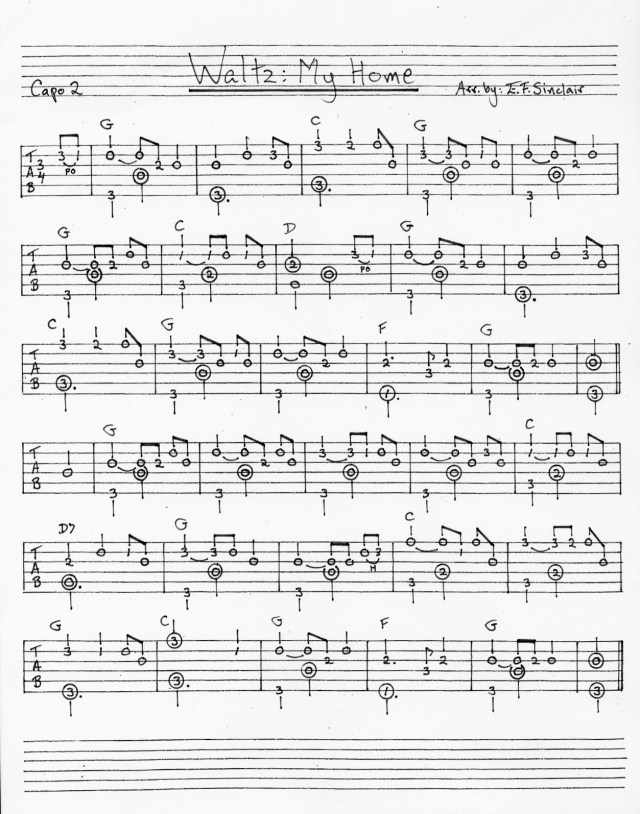
Since one of my guitar-playing followers asked, I decided it was time to transcribe my arrangement of the fiddle tune “Waltz: My Home” that I posted about last month.
Here it is!
To see more Guitar TAB transcriptions, click on Guitar Music in the Categories list!
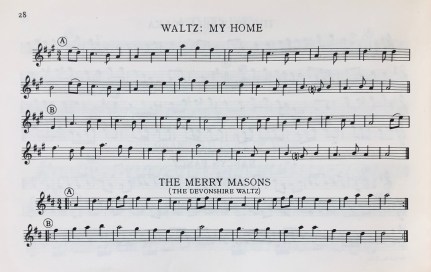
I found it here: The Second Fiddler’s Tune-Book – 100 More Traditional Airs. This small gold mine of music was edited by Peter Kennedy and published in 1954 by Hargail Music Press and The English Folk Dance And Song Society.
I don’t recall when I purchased my copy, but – according to the markings on the title page – I did so for $3.50 at The Music Emporium in Cambridge, Massachusetts.
“Waltz: My Home” appears among the hornpipes, reels, schottisches and polkas on the first page of the section titled: “Waltzes & Jigs.”
In arranging this lovely tune for the guitar, I found that the notes fit my fingers better in the Key of G than the published Key of A. Putting a capo at the second fret, of course, returns the lower pitches to the “proper” key.
Give a listen.
For all the times I’ve played “Waltz: My Home,” it never fails to bring me comfort, peacefulness and joy.
Just like being home.
P.S.: It was the marvelous recordings of Doc Watson and Eric Schoenberg that introduced me to the wonders and fun of playing fiddle tunes on the guitar.
P.S.S.: That recording came from a Sony Metal-SR cassette tape dated 8/28/02. “Waltz: My Home” is the third track among nine instrumentals that I recorded that day. (A most successful recording session, if I do say so myself!)
Today – April 18, 2020 – is the 10th anniversary of the day that I, with the able assistance of my always amazing daughter, launched this blog.
Today is also the 22nd day here in New Hampshire of living under the stay-at-home order issued by our governor in response to the spread of the novel coronavirus.
Finally, when I first looked out my window today, it was snowing.
April 18, 2020, the 31st day of Spring.
So… given the present situation this little bit of celebration called for something unique.
How about a 10-string guitar?
Yes, there really is such an instrument, and I’ve found a remarkable musician to play one for us.
Marina Krupkina is a performer, composer, arranger and recording artist from Smolensk, Russia.
As a classical guitarist, Marina studied at the Smolensk Regional Music College and the Moscow State Classical Academy.
In 2012 & 2013, she was a prize-winner at a number of international classical guitar competitions in Moscow and St. Petersburg.
Marina made her debut on 10-string guitar in 2015. She released But Does It Djent?, her first album of music for the 10-string guitar in 2018. Her second album, Decacorde Stories, came out in 2020.
“Ouroboros” is a piece composed by Marina Krupkina and included on But Does It Djent? This mesmerizing live performance video is from July, 2019.
Go ahead. Take a few minutes and watch/listen to this. You’ll be very glad you did!
Here’s to the decade past and whatever lies ahead.
Now and always, “Good music doesn’t get old.”
JTLYK: “Djent” is the name given to a subgenre of the style of rock music known as progressive metal.