On March 1, 1938, singer/guitarist Big Bill Broonzy and singer/pianist Curtis Jones entered the NBC studios in Chicago, Illinois.
Big Bill Broonzy (1903-1958) was a popular Chicago-based Blues musician and prolific recording artist who’d cut his first record in November, 1927.
Curtis Jones (1906-1971) had started his recording career in Chicago in September, 1937 and was best known for his song “Lonesome Bedroom Blues.”
On this day – according to the invaluable reference book Blues & Gospel Records 1890-1943 (4th edition) by Dixon, Godrich & Rye – each of these artists recorded the same two songs in their respective sessions: “Sweetheart Land” and “It’s A Low Down Dirty Shame.”
The common denominator of these recordings was the 16-year-old NBC session guitarist who played on all four tracks: George Barnes.
The significance of these recordings is that George Barnes (1921-1977) played an electric guitar and this would be the first time an electric guitar was used on a Blues recording.
Mr Broonzy went first, laying down a lively rendition of “Sweetheart Land.”
Mr. Barnes’ solo starts at the 1:51 mark.
When it was Mr. Jones’ turn, he started off with “It’s A Low Down Dirty Shame.”
Mr. Barnes takes the opening solo and solos again at the 2:22 mark.
Both of those recordings were released in 1938.
Curtis Jones’ version of “It’s A Low Down Dirty Shame” (b/w “Little Jivin’ Woman”) was released on Vocalion Records, #04027.
George Barnes was credited on that record under the name Hobson “Hot Box” Johnson.
Big Bill Broonzy’s performance of “Sweetheart Land” (b/w “I Want You By My Side”) was released in 1938 on Vocalion Records, #04041.
Mr. Broonzy’s recording of “It’s A Low Down Dirty Shame” was not released until 1990. (Didn’t they know it was one of the first Blues records to feature an electric guitar?!)
For some unknown reason, Mr. Jones’ recording of “Sweetheart Land” has never been released.
“When someone asks me what kind of guitar to buy, I say one that makes you want to pick it up. That you’ll leave lying across the bed, on a chair, within easy reach. The one you’ll keep playing.”
That quote is from guitarist, composer, record producer and music journalist, Lenny Kaye.
It is taken from the foreward that Mr. Kaye wrote to Dangerous Curves: The Art of the Guitar by Darcy Kuronen and published in 2000 by MFA Publications, Boston, Massachusetts.
I rediscovered Mr. Kaye’s advice while doing some research for my last post, Three More Guitars.
He goes on to say…
“A decade or two down the line, the guitar that you bought new in a music store hanging on a rack with a dozen others will have opened up its resonance, stretched its wood in appreciation of the music that has been made, and accommodated all willing hands, or just yours alone.”
…and concludes:
“An instrument requires respect, give and take. You should get to know each other.”
Three Guitars was the title of the piece I posted back on August 13, 2019.
It featured three very cool instruments from Medieval to Metal: The Art and Evolution of theGuitar; an exhibit I saw at the Currier Museum of Art in Manchester, New Hampshire earlier that summer.
Three More Guitars highlights a trio of dazzling electrics that were part of Play It Loud: Instruments of Rock &Roll. That incredible exhibit ran from April 8 through October 1, 2019, at the Metropolitan Museum of Art in New York City.
(The Play It Loud: Instruments of Rock & Roll exhibit is on view now through September 13, 2020 at the Rock and Roll Hall of Fame in Cleveland, Ohio.)
I chose these instruments because of the new meaning they give the term: “The Art of the Guitar.”
More like “The Art On the Guitar.”
Take a look. (And let me know which one is your favorite!)
The first beauty is a 1957 Gibson Les Paul Custom.
This instrument belongs to Keith Richards of the Rolling Stones. He painted the guitar himself – using “very early acrylic pens” – sometime in 1968. When trying to recall if his art had been inspired by what he was playing or a song he was writing, he finally admitted, “No, this is definitely acid, man. It’s a great inspiration.”
Keith performed with this guitar during the December 11, 1968 concert known as The Rolling Stones Rock and Roll Circus.
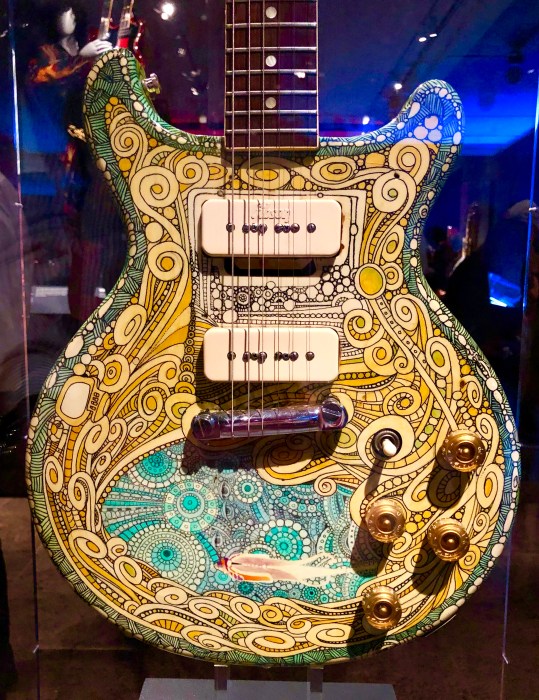
Guitar #2 is a 1961 Gibson Les Paul TV Special.
This double-cutaway electric belongs to Steve Miller. It was given to him by Leslie West of the band Mountain (Remember “Mississippi Queen?”) in about 1967-68. Miller used it extensively throughout the 1970’s and had it painted by Bob Cantrell, a surfboard artist, in 1973.
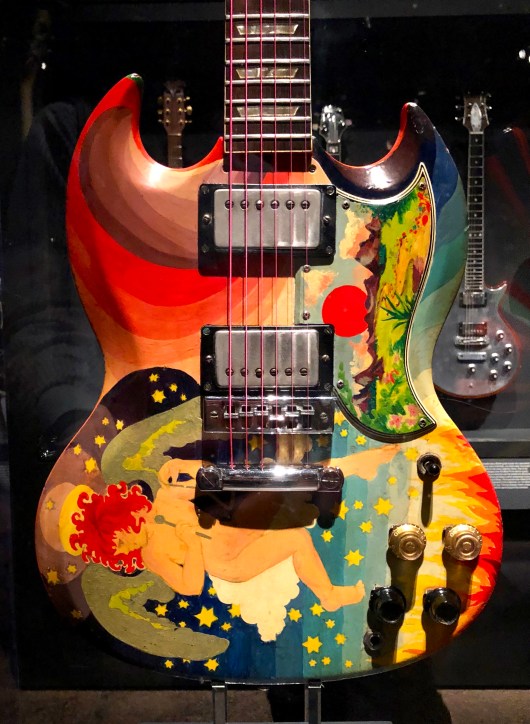
Finally, I give you “The Fool.”
That is a 1964 Gibson SG. It has belonged, in turn, to George Harrison, Eric Clapton and Todd Rundgren. The instrument is now part of the collection of Perry A. Margouleff.
Eric Clapton was a member of the band Cream when he owned it. He used it frequently in concert as well as on the trio’s albums Disraeli Gears (1967), Wheels of Fire (1968) and Goodbye (1969).
The decidedly psychedelic designs were created and applied to the SG‘s mahogany body using “oil-based enamel paint” by Marijke Koger and Simon Posthuma in London in 1967.
The World of Guitar is definitely a wild and wonderful place.
The information used in the writing of this post came from the Play It Loud: Instruments of Rock & Roll exhibition catalogue by Jayson Kerr Downey and Craig J. Inciardi. It was published in 2019 by The Metropolitan Museum of Art, New York.
Over the past ten years – along with cards and presents, video chats and phone calls – your birthday has been celebrated and commemorated twice here on sixstr stories.
Each time included a song: “Birthday” by The Beatles in 2014 and “My Daughter’s Eyes” (a song of mine) in 2012.
This year it seemed like it was about time to “present” you with the instrumental that I wrote almost half of your lifetime ago and titled in honor of the day of your birth.
In February of 1970, I was a high school student, a drummer and a passionate Led Zeppelin fan. (Led Zeppelin II had come out in October 1969!!)
Come the Fall, I was in my senior year, teaching myself how to play the acoustic guitar and listening intently to James Taylor.
“Fire And Rain” – the first single from Sweet Baby James, Taylor’s second album – was all over the radio, inching towards its October 31st peak of #3 on the Billboard Hot 100.
The Sweet Baby James LP made it onto my Magnavox stereo around that time and soon became #1 on my listening chart.
The gorgeously intricate finger-style guitar playing that percolated across every track of Taylor’s album was hugely influential to me at a crucial time in my development as a guitarist.
“Sunny Skies” – Side 1, Track 3 – was the first song from Sweet Baby James that I somehow successfully learned how to play and sing. It still brings great joy.
Give a listen.
Bass guitarist John London, drummer Russ Kunkel and vocalist Carole King accompany James Taylor’s vocals and acoustic guitar on that recording.
Sweet Baby James also re-introduced me to the music of Stephen Foster, thanks to Taylor’s wonderful cover of “Oh Susannah” that closes out Side 1.
Check out the fabulous double-tracked fingerpicked acoustic guitar intro & coda!
James Taylor recorded Sweet Baby James at Sunset Sound in Los Angeles, California over the course of ten days in December 1969. Peter Asher was the producer.
The record received a nomination for Album of the Year at the Grammy Awards in 1971. (Bridge Over Troubled Water by Simon & Garfunkel was the winner.)
William Ruhlmann wrote in the All Music Guide to Rock: “Sweet Baby James… launched not only Taylor’s career as a Pop superstar but also the entire singer/songwriter movement of the early 70’s.”
Sweet Baby James was released by Warner Brothers Records 50 years ago today, on February 1, 1970.
Ballad: “A poem or song narrating a story in short stanzas, or verses.”
Verse 1
I’m just a poor wayfaring stranger, a traveling through this world of woe
But there’s no sickness toil or danger in that bright land to which I go.
I’m going there to see my father, I’m going there no more to roam
I’m just a going over Jordan, I’m just a going over home.
The melody those lyrics are set to is one of my favorites.
It is one of the pieces I play pretty much every time I pick up my guitar.
It is what I play when I’m trying out a new guitar; my test to determine the true quality of an instrument’s voice.
It goes like this.
Verse 2
Sheet music for “Wayfaring Stranger” first made its way onto my music stand decades ago in a songbook called Jerry Silverman’s Folk Song Encyclopedia, Volume 2.
Published by Chappell Music Company in 1975, this large thick paperback does indeed contain “Over 1,000 Favorite Songs Arranged For Voice And Guitar.”
“Wayfaring Stranger” resides in the Gospel section, sharing pages 76 & 77 with two other classics.
Verse 3
In 1941, the father & son song-collecting team of John and Alan Lomax published their third book of songs. Our Singing Country: A Second Volume of American Ballads and Folk Songs contained 205 songs. All but 13 of these were chosen from the thousands of field recordings made by the Lomaxes in the 1930’s and held in the Archive of American Folk Song at the Library of Congress.
The transcriptions of the songs in Our Singing Country were painstakingly and lovingly made from those recordings over the course of four years by the composer Ruth Crawford Seeger.
My copy of Our Singing Country is an “unabridged republication” released by Dover Publications in 2000. “Wayfaring Stranger” is on page 37 under the main title of “Over Jordan.”
I learned about Our Singing Country from reading Ted Anthony’s brilliant 2007 book Chasing The Rising Sun – his “biography” of the folk song “House of the Rising Sun.”
Verse 4
After playing and singing and teaching “Wayfaring Stranger” for so many years, the time came to find out from whence it came. So, in March of 2018, I paid a visit to the American Folklife Center at The Library of Congress in Washington, D.C.
In the Folklife Center Reading Room, I was most fortunate to gain the knowledgeable and patient assistance of Mr. Todd Harvey, Collections Specialist in Reference at the AFC and Curator of the Alan Lomax Collection.
Thanks to Mr. Harvey, I was able to listen to several field recordings of “Wayfaring Stranger.” Among them was the November 22, 1936 solo vocal performance by L.L. McDowell – collected by Sidney Robertson & Charles Seeger – that was the source for the Our Singing Country transcription.
I was also able to look through a collection of documents that Mr. Harvey presented to me in a plain manila folder simply marked “Poor Wayfaring Stranger.”
Among these papers was a copy of an article titled “Poor Wayfaring Stranger – Early Publications” by John F. Garst. This article had originally appeared in the April 1980 edition of The Hymn – a publication of the Hymn Society of America, based at Wittenberg University, Springfield, Ohio. (Mr Garst’s day job in 1980 was as a Professor of Chemistry at The University of Georgia.)
This article answered all of my questions about “Wayfaring Stranger.”
Verse 5
Mr. Garst states that during his research on “Poor Wayfaring Stranger,” he “examined several hundred, perhaps a thousand, hymn and hymn-and-tune books of the 18th-20th centuries.”
The earliest publication that Mr. Garst found of the text of the song was under the title of “Going Over Jordan” in a 1858 book by Joseph Bever called The Christian Songster.
Mr. Bever presents Verse 1 of “Going Over Jordan” as…
I am a pilgrim and a stranger, while wandering through this world of woe;
But there’s no sickness, death nor sorrow, in that bright land to which I go.
…and these lines as the Chorus:
I’m going there to see my father, I’m going there to see my Lord;
I’m just a going over Jordan, I’m just a going over home.
Verse 6
The earliest publication of the words and music together were located by Mr. Garst in a hymnal called The Revival by Charlie D. Tillman, published in 1891.
The Reverend J.L. Tillman was Charlie’s father. Evidently, the elder Tillman sang “A Poor Wayfaring Stranger” in the key of E-flat major.
Here’s the tune to Rev. Tillman’s rendition.
Verse 7
Mr. Garst’s article also contained a reproduction of the first publication of “A Poor Wayfaring Stranger” with its melody as we now know and love it best: built (mostly) from the notes of a pentatonic minor scale.
This transcription was from Times of Refreshing, an 1893 hymnal compiled by W.T. Dale. Mr. Dale credits himself with this arrangement of “A Poor Wayfaring Stranger.”
This is what the melody of Mr. Dale’s E minor setting sounds like. (It’s my guess that the flat next to the eighth note D in the first measure of the last staff is a typo, but I played it anyway.)
Verse 8
Also tucked in that plain manila folder was a thin yellowed paper pamphlet containing the music for “Wayfaring Stranger” written out in something called “the four-shape notation.”
This paper was a “song sheet” – number 9 of a series of American songs – issued by the Special Skills Division of the Resettlement Administration circa 1938. The song sheets were the idea of musicologist Charles Seeger as a way to help resettled families carry their musical tradition with them.
Verse 9
The first commercial recording of “Wayfaring Stranger” was done by Vaughan’s Texas Quartet. This male quartet with piano accompaniment was recorded in Dallas, Texas by Victor Records on October 9, 1929. The Quartet called their song “The Wayfaring Pilgrim.” Their melody and lyrics are similar to those in the Dale transcription.
The most recent recording of “Wayfaring Stranger” that I have heard was released in May, 2019. It features the always wonderful Rhiannon Giddens on vocals and banjo with Francesco Turrisi on accordion.
If you’ve listened to nothing else in this post, please listen to this. You’ll be glad you did.
Every December since 2011 I’ve put together a personal “Best of…” playlist that I call Discoveries & Resurrections.
The list draws from all of the music I’ve read about, written about, discovered, listened to, heard in concert, performed, taught and – if my Muse has been generous – created over the course of the year about-to-be gone by.
Usually, I get this done in time to burn the playlist to CD and include a copy among the Christmas gifts to each of my children.
However, the 2019 collection was not compiled until December 31st. Better late than not at all!
I like these playlists – as I like my set lists – to begin with an acoustic guitar instrumental.
“Are You Awake?” (Thank you, Muse) kicks off this year’s collection.
[The Best of 2014 started with “Sixstr (The sixstr stories Theme)” and “Before Breakfast” took the lead in 2016.]
“Are You Awake?” got its title from the fact that the opening phrase of the melody did indeed wake me up one morning this past November. Fortunately, I had a bit of time to not only find those notes on my guitar but also capture them in a voice memo recording on my phone. (Ah, the wonders of modern technology!)
Several days and many stolen moments later, my new piece was finished, mastered, properly recorded and transcribed.
So, ladies and gentlemen, for your listening pleasure, I give you “Are You Awake?”
I hope that helps to get your new musical year off to a good start.
My Sparklers category is supposed to feature: “Recordings of outstanding performances by noteworthy guitarists – or outstanding guitarists giving noteworthy performances.”
Oh, well! Not today.
Dave McKenna’s Christmas Ivory is very high on my list of all-time-favorite Christmas music albums.
This 16-track collection of unquestionably outstanding and noteworthy solo piano performances was recorded on February 18 & 19, 1997 at the Sound On Sound studio in New York, New York, and released later that year by Concord Jazz.
“Santa Claus Is Coming To Town” – written in 1934 by J. Fred Coots & Haven Gillespie – is the opening cut on this effervescent and infectiously joyous recording.
As is written on the back cover of the CD: “There is still no finer vehicle for beautiful music than an exceptional talent playing the sounds of the most wonderful time of the year.”
Sit back and listen for yourself.
Dave McKenna was a New England-based Jazz pianist. He was most highly regarded for his solo work in what came to be known as his “three-handed” swing style of playing.
Born May 30, 1930, in Woonsocket, Rhode Island, Dave joined the Musicians’ Union at the age of 15. His discography lists over 50 albums starting in 1955 with Solo Piano on Paramount Records and (nearly) concluding with the 2002 Arbors Records release, An Intimate Evening with Dave McKenna. Dave passed away on October 18, 2008.
Concord Jazz re-released Christmas Ivory in 2000 as the unfortunately titled Christmas Cocktail Party: Holiday Piano Spiked With Swing. Either way, it is well worth seeking out and highly recommended as an addition to your Christmas music collection/playlist.
Happy Holidays to you and yours from all of us here at sixstrstories.
May your days be merry, bright and, of course, filled with music.
One day a couple of months ago, quite out of the blue, I started singing part of an old song of mine called “Pavement Ends.”
I located the complete lyrics of the song, undated, on page 170 in Volume 2 of my songwriting journals.
The first draft of the lyrics to “Pavement Ends” appeared on pages 5-7 in the same volume, sitting between one entry dated 9/7/93 and another marked 11/15/93.
Playing the song, however, proved to be a problem.
I (eventually) found my homemade demo recording of the song on the B-side of a 90-minute cassette tape labelled Recent Originals 1994. It was hiding in a very full storage box of cassettes marked “Work Tapes.”
Finally, after going through the odd process of listening to that recording and teaching myself the chords and fingerpicking to a song that I wrote, I’ve been playing and singing “Pavement Ends” quite a bit lately.
This past week, I had the good fortune to be invited to perform at a local art gallery. The “evening session” had been described as “an informal trade-off of talent” done in “round robin” or “songwriter circle” style. The folks who joined the circle that night included another singer/songwriter/guitarist, a trio of Celtic musicians, a poet, a short-story writer and a Jazz vibraphonist.
“Pavement Ends” was my first contribution.
A young man from the audience came up to me after and asked if the song was on my website. “It is not,” I answered.
Now it is.
I hope you enjoy it.
“Pavement Ends” – words & music, guitar & vocals by Eric Sinclair.
I first learned about Merle Travis in the September 1976 issue of Guitar Player magazine.
GP editor Jim Crockett began his introduction to Bob Baxter’s cover-story article/interview with Mr. Travis with this statement: “Countless guitarists, particularly in the country music field, owe a good deal of their picking to the finger style licks of Merle Travis.” Merle’s style of playing was so influential that, according to Mr. Crockett, it had actually been given a name: “Travis Picking.”
“Hmm,” I thought. “I’d like to hear some of this music.”
Fortunately, the article concluded with a “Selected Travis Discography.” The first disc listed was a 1956 solo album on Capitol Records simply titled The Merle Travis Guitar.
“That’s the one for me!”
Unfortunately, as Mr. Crockett also stated in his 1976 introduction, Mr. Travis’ older recordings were “all but extinct today.”
So, the quest to find a copy of The Merle Travis Guitar took many years.
But finally, I got lucky.
While browsing in a local record store, I chanced upon a copy of the album as reissued by the Stetson Records label from England.
There were 12 tracks on The Merle Travis Guitar and Side 1 began with “Blue Smoke” – the very same piece that Bob Baxter had included a transcription of in his 1976 Guitar Player article.
The album’s uncredited liner notes offered the listener the following preparation: “When Merle plays, every phrase is fluent, every note is clean. Merle does not use his impressive technique merely for show, but always as a tool that helps to make his music as meaningful and clear as possible.”
I completely agree, but you should listen for yourself.
Merle Robert Travis was born on November 29, 1917 in the Muhlenberg County, Kentucky town of Rosewood. He passed away on October 20, 1983.
Over the course of his 46-year career, Merle Travis was a very popular performer in radio programs, stage shows, Hollywood feature films, television shows and in concerts. He recorded over a dozen LP’s (two of which earned 5-star ratings from Rolling Stone magazine) and a string of Hot Country chart-topping hit singles. His 1974 album The Atkins-Travis Traveling Show – with fellow guitarist Chet Atkins – received the Grammy Award for Best Country Instrumental Performance.
In 1970, Merle was inducted into the Nashville Songwriters Hall of Fame and the Country Music Hall of Fame in 1977.
Finally, Merle Travis is widely acknowledged as one of the most influential American guitarists of the 20th Century.