…I’ve become a grandfather.
“Oh, Boy!”
(“Oh, Boy!” was composed and performed by yours truly, with all due respect to Buddy Holly and Big Bill Broonzy.)
Happy Birthday, Grandson.
…I’ve become a grandfather.
“Oh, Boy!”
(“Oh, Boy!” was composed and performed by yours truly, with all due respect to Buddy Holly and Big Bill Broonzy.)
Happy Birthday, Grandson.
“Really?!”
I couldn’t believe it when I first heard the news.
Rhiannon Giddens was going to start her Spring 2016 US Tour here in southeast New Hampshire. The singer, fiddler, banjo player and songwriter was scheduled to perform on Tuesday, April 5 at Phillips Exeter Academy, in near-by Exeter.
I immediately wrote the event on my calendar. Having twice seen Rhiannon Giddens perform with her other band, the Grammy-winning Carolina Chocolate Drops, this was a show I didn’t want to miss. As the date got closer, I started heartily recommending the concert to my students.
The supremely-talented Rhiannon Giddens was backed that chilly April evening by a superb band – Hubby Jenkins on guitar, banjo & mandolin; Rowan Corbett on guitar & bones; Jason Sypher on acoustic bass; the astonishing Jamie Dick on drums & percussion; and a cellist who was doing his first show with the group (and who’s name, unfortunately, has escaped both me and the internet). The six musicians filled the hallowed hall and transported the audience with their relentless energy, astounding skills and dazzling versatility.
The set list for the show featured material from Rhiannon’s excellent first solo album, Tomorrow Is My Turn (released in February, 2015) and Factory Girl, a five-song EP released in November, 2015. Among the evening’s many highlights were outstanding renditions of songs from Odetta, Dolly Parton, Sister Rosetta Tharpe and Patsy Cline.
For me, the most memorable performance from the show was Rhiannon’s stunning turn on “Factory Girl,” a traditional Irish song to which she had added additional lyrics.
Rhiannon’s cover of the Patsy Cline song, “She’s Got You,” was a big favorite among my students. Since April, I have helped three of them each learn how to play and sing a solo, acoustic guitar & vocals arrangement of the song.
For the version of “She’s Got You” that appears on Tomorrow Is My Turn, Rhiannon states in the liner notes from the CD that she and Hubby Jenkins “recast (the song) in a sort of old-timey R&B vibe.”
Check it out for yourself!
Rhiannon Giddens is accompanied on that track by: Jay Bellerose, drums; Dennis Crouch, acoustic bass; Colin Linden & T-Bone Burnett, guitars; Keefus Ciancia, keyboards; Gabe Witcher, fiddle; Jack Ashford, tambourine; Darrell Leonard & Lester Lovitt, trumpets; Tom Peterson, Joe Sublet & Jim Thompson, saxophones; and Jean Witherspoon & Tata Vega, background vocals.
“She’s Got You” was written in 1961 by the Nashville, Tennessee-based songwriter, Hank Cochran.
Hank presented the song to Country singer Patsy Cline, claiming that it would be her next #1 hit. (Hank Cochran & Harlan Howard had written Ms. Cline’s first #1 hit, “I Fall To Pieces.”) Patsy immediately loved the song and recorded it on December 17, 1961 in Nashville, TN.
“She’s Got You” (b/w “Strange”) was released as a single on January 10, 1962. Before long, it did indeed reach the #1 spot on Billboard’s Hot C&W Sides Country records chart.
Here is that recording!
Patsy Cline included “She’s Got You” on her August, 1962 LP, Sentimentally Yours.
Patsy Cline was born Virginia Patterson Hensley on September 8, 1932 in Gore, Virginia. She passed away on March 5, 1963.
Hank Cochran was born Garland Perry Cochran on August 2, 1935 in Isola, Mississippi. He passed away on July 15, 2010.
Rhiannon Giddens was born on February 21, 1977 in Greensboro, North Carolina.
In case you were wondering, Patsy Cline sang the song in the Key of F. Rhiannon Giddens set the song higher, in the Key of Ab. Each of my three students preferred going vocally lower to the Key of D while fingering the guitar chords in the Key of G with their instrument capoed up at the seventh fret.
In case you were wondering…
sixstr stories turns six years old today!
Two “six” songs came immediately to mind as I began planning for this birthday party post: “Six Days On The Road” and “Route 66.”
“Six Days On The Road” was written by Alabama songwriters Earl Greene and Carl Montgomery. It was first recorded in 1963 by Country musician Dave Dudley and is today considered to be the definitive truck driving song.
My favorite version of “Six Days On The Road” is by singer, songwriter & acoustic guitarist Livingston Taylor. Recorded at Capricorn Sound Studios in Macon, Georgia, it was released as the third track on the first side of Livingston’s 1970 self-titled debut album.
Joining Livingston on this track are Pete Carr, electric guitar; Paul Hornsby, piano; Robert Popwell, bass guitar; and Johnny Sandlin, drums.
Let’s get this party started!
“Route 66” was originally titled “(Get Your Kicks On) Route 66.” It was written by American R&B songwriter Bobby Troup and first recorded by the King Cole Trio in 1946.
The Rolling Stones learned “Route 66” from recordings by Chuck Berry and Perry Como. They liked their version so much, they featured it as the first song on the first side of their British self-titled debut LP in 1964. The song was a staple of The Stones’ live shows during those early days and a scorching rendition was captured on tape during their March 1965 British tour. That track was released on The Rolling Stones’ first and chart-topping British EP, “got LIVE if you want it!,” in June, 1965.
Give it a listen!
That was Mick Jagger, vocals; Brian Jones, electric guitar; Keith Richard, electric guitar; Bill Wyman, bass guitar; and Charlie Watts, drums.
So, there you go. sixstr stories is six years, 319 posts and over 25,000 views old today.
To each and every one of you who visit, read, follow, listen to, like and comment on my random musings and enthusiasms here at sixstr stories, please accept my heartfelt thanks and know that I am sincerely grateful for your past, present and future support.
As always, “Good music doesn’t get old.”
Yes, it really is!
To join in on the celebration, I am re-posting a piece I first published on April 16, 2011. Included this time are Richard Berry & The Pharaohs’ original recording of the song and the famous cover version by The Kingsmen!
Here you go!
He could hear the band through the walls of the dressing room.
It was summer, 1955. Richard Berry was the featured singer that night at the Harmony Park Ballroom in Anaheim, California. The band was Ricky Rillera and The Rhythm Rockers, led by brothers Bobby and Barry Rillera. As the band played the first set on their own, warming up the crowd, Richard relaxed and waited backstage.
The incessant rhythm of one number, however, really caught Richard’s attention: duh duh duh.. duh duh, duh duh duh.. duh duh. It stuck in his head and gave the songwriter in him an idea. Richard picked up the handiest piece of paper, a crumpled bag, and jotted down a few lines of a lyric.
Later, he asked the Rillera brothers what the song was with that great rhythm. “That was ‘El Loco Cha Cha’ by Rene Touzet.”
Richard Berry (born April 11, 1935 in Extension, LA) was an accomplished R&B singer with a strong and versatile voice. He was capable of doing a frantic, Little Richard-style lead, switch to a deep, Muddy Waters-style Blues growl and then turn in a smooth and soulful performance on a slow ballad. He’d had hit records as a member of The Flairs, with The Robins on their classic “Riot In Cell Block #9,” and with Etta James on her hit “The Wallflower.”
As a songwriter, Richard knew how to follow a moment of inspiration and how to remain open to influence by other songwriters. “El Loco Cha Cha” had provided the riff, the basic rhythm, to build his new song on. “Havana Moon” – the Chuck Berry song that served as the B-side to Chuck’s 1956 single “You Can’t Catch Me” – and the Johnny Mercer/Harold Arlen 1940’s-era standard “One For My Baby (and One More for the Road)” eventually served as melodic and lyrical inspiration.
When the new song was done, Richard took it to a recording session with his regular band, The Pharaohs. In April of 1956, at Hollywood Recorders on Santa Monica Boulevard in Los Angeles, CA, Richard Berry and The Pharoahs recorded four songs: “You Are My Sunshine,” “Somewhere There’s A Rainbow,” “Sweet Sugar You” and the new one: “Louie Louie.”
In April of 1957, “Louie Louie” was released on a Flip Records single as the B-side to “You Are My Sunshine.” When “Louie Louie” started getting more attention and airplay, it was re-released as the A-side of a single with “Rock Rock Rock” on the back.
In April of 1963, two popular Northwest Rock & Roll bands: Paul Revere & The Raiders and The Kingsmen, went into the studios of Northwest Recorders in Portland, OR and each recorded their version of “Louie Louie.”
In late 1963/early 1964, “Louie Louie” b/w “Haunted Castle” by The Kingsmen had reached #1 on the Cashbox chart and held the #2 spot on the Billboard Hot 100 chart for six weeks in a row.
Dave Marsh, author of Louie Louie: The History & Mythology of the World’s Most Famous Rock ‘n’ Roll Song; Including the Full Details of Its Torture & Persecution at the Hands of the Kingsmen, J. Edgar Hoover’s F.B.I., & a Cast of Millions; & Introducing for the First Time Anywhere, the Actual Dirty Lyrics and the liner notes to the CD compilation Love That Louie: The Louie Louie Files, wrote: “‘Louie, Louie’ is either the essence of Rock ‘n’ Roll or definitive proof that no such essence ever could exist – unless it’s both of those at once.”
Information for this post was drawn from the two sources by Dave Marsh as listed above and The All Music Guide to Rock.
Happy International “Louie Louie” Day! Woo hoo, indeed!
I’ve written about days like this before: days that are pinpoints on the timeline of music history, when paths crossed and discoveries were made. Days that changed lives and (ultimately) changed music.
For instance…
August 1, 1927: The day that The Carter Family auditioned for Ralph Peer.
July 16, 1933: The day that John & Alan Lomax were introduced to Huddie Ledbetter.
August 16, 1939: The day that Charlie Christian auditioned for Benny Goodman.
July 6, 1957: The day that John Lennon met Paul McCartney.
This story is about two such days in 1940. The significant event on each of these days was an evening concert. It has been said that the after effects of these two concerts altered the course of American music; giving birth to what is now officially referred to as the “American Folk-music Revival.”
So, the first day…
On Sunday, February 25, 1940, the Mecca Temple (at 56th Street and 6th Avenue) was the setting for a huge benefit concert for Spanish Loyalist Civil War refugees. Well-known folk musicians Huddie “Lead Belly” Ledbetter and Alan Lomax were among the many artists on the diverse roster of performers that evening. Woody Guthrie, the heralded singer/guitarist from Oklahoma, was a last minute addition.
This was Woody Guthrie’s first public performance since arriving in New York City two weeks earlier. Guthrie had been encouraged to come to New York by the actor and activist Will Geer. The two had met and become friends in California the previous July. Geer served as master of ceremonies for the Mecca Temple event and specifically arranged for Woody to have a spot on the program.
Woody Guthrie did not perform until well into the long concert, finally appearing somewhere between a “workers’ chorus singing Russian folk songs and classically trained baritone Mordecai Bauman.” Bauman (Broadway star and Columbia Records recording artist) remembered Guthrie that evening as being “a talent we had never heard in New York. In a minute he had the audience in his hand.”
Alan Lomax later recounted Guthrie’s performance that night at the Mecca Temple in a bit more detail: “He stepped out on the stage, this little tiny guy, big bushy hair, with this great voice and his guitar, and just electrified us all.”
The first song that Woody sang was one of his own: “Pretty Boy Floyd.”
“Well,” Lomax continued, “I realized, listening to this song, that I was meeting a guy who was a ballad maker, in the same sense as the people who made ‘Jesse James’ and ‘Casey Jones.’ I thought they were from anonymous people. Well, here was Mr. Anonymous singing to me.”
Woody closed his short set with a new original song, “Why Do You Stand There In The Rain?” This clever, funny and well-received number was inspired by a New York Post article about a speech recently given by President Franklin Roosevelt to a meeting of the left-leaning American Youth Congress.
Lead Belly (Library of Congress, ARC and Musicraft recording artist and “King of the 12-String Guitar”) followed Guthrie to the stage. “But,” Lomax recalled, “only after a long wait filled with encores and roars of delighted laughter.”
Alan Lomax was more than an observant and well-versed folk singer. He was a renowned musicologist and, at the time, Assistant Director of the Archive of American Folk Music at the Library of Congress in Washington, D.C. Also, Alan Lomax was the writer, director, producer and host of the weekly “American Folk Songs” series for the New York-based CBS radio show American School of the Air.
Backstage at the Mecca, Lomax excitedly approached Woody, inviting him to come to Washington, D.C., visit the Library of Congress and to sing on his radio show. Guthrie was put off by Lomax’s fast talk and big city hustle and managed to side step his offers. He did, however, get Alan to introduce him to Lead Belly.
Then, the second day…
On Sunday, March 3, 1940, the Forrest Theater (230 W. 49th Street) was the setting for “A ‘Grapes of Wrath’ Evening” presented by “The Theatre Arts Committee and Will Geer of the Tobacco Road Company.” The 8:30 pm show was “For the Benefit of the John Steinbeck Committee for Agricultural Workers.” Ticket prices ranged from $.55 to $1.65.
The featured cast was announced as “American Ballad Singers and Folk Dancers: Will Geer, Alan Lomax, Aunt Molly Jackson, Lead Belly, Woody Guthrie, Pennsylvania Miners, Margo Mayo, Golden Gate Quartet and many others.” The “many others” included Bess Lomax, performing with her brother, Alan, and singer/banjo-player Pete Seeger making his public debut.
The show opened with Aunt Molly Jackson, a folk singer and United Mine Workers activist from Kentucky. Woody Guthrie, “a real dust bowl refugee,” followed.
Seeger recalled the evening for Mainstream magazine in 1963.
“Will Geer was MC of the show. Burl Ives was on it and also Lead Belly and Josh White. And there was Woody. A little, short fellow with a western hat and boots, in blue jeans and needing a shave, spinning out stories and singing songs that he had made up himself. His manner was laconic, offhand, as though he didn’t much care if the audience was listening or not.”
Guthrie sang three original songs that night at the Forrest: “Talking New York Subway Blues,” “Do Re Mi” and “Why Do You Stand There In The Rain?.” He interlaced his songs with observations and stories from his time in New York: “You know, they could have more people on these subway trains if they’d lay ’em down: when you got to your station, they could shoot you home like a torpedo… Trains were so crowded today, you couldn’t even fall down. I had to change stations twice, and both time I came out with a different pair of shoes on…”
The way Pete saw it, “Woody was the star of the show. He’d tell a joke and sing a song, and then he’d tell another joke. He must’ve been on stage for twenty minutes, more than any other member of the cast.”
As for his own performance, Seeger recounted in 1999: “I was allowed to sing one song on the program because my friend folklorist Alan Lomax insisted on it. I remember walking out to the front of the stage and singing, very amateurishly, the outlaw ballad ‘John Hardy.’ I got a smattering of polite applause.”
Woody Guthrie himself summed up the evening’s success: “We showed ’em where singing started. We showed ’em how songs come to be… We didn’t have no fancy costumes, nor pretty legs, but we showed ’em old ragged overalls, and cheaper cotton dresses… shows [folk music] can be useful.”
After the “Grapes of Wrath” show, Alan Lomax talked with Woody Guthrie again. He again invited Guthrie to visit Washington, D.C., to record his songs and stories for the Library of Congress and to be a guest on American School of the Air. This time, Woody accepted Alan’s invitations.
Finally, before their conversation was over, Alan Lomax pulled the evening’s rookie performer forward and said, “Here. Woody Guthrie, I want you to meet Pete Seeger.”
At the time of those concerts, Pete Seeger was 20 years old; Alan Lomax was 25; Woody Guthrie was 27; and Huddie Ledbetter was 51.
The work that those four men went on to do in the months and years after those two days in New York – along with the efforts of a roster of musicians that included Josh White, Burl Ives, Big Bill Broonzy, Jean Ritchie, Oscar Brand and Cisco Houston – resulted in a phenomenal rise of national interest in Folk music that stretched into the 1960’s.
The vast collection of recordings and writings that Pete Seeger, Woody Guthrie, Alan Lomax and Huddie Ledbetter produced in their lifetimes will continue to enlighten, inspire and delight musicians and music lovers around the world for many decades to come.
The information and quotes used in the writing of this post were gathered from many sources including:
This Land Is Your Land: Woody Guthrie and the Journey of An American Folk Song (2012) by Robert Santelli
Woody Guthrie: A Life (1980) by Joe Klein
Woody Guthrie: American Radical Patriot (2013) by Bill Nowlin
How Can I Keep From Singing: Pete Seeger (1981) by David Dunaway
Pete Seeger in His Own Words (2012) Selected & Edited by Rob & Sam Rosenthal
The Life & Legend of Leadbelly (1992) by Charles Wolfe & Kip Lornell
Alan Lomax: The Man Who Recorded The World (2010) by John Szwed
Alan Lomax’s liner notes to the 3 CD set: Woody Guthrie: Library of Congress Recordings (1988) Rounder Records
Wikipedia
November 8, 2014 was a Saturday.
Waking up with a tune in my head on a morning when I could actually take the time to sit with my guitar and get notes down on paper was a gift.
Three days and dozens of stolen moments later, the bulk of “Before Breakfast” was done.
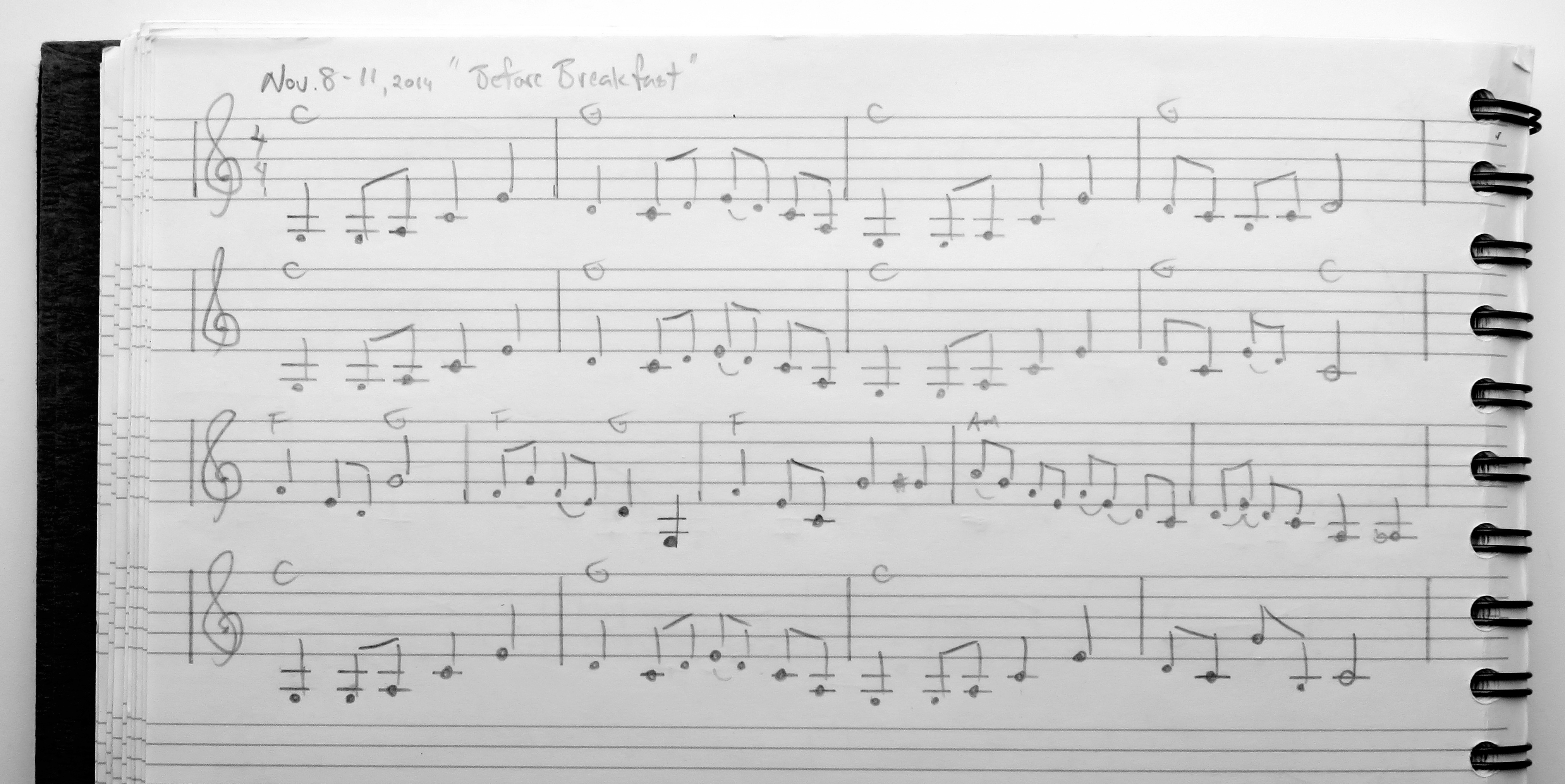
“Before Breakfast” dominated my repertoire for many months. However, it wasn’t until I added an intro/outro lick sometime last Summer that my compositon finally felt complete.
A couple of other pieces – fingerpicked arrangements of “Ain’t Misbehavin'” and “All My Loving” – eventually bumped “Before Breakfast” from my playlist. But this past Sunday – March 6, 2016 – I decided it was time to capture my “latest” original acoustic guitar instrumental in zeros and ones.
So, I did… and here it is!
“Before Breakfast” – composed and performed by Eric Sinclair.
“And now, ladies and gentlemen, here’s a classic track from Count Basie & His Orchestra guar-an-teeeed to add more than a little lift to your Leap Day festivities: ‘Jumpin’ At The Woodside!'”
“Jumpin’ At The Woodside” was recorded in New York City on August 22, 1938 and released on Decca Records.
Featuring William “Count” Basie on piano, the members of His Orchestra on this recording are: Buck Clayton, Harry Edison & Ed Lewis, trumpet; Dan Minor, Benny Morton & Dicky Wells, trombone; Earl Warren, alto saxophone; Herschel Evans & Lester Young, tenor saxophone & clarinet; Jack Washington, baritone saxophone & alto saxophone; Freddie Green, guitar; Walter Page, bass; Jo Jones, drums.
“Jumpin’ At The Woodside” was created – not composed – using a collaborative process frequently employed by Basie and his band that might have gone something like this:
In the midst of a full-band rehearsal, pianist Basie presents a simple, four note riff played over an 8-bar chord progression. The saxophone players learn and harmonize the riff and the trumpet players come up with a response riff. The members of the rhythm section settle on their various accompaniment parts. That becomes the pieces “A section.”
Basie then puts forth a complimentary “B section” chord progression and solos are assigned to individual players over one or the other – or both – of the sections. Back up riffs are worked out to run behind the solos and the tenor sax players decide when to switch off to their clarinets. Basie proposes an introduction using a driving, boogie-woogie-style piano bass line and, after multiple starts and stops, everyone helps establish the overall sequence of events of the final arrangement.
A piece of music created in this way was known as a “head arrangement.”
Happy Leap Day!
Can you imagine all of the Pop, Rock, Blues, Country & Jazz recordings of the past 90 years that have a guitar solo in them not having that guitar solo?
Well, the person who pioneered the single-string, played-with-a-pick, vibrato-and-string-bending-filled guitar solo was born on this day.
Alonzo “Lonnie” Johnson was born into a large and very musical family in New Orleans, Louisiana on February 8, 1894. In the Johnson family, Lonnie once recounted, “You’d better play something, even if you just banged on a tin can.” Lonnie started playing music on the violin then took up the piano and guitar. By the time he was a teenager he was playing professionally in the family string ensemble, directed by his father, and in a duo with his brother James “Steady Roll” Johnson, a pianist.
Lonnie and James moved to St. Louis, MO, in 1921. For almost two years, Lonnie worked in a steel foundry during the day and took all of the performing gigs he could get in the evenings and on the weekends.
In 1925, Lonnie entered a weekly Blues contest at the Booker T. Washington Theater in St. Louis. After eight straight weeks of taking first place honors, singer/guitarist Lonnie Johnson was declared the winner and awarded the grand prize: a recording contract with OKeh records.
On November 4, 1925, with OKeh Records’ executive Ralph Peer in charge of the proceedings, Lonnie Johnson recorded the two songs that would be his first record: “Mr. Johnson’s Blues” & “Falling Rain Blues.”
“Mr. Johnson’s Blues” was written by Lonnie and features John Arnold on piano. Lonnie is the vocalist and is playing a 12-string acoustic guitar.
Listen and check out those guitar solos!
Lonnie Johnson recorded for OKeh Records until 1932, cutting nearly 130 tracks. Among them were a series of ground-breaking guitar duets with Eddie Lang. However, since Eddie was a well-known white entertainer and OKeh didn’t think the record buying public was ready for a mixed race recording act, Lang was billed on these releases as “Blind Willie Dunn.”
“Handful Of Riffs” was recorded on May 8, 1929 in New York City. Even though this recording contains only the dizzying and virtuosic talents of Lonnie Johnson and Eddie Lang, it was released as being by Blind Willie Dunn and his Gin Bottle Four.
Prepare to be amazed.
In 1963, Lonnie Johnson travelled to England as a member of The American Folk Blues Festival. The following live performance features Lonnie playing electric guitar and singing the song “Another Night To Cry.” Accompanying Lonnie are pianist Otis Spann, bassist Willie Dixon and drummer Bill Stepney.
Watch & listen.
Lonnie Johnson made his last public appearance at Massey Hall in Toronto, Canada on February 23, 1970. Singing a few songs accompanied by guitarist Buddy Guy, Lonnie’s performance received a standing ovation.
Alonzo “Lonnie” Johnson passed away on June 6, 1970.
The roster of singers and guitarists who have been documented as being directly influenced by the music of Lonnie Johnson includes Django Reinhardt, Charlie Christian, Robert Johnson, T-Bone Walker, B.B. King, Elvis Presley and Bob Dylan.
In his 1982 book The Guitar Players: One Instrument & Its Masters In American Music, James Sallis wrote: “It is as a guitarist that Lonnie Johnson is best remembered now. His touch, the expressiveness he achieved on the instrument, was a revelation in his time and still affords a rich and rare harvest to guitarists. And his were the first solos to be actually built – constructed around subtle changes, gathering momentum directly from the music itself, climaxing in a way that also followed from the music and made perfect sense.”
(To see more Guitar TAB transcriptions, click on Guitar Music in the Categories list!)
sixstr stories, as it says on the home page above the right hand corner of the close-up photo of my favorite guitar, is “Just another WordPress.com weblog.”
Last December, the nice folks at WordPress sent me an email titled “Your 2015 year in blogging.” It contained a personalized annual report detailing how sixstr stories did statistically in 2015. Using some very cool graphics, the report provided stats in six categories including “Crunchy numbers” (how many times my blog was viewed in 2015), “How did they find you?” and “Where did they come from?”
Under “Attractions in 2015,” I learned that the two posts that got the most views in the last year were: “Deep River Blues” (posted on April 7, 2013) and “Buck Dancer’s Choice – A Transcription” (posted on February 4, 2015).
Hmm.
Those are the only two posts in all of sixstr stories that contain a scanned reproduction of one of my handwritten transcriptions of a piece of fingerstyle guitar music.
Well, viewers, if you liked those transcriptions, here’s another!
On August 28, 2012, I wrote a post about the classic English Folk song, “The Water Is Wide.” After giving a brief history of the song, I included a link to the recording of my instrumental fingerstyle arrangement of “The Water Is Wide.” [I played it on the guitar pictured on my home page!]
Here again is that recording…
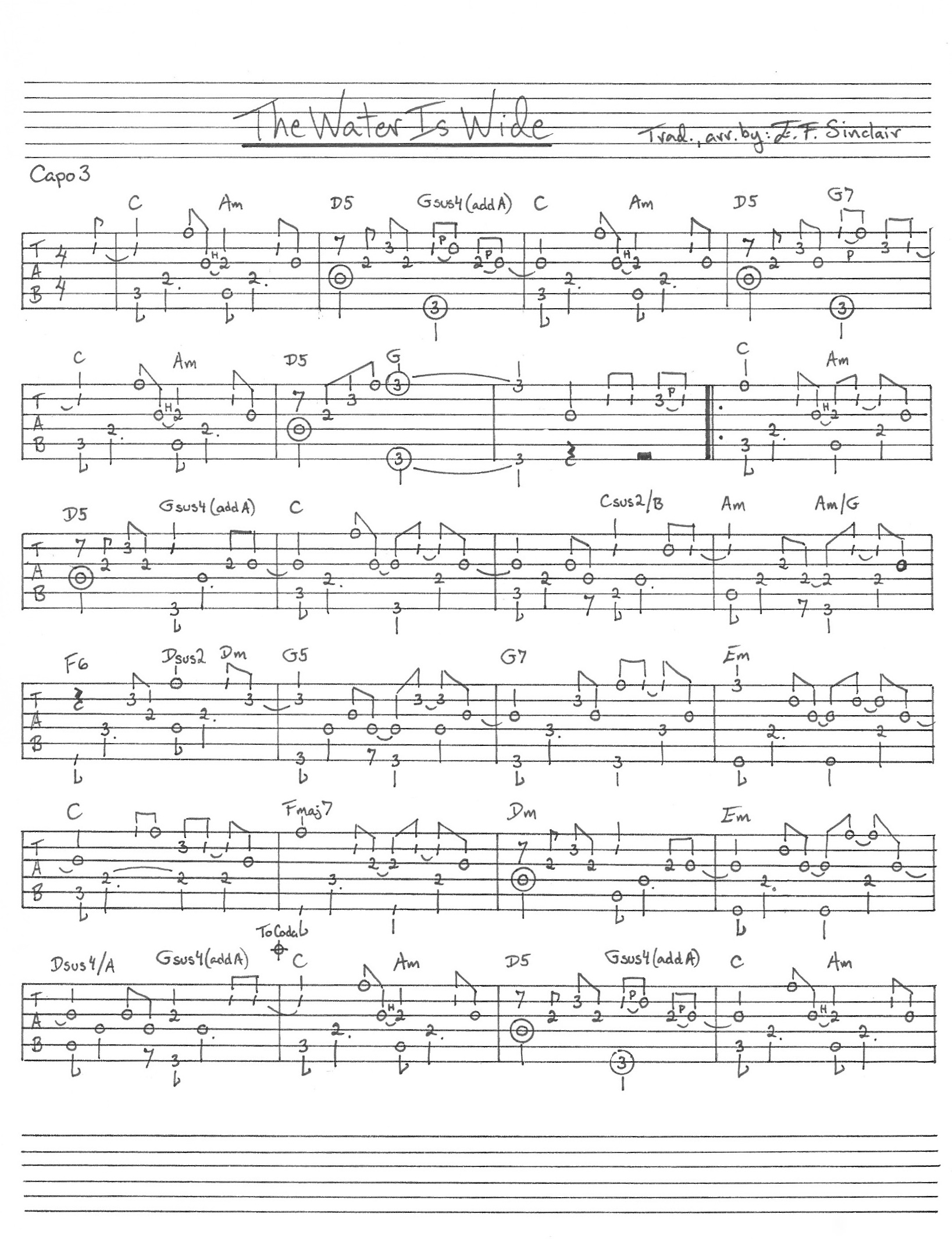
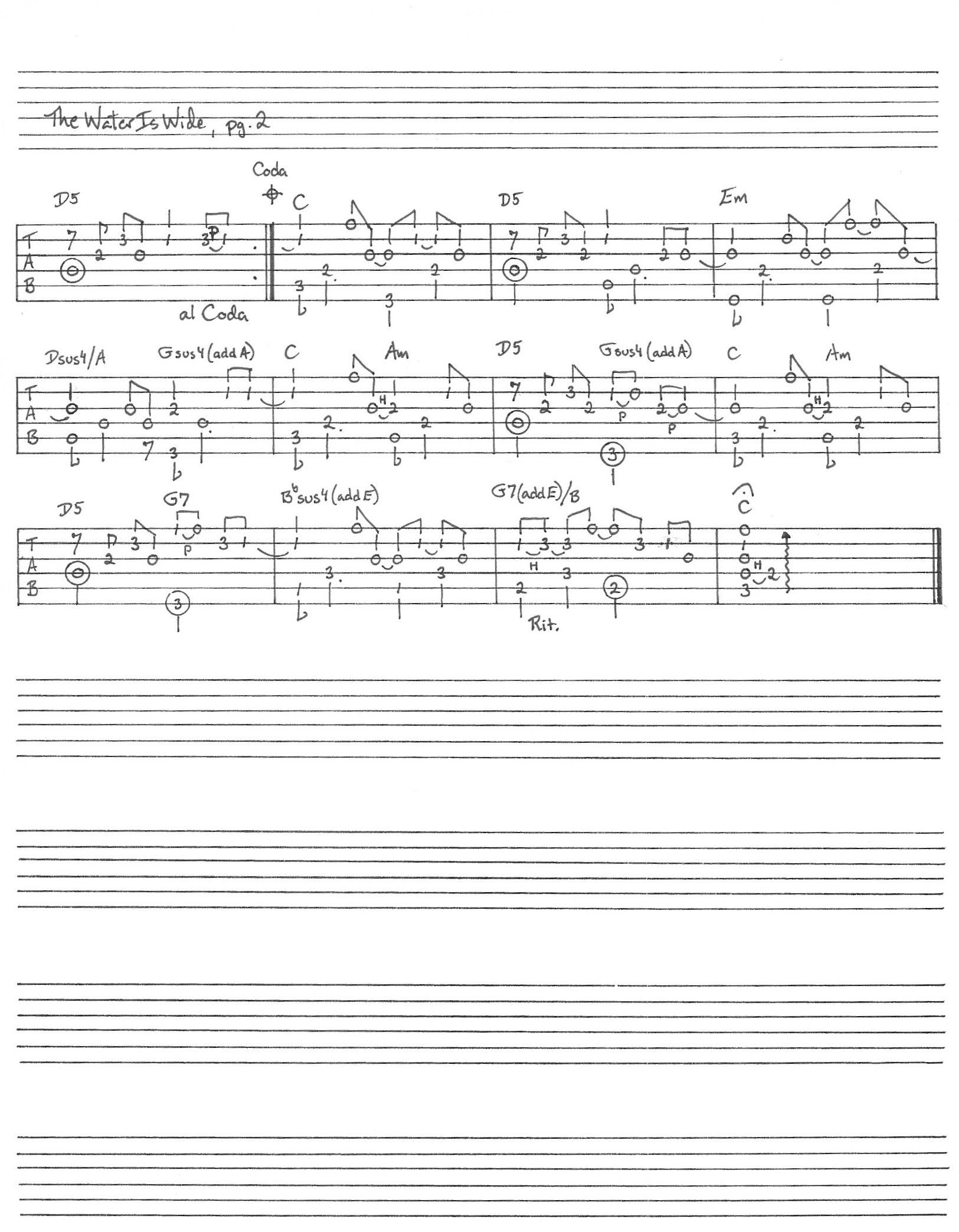
…and here is a transcription of my arrangement:
There you go!
Whenever I play “The Water Is Wide,” these are the lyrics that I hear in my head:
Verse 1) The water is wide, I can’t cross o’er, and neither have I wings to fly.
Give me a boat that can carry two and both shall row, my love and I.
Verse 2) There is a ship and she sails the sea, she’s loaded deep as deep can be.
But not so deep as the love I’m in, I know not how to sink or swim.”
If you’re a guitarist, I hope you’ll try out my arrangement. If you know a guitarist (or two) who would be interested, please share a link to this post.
 sixstr stories