This Historic Day In Music: John Winston Lennon

Seventy-five years ago today, on October 9, 1940, at 7:00 am in the Maternity Hospital on Oxford Street in Liverpool, England, John Winston Lennon was born. He was the first and only child of Fred and Julia Stanley Lennon.

John would grow up to be a guitar player; a singer; the leader of a skiffle band; a songwriter; and a recording artist. He would achieve his greatest success and most enduring fame as a member of the 1960’s British rock band known as The Beatles.

This sixstr story is about one of John Lennon’s songs. 

Not long after The Beatles – John Lennon, Paul McCartney, George Harrison & Ringo Starr – started recording for Britain’s EMI/Parlophone Records, Brian Epstein, the band’s manager, set a rather lofty goal for the quartet. He decreed that, henceforth, The Beatles would record and release two, 14 song, long playing record albums of new material during each calendar year.

And they did, at first.

In 1963, they produced Please Please Me and With The Beatles.

In 1964, A Hard Day’s Night (sadly, with only 13 songs) and Beatles For Sale topped the charts.

Help!, The Beatles’ fifth album, was released on August 6, 1965.

Fully aware of the pending end-of-the-year deadline, the band gathered at Abbey Road Studios in London, England, on Tuesday, October 12, 1965 to begin recording their sixth album. Working with them in Studio Two were producer George Martin and recording engineers Norman Smith, Ken Scott and Ron Pender.

The first two songs The Beatles worked on – “Run For Your Life” and “Norwegian Wood (This Bird Had Flown)” – had been written (mostly) by John Lennon.

Over the next seven days, they recorded three more songs for the new LP: Paul’s “Drive My Car” 0n October 13; George’s “If I Needed Someone” on October 16; and the John (mostly) & Paul collaboration, “In My Life,” on October 18.

(Also on October 16, The Beatles churned out the song “Day Tripper” and on October 20, they cut the song “We Can Work It Out.” These songs were not for the next LP, but would be released as a single on December 3, 1965.)

As good as the five numbers intended for the LP were, The Beatles needed more songs.

So, John Lennon went home.

He spent five hours trying to write a new song. As he told Beatles’ biographer, Hunter Davies, years later: “Nothing would come. I’d actually stopped trying to think of something. I was cheesed off and went for a lie down, having given up. Then I thought of myself as Nowhere Man – sitting in this nowhere land. “Nowhere Man” came, words and music, the whole damn thing.”

Late in the evening on October 21, 1965, The Beatles recorded two unsatisfactory takes of “Nowhere Man.”

On Friday, October 22, in a session that ran from 2:30-11:30 pm, they started over on “Nowhere Man” and produced the finished tracks for the song in three takes.

For the recording of “Nowhere Man,” John played the rhythm guitar part on his Gibson J-150 E acoustic guitar and sang the lead vocal. Paul played the bass guitar and Ringo played the drums. George played the lead guitar part on his new blue Fender Stratocaster electric guitar.

Paul and George sang harmony vocals with John on the song’s “A” sections. (“He’s a real Nowhere Man…,” “Doesn’t have a point of view…,” and “He’s as blind as he can be…”) They also added “Aaaaaah, la, la, la” back-up vocals to the “B” sections. (“Nowhere Man, please listen…” and “Nowhere Man, don’t worry…”)

For the song’s guitar solo, George and John (using his new Fender Strat) played the eight-bar melody in unison.

George Martin produced the mono and stereo mixes of “Nowhere Man” in Abbey Road’s Studio One on October 25-26, 1965.

“Nowhere Man” was released as the fourth track on the first side of the album Rubber Soul on December 3, 1965.

Listen.

There are two things about “Nowhere Man” that I really enjoy.

One is the gorgeous three-part harmony singing that The Beatles open the song with and continue using for every “A” section throughout the recording.

The other is the chord progression that John Lennon came up with to accompany those “A” sections.

John Lennon wrote and played “Nowhere Man” in the key of E major. In the third measure of the eight measure “A” section, John strums a big, open-position A major chord on his Gibson acoustic. (Listen behind the lyric “…knows not where he’s….”) A major is the standard “4 chord” or “IV chord” in the key of E. But then, in the sixth measure of the “A” section, John switches his fingering to an open-position A minor chord. This introduces a harmony that is outside of the key of E and is known as a “minor IV” chord. (Listen behind the lyric “…bit like you and…”)

Simply brilliant.

Listen again?

In the United States, the Capitol Records version of Rubber Soul did not include “Nowhere Man.” Instead, the company released it as a single (b/w “What Goes On”) on February 21, 1966.

Finally, “Nowhere Man” was one of the songs that The Beatles played in their last official public performance on August 29, 1966 at Candlestick Park in San Francisco, California.

1965 would be the last year that The Beatles released two albums of new material in the same calendar year.

Posted in Posts with Video, This Historic Day In Music | Tagged , , , , , , , , , , | Leave a comment

September’s Songs

On the sixstr stories calendar of historic days in music, no month has as many dates commemorating individual pieces of music than September.

Here’s the list! (Happy listening!)

September 4th

On this date in 1962, The Beatles – 21-year-old John Lennon; 20-year-old Paul McCartney; 19-year-old George Harrison; and 22-year-old Ringo Starr – entered Abbey Road Studios in London, England to record the songs for their first single for EMI/Parlophone Records. Under the direction of producer George Martin, the quartet recorded “How Do You Do It?,” a song by English songwriter Mitch Murray, and “Love Me Do,” a Lennon & McCartney original.

The September 4th recording of “Love Me Do” – with John Lennon on vocals & harmonica; Paul McCartney on vocals & bass guitar; George Harrison on acoustic guitar; and Ringo Starr on drums – would be released on October 5, 1962 in the United Kingdom as the A-side of the first run of The Beatles’ first 7-inch, 45-rpm record. (Another Lennon & McCartney song, “P.S. I Love You” was on the B-side.)

The September 4th recording of “Love Me Do” would not be released on an album until March 2, 1980. On that day it was featured as the first track on The Beatles’ Capitol Records LP Rarities. These days, the Ringo-on-drums/September 4, 1962 recording of “Love Me Do” is available on The Beatles’ Past Masters, Volume 1 CD.


September 6th

On this date in 1933, the American Southern Appalachian duo, Ashley & Foster – 37-year-old Clarence Ashley on guitar & vocals and 30-year-old Gwen Foster on guitar & harmonica – recorded “Rising Sun Blues” for Vocalion Records in New York, NY.

This would be the first commercial recording of the song that would one day be known as “The House Of The Rising Sun.”


September 11th

On this date in 1847, a small troupe of singers under the direction of Mr. Nelson Kneass – an actor, singer, pianist & banjo player – gave the first public performance of “Oh! Susanna” at the Eagle Ice Cream Saloon in Pittsburgh, PA. “Oh! Susanna” was the latest song by the up-and-coming, 21-year-old songwriter, Stephen Foster.

Here’s one of my favorites: James Taylor’s take on “Oh! Susanna” from his 1970 album, Sweet Baby James.


On September 11, 1962, The Beatles returned to Abbey Road Studios. At the suggestion of producer Martin, the group re-recorded “Love Me Do” with Andy White, a well-respected London recording session musician on drums instead of Ringo Starr. Ringo was relegated to playing the tambourine.

The September 11 recording of “Love Me Do” replaced the September 4th recording on all pressings of The Beatles’ Parlophone single sometime in early-1963. This is the recording of “Love Me Do” that is on Please, Please Me, The Beatles’ first album released in the UK on March 22, 1963. It is also the recording of “Love Me Do” that was released in the United States by Capitol Records as a single on April 27, 1964.


September 13th

On this date in 1947, 37-year-old American Blues singer & electric guitarist Aaron “T-Bone” Walker recorded his original song, “Call It Stormy Monday (But Tuesday Is Just As Bad)” for Black & White Records in Hollywood, California.

Accompanying T-Bone on the session were pianist Lloyd Glenn, bassist Arthur Edwards, drummer Oscar Lee Bradley, trumpeter John Bruckner and tenor saxophone player Hubert “Bumps” Myers.


September 15th

On this date in 1926, 35-year-old New Orleans Jazz pianist and composer Ferdinand Joseph “Jelly Roll Morton” LaMothe and his band, His Red Hot Peppers, recorded Mr. LaMothe’s composition, “Black Bottom Stomp” for Victor Records at the Webster Hotel in Chicago, Illinois.

The members of Jelly Roll Morton and His Red Hot Peppers on “Black Bottom Stomp” were: Jelly Roll Morton, piano; George Mitchell, cornet; Kid Ory, trombone; Omer Simeon, clarinet; Johnny St. Cyr, banjo; John Lindsay, bass; and Andrew Hilaire, drums.


On September 15, 1937, Library of Congress song collector Alan Lomax recorded 16-year-old Georgia Turner singing her favorite song, “Rising Sun Blues,” in Middlesboro, Kentucky.

Lomax collected two other renditions of “Rising Sun Blues” on the same trip through Kentucky, one by Bert Martin and another by Daw Henson. Lomax drew from all three recordings to create a transcription of “Rising Sun Blues” that he published in the 1941 songbook, Our Singing Country.

Georgia Turner’s recording of “Rising Sun Blues” was not released commercially until Rounder Records included it on the 2003 CD Alan Lomax: Popular Songbook.


If you’ve made it this far and you’re so inclined, you can find more of my posts on September’s Songs in the blog archives for September 2010, 2011, 2012 and 2013.

Writing this post reminded me of the quote from Jelly Roll Morton that I appropriated as the sixstr stories motto: “Good music doesn’t get old.”

Posted in Posts with Video, Random Topics | Tagged , , , , , , , , , , , , , | Leave a comment

Thomas Edison’s First Phonograph

“Of all my inventions, I liked the phonograph best.”

Thomas Alva Edison (1847-1931)
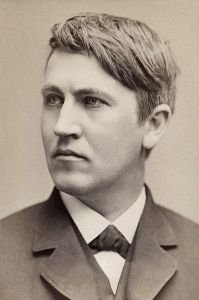
thomasedison

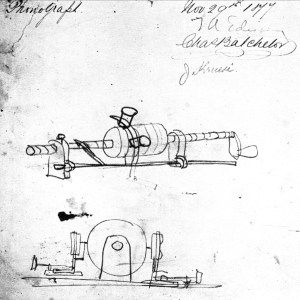
Thomas Edison wrote the date – November 29, 1877 – in the upper right-hand corner of the piece of paper on which he had drawn the sketch of his design for a new invention.

Working that Thursday at his Menlo Park, New Jersey laboratory, Edison had combined the results of his experiments on “an automatic method of recording telegraph messages” with what he’d learned from his experiments on the telephone about “the power of a diaphragm to take up sound vibration.” The “little machine” he envisioned used “a cylinder provided with grooves around the surface.” Over the cylinder “was to be placed tinfoil, which easily received and recorded the movement of the diaphragm.”

Thomas A. Edison called the invention in his sketch a “phonograph.”
Edison phonograph sketch November 29 1877

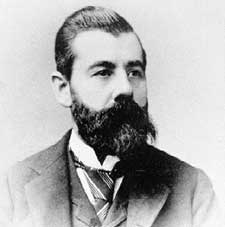
Edison gave the sketch (shown above) to John Kruesi (1843 – 1899), the Swiss-born machinist that he considered to be the best in his employ at Menlo Park.
John_Kruesi

John Kruesi’s job was to build a prototype of the machine from Edison’s sketch. When he had nearly completed the task, Kruesi asked Edison what the machine was for. Edison told him, “I was going to record talking, and then have the machine talk back.” Kruesi thought that Edison’s idea was “absurd.”

In early December of 1877 (possibly as early as Tuesday, December 4), John Kruesi presented Thomas Edison with the finished prototype of his phonograph.

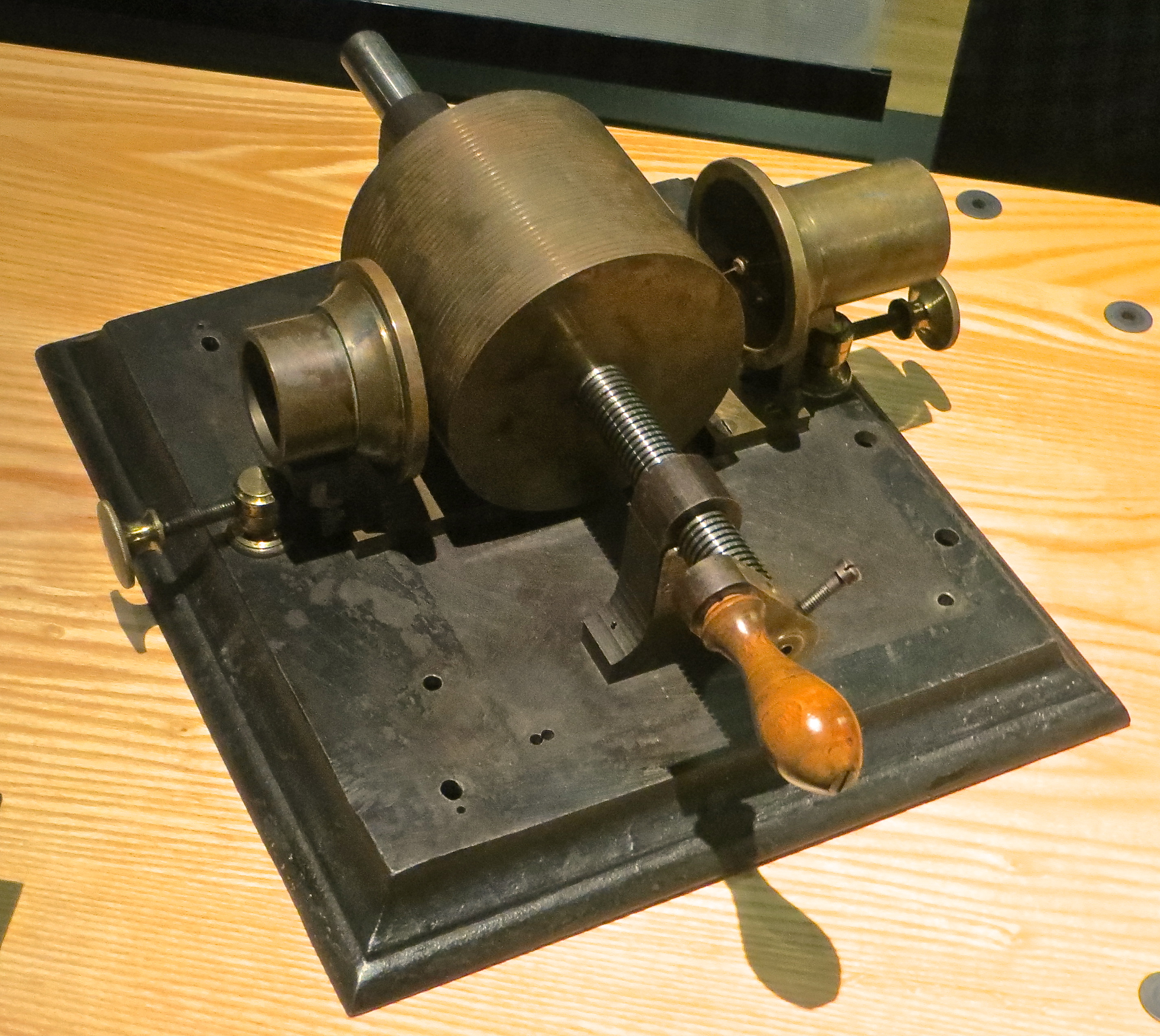
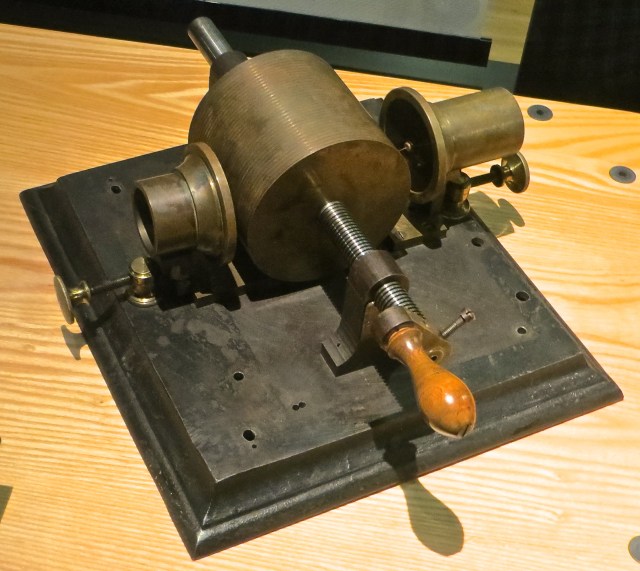
Here is a photograph of Thomas Edison’s first phonograph as displayed at Thomas Edison National Historic Park in West Orange, New Jersey.
IMG_2381 - Version 2

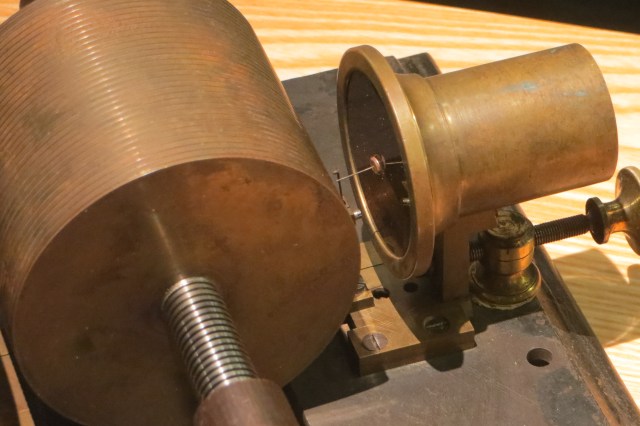
The “cylinder provided with grooves around the surface” is in the middle of the machine. The cylinder’s surface is inscribed from end to end with a helical or spiral “indenting groove.” A screw-threaded shaft runs length-wise through the center of the cylinder. Each end of the shaft is held by a vertical support, keeping the cylinder suspended above the base plate. A wooden crank handle is attached to one end of the shaft. When the crank is turned, the cylinder/shaft unit simultaneously rotates and moves horizontally between the two vertical supports.

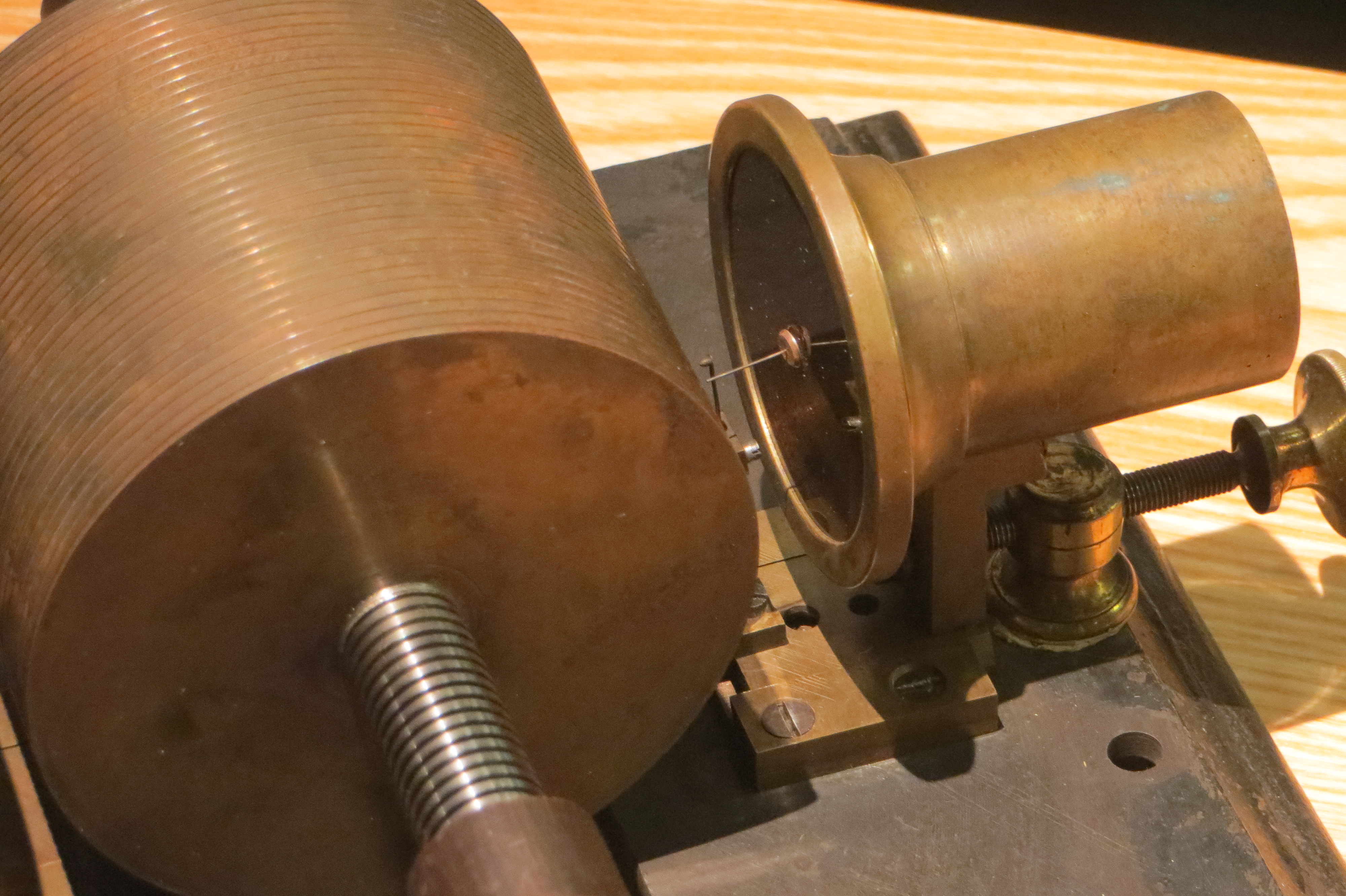
To the right of the cylinder stands the mouth piece or “speaking tube.” A metal diaphragm with a metal “indenting-point” attached to its center covers the end of the speaking tube closest to the cylinder.

To the left of the cylinder is the shorter “reading tube.” This tube is also outfitted with a metal diaphragm and an attached indenting-point on the end facing toward the cylinder.

Here’s a close-up of the speaking tube and part of the cylinder and the threaded shaft.
IMG_2418

“So,” John Kruesi might have asked, “how does this machine record talking?”

“Well,” Thomas Edison might have replied, “hopefully, like this…”

Position the cylinder so that the beginning of the indenting groove is opposite the indenting-point on the speaking tube’s diaphragm.

Wrap a thick sheet of tinfoil smoothly and completely around the cylinder.

Adjust the speaking tube towards the cylinder so that its indenting-point makes contact with the tinfoil and presses the tinfoil slightly into the indenting groove.

Begin turning the crank handle.

Lean over and speak loudly into the open end of the speaking tube.

The resulting sound waves within the speaking tube cause its diaphragm to vibrate. The indenting-point pulsates in and out against the moving tinfoil, forming a continuous trail of hill-and-dale-like indentations along the track provided by the indenting groove on the rotating and horizontally-moving cylinder.

When finished, the “recording” of the sound of the operator’s voice will lie in the spiral groove that has been “easily received” by the tinfoil.

“How then,” the still-doubtful Kruesi might have continued, “does the machine talk back?”

Adjust the speaking tube back away from the cylinder.

Turn the crank in the opposite direction until the cylinder is rewound to its original position.

Adjust the reading tube towards the cylinder so that its indenting-point is resting in the beginning of the spiral groove inscribed into the tinfoil.

Turn the crank handle in the same direction and at the same speed as during the recording process.

As the cylinder revolves, the indenting-point of the reading tube’s diaphragm traces the hill-and-dale-like indentations in the groove on the tinfoil. The diaphragm vibrates and the reproduced sound of the operator’s voice emanates from the open end of the reading tube.

“Anyway, that’s the plan,” Edison might have concluded.

Well…

The very first time Thomas Edison tried his phonograph – he recorded himself reciting the poem “Mary Had A Little Lamb” – it worked.

“I was never so taken aback in my life,” Edison later recalled. “I was always afraid of things that worked the first time; but here was something there was no doubt of.” Thomas Edison’s first phonograph showed “that speech and song could be actually recorded, preserved and reproduced” by the same machine.

On Friday, December 7, 1877, Thomas Edison demonstrated his phonograph in the New York City office of the esteemed publication Scientific American – “A Weekly Journal of Practical Information, Art, Science, Mechanics, Chemistry and Manufactures.”

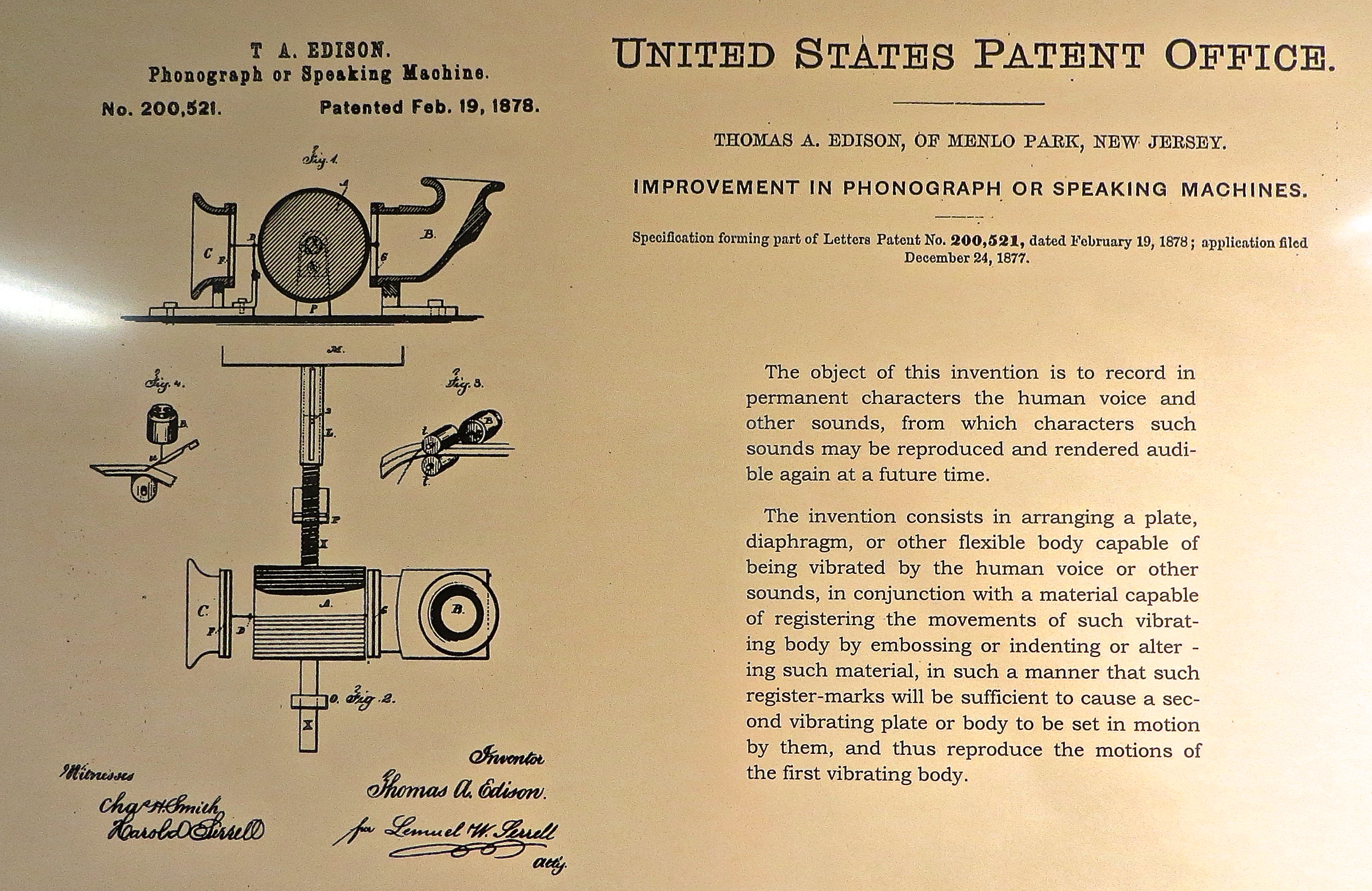
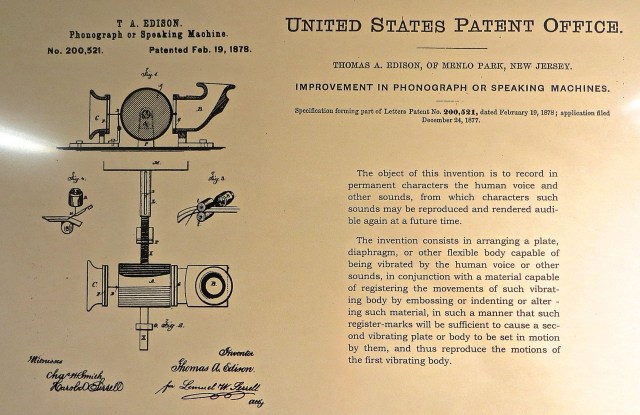
On December 15, 1877, Thomas Edison signed an application to the United States Patent Office asking to be awarded a patent on his invention of a “Phonograph or Speaking Machine.” (The date on which an application for a patent is signed is known as the “execution date.” It is considered to be “the date in the patenting process that comes closest to the time of actual inventive activity.”)

In the application, Edison makes this opening statement about his phonograph:

“The object of this invention is to record in permanent characters the human voice and other sounds, from which characters such sounds may be reproduced and rendered audible again at a future time.”

In its December 22, 1877 edition (Volume 37, Number 25), Scientific American recounted Thomas Edison’s December 7th visit in the first paragraph of an article on page 2 titled “The Talking Phonograph.”

“Mr. Thomas A. Edison recently came into this office, placed a little machine on our desk, turned a crank, and the machine inquired as to our health, asked how we liked the phonograph, informed us that it was very well, and bid us a cordial good night.”

Towards the end of the article, Scientific American summarizes Thomas Edison’s phonograph as being: “a little affair of a few pieces of metal, set up roughly on an iron stand about a foot square, that talks in such a way, that, even if in its present imperfect form many words are not clearly distinguishable, there can be no doubt that the inflections are those of nothing else than the human voice.”

(FYI: Page 1 of the December 22, 1877 edition of Scientific American featured articles on and illustrations of “The Tuttle Family Knitter” and “The Foster-Firmin Amalgamator And Ore Washer.”)

On December 24, 1877, the United States Patent Office received and recorded Edison’s application.

On February 19, 1878, the United States Patent Office issued/awarded patent #200,521 to “Thomas A. Edison, of Menlo Park, New Jersey” for his “Phonograph or Speaking Machine” and/or “Improvement In Phonograph Or Speaking Machines.”
IMG_2360

Thomas Edison soon became internationally known as “The Wizard of Menlo Park.”

On February 28, 1878 and on March 19, 1879, Thomas A. Edison would execute applications for – and eventually be awarded – two more patents for inventions involving the phonograph and speaking machines.

By the summer of 1879, however, Edison had completely set the phonograph aside and was focusing his energy on perfecting the incandescent lightbulb.

Not until 1887 would Thomas Edison turn his attention back again to the phonograph. Working then in his new and much larger laboratory in West Orange, New Jersey, Edison would be awarded (from May 8, 1888 to May 16, 1933) another 196 patents for inventions concerning phonographs and sound recording.

In conclusion, here is one more quote from Thomas Edison.

“I never did a day’s work in my life. It was all fun.”

Thomas Alva Edison passed away on October 18, 1931 at “Glenmont,” his home in Llewellyn Park, West Orange, New Jersey.


The sources of the quotes, terminology, information and inspiration used in the writing of this post were:

“How Edison Invented The Phonograph” (1922) – an advertising booklet produced by Thomas A. Edison, Inc., Orange, New Jersey.

The text of Thomas A. Edison’s patent application for “Improvement In Phonograph Or Speaking Machines” (December 15, 1877) – as found on the Rutgers University website, The Thomas Edison Papers, at: edison.rutgers.edu.

“The Talking Phonograph” – Scientific American, Volume 37, Number 25 (December 22, 1877)

Famous Quotations from Thomas Edison at: thomasedison.org.

My late-August, 2014 visit (with my cousin, Jack) to The Thomas Edison Center at Menlo Park in Edison, New Jersey and Thomas Edison National Historical Park in West Orange, New Jersey.
Posted in Random Topics | Tagged , , , , , | 1 Comment

On This Historic Day In Music: Columbia Records, PC 33795

“The release date is just one day. The record is forever.” Bruce Springsteen, 1975

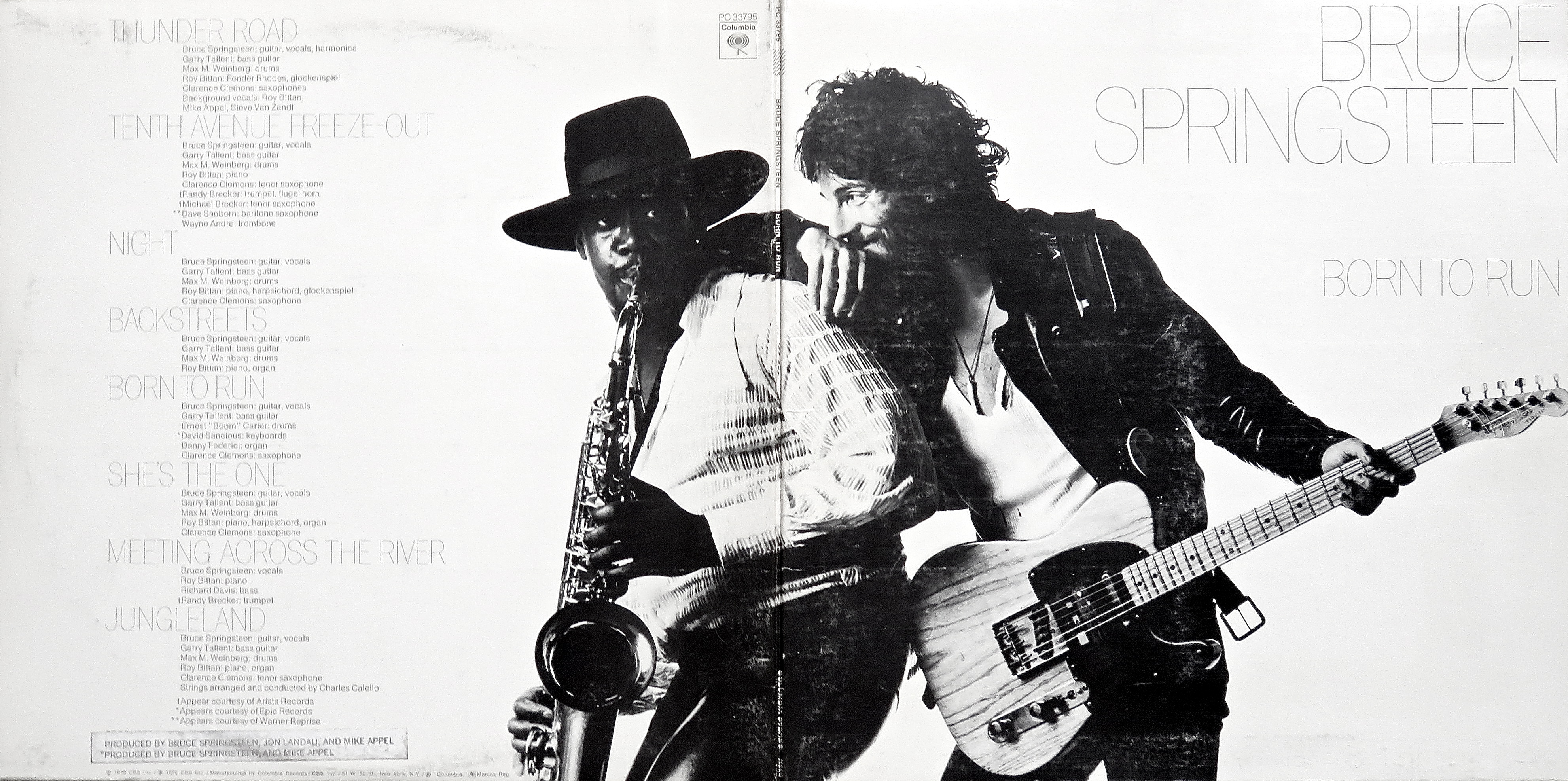
Forty years ago today, on August 25, 1975, Columbia Records released Born To Run, the third album by the New Jersey-born, songwriter/singer/guitarist Bruce Springsteen.

IMG_0317

The song “Born To Run” started rather simply.

“One day I was playing my guitar on the edge of my bed, working on some song ideas, and the words ‘born to run’ came into my head. At first I thought it was the name of a movie or something I’d seen on a car spinning around the Circuit, but I couldn’t be certain. I liked the phrase because it suggested cinematic drama I thought would work with the music I was hearing in my head.”

[From: Songs (1998) by Bruce Springsteen and the 48 page booklet included in Bruce Springsteen – Born To Run – 30th Anniversary Edition.]

The album Born To Run was anything but simple.

Writing about Born To Run for the All Music Guide to Rock (2002), William Ruhlmann describes the album as being “an updated West Side Story with spectacular music that owed more to (Leonard) Bernstein than to (Chuck) Berry” and “an intentional masterpiece.”

For Bruce, “The primary questions I’d be writing about for the rest of my work life first took form in the songs on Born To Run (“I want to know if love is real”).”

[Also from: Songs (1998)…]

There are eight songs on Born To Run: “Thunder Road,” “Tenth Avenue Freeze Out,” “Night” and “Backstreets” on Side 1; “Born To Run,” “She’s The One,” “Meeting Across The River” and “Jungleland” on Side 2.

I love them all. But if I had to pick a favorite, the single song and performance that for me really stands out from all of the devastatingly great songs and performances on the album, I would have to say that “Meeting Across The River” is the one.

Stop and listen.


That recording features: Bruce Springsteen, vocals; Roy Bittan, piano; Richard Davis, bass; and Randy Becker, trumpet.

What’s your favorite song on Born To Run?

In 2009, Bloomsbury Press published the book Runaway Dream: Born To Run and Bruce Springsteen’s American Vision by Louis P. Masur.

In this wonderful book, Louis asks: “How do you calculate the influence of a song in your life? We have songs that carry enormous meaning for us, songs we want played at our weddings or at our funerals, songs that every time we hear them, every single time, we pause, we remember, we smile, we sing, we ignite. And maybe even more than that. Maybe we have music that has changed or saved our lives.”

The music of Bruce Springsteen has indeed influenced, ignited and changed my life. His music never fails to make me pause, remember, smile and sing. And as long as Bruce Springsteen continues writing and recording and performing, I will continue to have new music from him to look forward to.

How great is that?

Posted in Posts with Video, This Historic Day In Music | Tagged , , , , , , , , | 1 Comment

Songs

Long before I started writing this blog, I wrote songs.

Love songs, story songs, list songs, silly songs, songs about songs, songs without words, songs drawn from the day-to-day of my life.

Thirty of those songs – including tracks from my two self-produced albums: Anytime and (There Are) Songs To Be Sung – can be heard via links embedded into posts here on sixstr stories. Those posts are gathered and easily accessible under the category EFS Music.

These days, however, it seems that my songwriting muse needs a very special occasion to send me a new song. My daughter’s wedding was one of those occasions. (“The Embrace of Love” – posted on October 8, 2012.) My sixtieth birthday was another.

“Best Walked (Life’s A Road)” is one of those songs that I’d finished, but something about it didn’t feel finished. I’d play it, leave it for awhile (another birthday passes), go back to it, tweak the guitar part… almost, but not quite.

A little re-writing of the second verse helped, but the “big” problem was with the segue from the second chorus into the bridge. It went: “Life’s a road that winds through time and tradition…” and as much as I liked the line, every time I sang it, “winds” sounded like “whines.” Then, a few weeks ago, as yet another birthday approached, my muse tapped me on the shoulder on my way to work and the troublesome line became: “Life’s a highway winding through…”

Yes. That did the trick. (Thank you, thank you!)

So, now that it’s done, here’s my “new” song.

(To hear the recording, click on the blue link below and… wait for it!)

“Best Walked (Life’s A Road)” – Words & Music, Guitar & Vocals by Eric Sinclair

Posted in EFS Music, Posts with Audio, Random Topics | Tagged , , , , | Leave a comment

This Historic Day In Music: John & Alan Lomax Meet Huddie Ledbetter

This is a reprise of a post that originally appeared on sixstr stories in July, 2010.

In early June, 1933, Texas-based Folk song collector John Lomax and his 18-year-old son, Alan, drove out of Dallas on a mission. They were going on “the first major trip in the United States to capture black folk music in the field.” (All quotes, unless otherwise noted, are from the 1992 book The Life & Legend of Lead Belly by Charles Wolfe & Kip Lornell.)

The elder Lomax was no stranger to song collecting. In 1910, he had published the results of many years of work in the book Cowboy Songs and Other Frontier Ballads. Through subsequent research in the published and unpublished folk song collections of the Library of Congress and those of several Ivy League colleges, John had found that there was “a dearth of black folk song material.”

John Lomax wanted to rectify this deficiency. He came up with the idea for a new book to be called: American Ballads and Folk Songs. He envisioned that this book would “especially focus on the neglected genre of the black work song.” To collect such music, John decided to visit “sections of the South with a high percentage of blacks.” Specifically, his journey would pinpoint “labouring camps, lumber camps… and eventually, prisons and penitentiaries.”

(Prisons and penitentiaries? Alan Lomax gave this answer to that question in his 1993 book, The Land Where The Blues Began: “We thought we should find that the African-American away from the pressure of the church and community, ignorant of the uplifting educational movement, having none but official contact with white men, dependent on the resources of his own group for amusement, and hearing no canned music, would have preserved and increased his heritage of secular folk music.”)

John Lomax convinced the Macmillan Company publishers to give him a contract and a small cash advance. He also got the Library of Congress to provide research funds and a new disc-based recording machine.

The only recording equipment that John and Alan Lomax had when they started their trip in June, however, was a dictaphone. This machine, originally intended for taking dictation in an office setting, recorded onto metal-coated wax cylinders and made “scratchy and squeaky sounds” at best. The state-of-the-art machine that recorded onto 12-inch annealed aluminum discs that the Library of Congress had promised did not catch up with the travelers until they reached Baton Rouge, LA in early-July.

But it arrived just in time.

On or about the 12th of July, the Lomaxes arrived at the Louisiana State Penitentiary in Angola, LA. They spent four days listening to and recording many talented inmates. But on Sunday, July 16, Captain Andrew Reaux of Camp A introduced them to inmate Huddie Ledbetter. John later wrote that “we found a Negro convict so skillful with his guitar and his strong, baritone voice that he had been made a ‘trusty’ and kept around Camp A headquarters as laundryman, so as to be near at hand to sing and play for visitors. Huddie Ledbetter…was unique in knowing a very large number of songs, all of which he sang effectively while he twanged his twelve-string guitar.”

The Lomaxes recorded Huddie Ledbetter, who went by the nickname “Lead Belly,” playing and singing parts of eight different songs. “Irene,” a song John and Alan had never heard before, warranted three recordings.

In his wonderful book, Delta Blues (2008), Ted Gioia writes: “Prisons are not supposed to play a role in the history of music.”

Good thing John and Alan Lomax didn’t know that.

Posted in This Historic Day In Music | Tagged , , , , | Leave a comment

This Historic Day In Music: “Blowin’ In The Wind” – Take 1

Bob Dylan wrote “Blowin’ In The Wind” sometime in late March/early April, 1962. He used the song “No More Auction Block” – a Civil War-era, African-American marching song/spiritual – as his starting point. (Dylan was a big fan of singer/guitarist Odetta, one of the major artists in the American Folk music revival of that time. Odetta had included her rendition of “No More Auction Block” on her 1960 album, Odetta At Carnegie Hall.)

Dylan gave “Blowin’ In The Wind” its first public performance on April 16, 1962, during a hootenanny hosted by folksinger Gil Turner at Gerdes Folk City, a West Village, New York City music venue.

In early May of 1962, Dylan played “Blowin’ In The Wind” during “The Broadside Show” on New York radio station WBAI-FM. Folksingers Pete Seeger, Gil Turner and Sis Cunningham added their voices to his performance.

Broadside was a New York-based Folk music magazine founded in 1962 by the husband-and-wife team of Sis Cunningham and Gordon Friesen. Cunningham did song transcriptions for Broadside and her transcription of Dylan’s radio performance of “Blowin’ In The Wind” was published in the late-May, 1962, issue of the magazine.

On Monday, July 9, 1962, 21 year old Bob Dylan settled into Columbia Records’ Studio A in New York City for the third of the eight recording sessions that it would take to cut the tracks for his second LP. He recorded four songs that day that would eventually be released as part of that 13-song collection: “Bob Dylan’s Blues,” “Blowin’ In The Wind,” “Honey, Just Allow Me One More Chance,” and “Down The Highway.”

For “Blowin’ In The Wind,” Dylan played a steel-string acoustic guitar in standard tuning with a capo placed at the seventh fret. His left hand fingered open-position chords in the key of G major, his right hand picked out a Maybelle-Carter-by-way-of-Woody-Guthrie bass note/strumming pattern and he soloed at the end of each verse on a key-of-D harmonica mounted in his around-the-neck harmonica rack.

Listen for yourself.


On July 30, 1962, Witmark Music, the company that published Bob Dylan’s songs at that time, registered “Blowin’ In The Wind” for copyright.

Bob Dylan’s second album, The Freewheelin’ Bob Dylan was released by Columbia records in May of 1963.

“Blowin’ In The Wind” backed with “Don’t Think Twice, It’s All Right” was released as a single in August of 1963.

“Blowin’ In The Wind” was inducted into the Grammy Hall of Fame in 1994 and posted as #14 on Rolling Stone magazine’s “500 Greatest Songs of All Time” in 2004.

Posted in Posts with Video, This Historic Day In Music | Tagged , , | Leave a comment

This Historic Day In Music: Stephen Collins Foster

Stephen Collins Foster – America’s first professional songwriter – was born on July 4, 1826 in Lawrenceville, Pennsylvania.

Image

Stephen Foster’s songwriting career started in December, 1844, with the publication of “Open Thy Lattice Love.” Over the next decade he became well known as a composer of both minstrel songs and parlor ballads. His catalogue of original songs included “Oh! Susanna” (1848), “Gwine To Run All Night” aka “De Camptown Races” (1850), “Old Folks At Home” (1851), “My Old Kentucky Home, Good Night!” (1853) and “Jeanie with the Light Brown Hair” (June, 1854). But in December of 1854, Foster wrote his first political protest song: “Hard Times Come Again No More.”

Since the previous October, Foster had been living in Allegheny City (now part of Pittsburgh), Pennsylvania. The area had been hard hit by unprecedented levels of unemployment and a summertime outbreak of cholera that had killed hundreds in two weeks time. Foster was well aware of the poverty, distress and suffering in the world around him.

The first verse of “Hard Times Come Again No More” begins:

“Let us pause in life’s pleasures and count its many tears,

while we all sup sorrow with the poor”

The chorus continues:

“‘Tis the song the sigh of the weary;

Hard Times, Hard Times, come again no more;

Many days you have lingered around my cabin door;

Oh! Hard Times, come again no more.”

The fourth verse concludes:

“‘Tis a sigh that is wafted across the troubled wave,

‘Tis a wail that is heard upon the shore,

‘Tis a dirge that is murmured around the lowly grave,

Oh! Hard Times, come again no more.”

“Hard Times Come Again No More” was published in 1954 by the New York music publisher Firth, Pond & Co. The song was registered for copyright on January 17, 1855.

The song was recorded for the first time in 1905 by the Edison Male Quartette for the Edison Manufacturing Company. It was released on an Edison Gold Moulded cylinder, #9120.

Amazingly, here it is! (being played on an actual Edison Home Phonograph)


“Hard Times Come Again No More” is today revered as one of Stephen Foster’s greatest songs and has been recorded and performed by a long list of contemporary musicians. Among those on that list are Kate & Anna McGarrigle, Emmylou Harris, Nanci Griffith, Bob Dylan, Johnny Cash, Bruce Springsteen, Mavis Staples, Iron & Wine, Kristin Chenoweth and Mary J. Blige.

One of my favorite renditions of “Hard Times Come Again No More” is from the 2000 album Appalachian Journey. This is the second album by the string trio of fiddler Mark O’Connor, cellist Yo-Yo Ma and bassist Edgar Meyer. The trio is joined on this track by singer/guitarist James Taylor.


Stephen Collins Foster passed away, impoverished and destitute, in New York City’s Bellevue Hospital on January 13, 1864.

The sources for the information used in this post were: Doo-Dah! Stephen Foster and the Rise of American Popular Culture (1997) by Ken Emerson; Stephen Foster & Co.: Lyrics of America’s First Great Popular Songs (2010), edited by Ken Emerson; and the Wikipedia page for “Hard Times Come Again No More.”

P.S.: This is sixstr stories’ 300th post.

Posted in Random Topics | Tagged , , , , | Leave a comment

“Father’s Day”

Eight different musicians/groups have each written and recorded a song called “Father’s Day.”

Rap artist Father M.C. did in 1990 and Hip Hop duo Method Man & Redman did in 1999.

Americana duo Barry & Michelle Patterson did in 2001 and Englishman Frank Turner did in 2007. (Frank Turner is great!)

Portland, Oregon’s Michael Dean Damron did in 2009 and the Waukesha, Wisconsin Rock band, BoDeans did in 2011.

New York rapper Chino XL did in 2012 and the Boston-based Metalcore band ICE NINE KILLS did in 2013.

(That’s some playlist.)

Two entire albums are titled Father’s Day: one by The Starlite Singers, a group of Canadian studio musicians, and one by Michael Dean Damron. Both were released in 2009.

By the way: July 17, 2015 is the release date for the new album by Blues electric guitarist Ronnie Earl and his band The Broadcasters. The album will be titled Father’s Day. (Ronnie Earl is an outstanding guitarist!)

There is an instrumental piece for piano and orchestra called “Father’s Day” composed by Murray Gold. It is part of the 2007 Original TV Soundtrack for the BBC science-fiction series Doctor Who.

There are two books titled “Father’s Day.” Bill McCoy published his in 1995 and Buzz Bissinger’s came out in 2012.

At least twelve television series have had episodes titled “Father’s Day.” Among them are The Fosters, Shameless, Children’s Hospital, The Mary Tyler Moore Show and Tyler Perry’s House of Payne.

Robin Williams and Billy Crystal co-starred in a 1997 movie called “Fathers’ Day” (the position of the apostrophe is correct) and Father’s Day is the title of a 2012 package of the early films by the Japanese director Sion Sono.

But, to the best of my knowledge, “Father’s Day” has never been the title of a solo fingerstyle acoustic guitar instrumental piece… until now.

Here it is!

“Father’s Day” – Composed & Performed by Eric Sinclair

(To listen, click on the blue link and wait for it…)

On this day, as I celebrate my 34th Father’s Day, I dedicate this post and extend my best wishes to all the fathers among the followers, readers and viewers of sixstr stories. 

Posted in EFS Music, Posts with Audio, Random Topics | Tagged , , , | 1 Comment

Wrestling With The Angel, Chapter 10

If you’re a new visitor to this blog, the purpose of my Wrestling With The Angel series (or category) is to highlight and share individual songs that are on a list of mine entitled: Devastatingly Great Songs. The title phrase, “Wrestling With The Angel,” is my paraphrase of a line from a poem by Herman Melville called “Art.” You can read the complete poem in my archived post of November 4, 2011: “The Source.”

1967, 1968 and 1969 were banner years for folksinger and guitarist Sandy Denny.

Sandy – born Alexandra Elene MacLean Denny on January 6, 1947 in Merton Park, London, England – started 1967 as a student at London’s Kingston College of Art (where musicians John Renbourn, Eric Clapton and Jimmy Page were among her classmates). She was also a frequent and increasingly popular performer on the London area’s extensive circuit of Folk music clubs.

Sandy made her first professional recordings in early 1967 for Saga Records. Those sessions resulted in the release of two albums: Alex Campbell & Friends in March and Sandy and Johnny in April. (Alex Campbell was a Scottish folksinger/guitarist and Johnny Silvo was a British Folk and Blues singer/guitarist.) Among Sandy’s contributions to those albums were her renditions of “Pretty Polly” and “The False Bride” (both traditional Folk songs) and “The Last Thing On My Mind” by the contemporary American songwriter Tom Paxton.

In mid 1967, Sandy was performing one evening at The Troubadour folk club in London. Dave Cousins, leader of The Strawbs, a British Folk/Rock group, was in the audience. Years later, Cousins wrote about that evening: “She was sitting on a stool playing an old Gibson guitar, about eighteen, wearing a white dress, a white straw hat, with long blond hair and singing like an angel. I don’t know what came over me but I went up to her immediately afterwards, introduced myself and invited her to join The Strawbs.”

Sandy left art school behind and, in July 1967, travelled with The Strawbs to Copenhagen, Denmark to record their first album. Among the 13 songs the band recorded for that album was a Sandy Denny original. That song, only the second song Sandy had written, was called “Who Knows Where The Time Goes?”

That album, All Our Own Work, was unfortunately not released until 1973.

In early 1968, however, a tape of “Who Knows Where The Time Goes?” from the All Our Own Work sessions ended up in the hands of David Anderle, a producer for the Amercian record company, Elektra Records.

In June of 1968, David was producing an album for Judy Collins at Elektra’s studios in Los Angeles, California. He played the tape of Sandy Denny singing “Who Knows Where The Time Goes?” for Judy on a little tape player in his office. In her 2011 autobiography, Suite Judy Blue Eyes: My Life In Music, Judy remembered that time: “I was ready to catch the gems when they fell into my lap.”

“Who Knows Where The Time Goes?” became the title song of Judy Collins’ eighth album, taking its place among songs by Ian Tyson, Leonard Cohen and Bob Dylan. Released in November, 1968, the LP “Who Knows Where The Time Goes” sold over 500,000 copies in the United States and in 1969 was certified as a Gold Album.

Meanwhile in England in June of 1968, Sandy Denny had left The Strawbs and, wanting to “do something more with my voice,” took an audition with the Folk/Rock band Fairport Convention. Fairport Convention had just released their first album and were looking for a vocalist to replace Judy Dyble, their original lead singer, who’d left the band.

Simon Nicol – singer, guitarist and founding member of Fairport Convention – has often recounted that among the many who auditioned, Sandy Denny stood out “like a clean glass in a sink full of dirty dishes.”

Sandy Denny immediately joined Fairport Convention in a London recording studio to begin the five months of work it would take to produce the band’s second album. Released in January 1969, What We Did On Our Holidays featured a new Sandy Denny original, “Fotheringay,” as the first track on the LP.

That same month, Fairport Convention began work on their next album, Unhalfbricking. That album, released in July 1969, contained two songs by Sandy Denny: “Autopsy” and the now internationally-well-known, “Who Knows Where The Time Goes?”

Here is that recording.

Listen, listen.


The musicians on that recording are: Sandy Denny, vocals; Richard Thompson, electric guitar; Simon Nicol, acoustic guitar; Ashley Hutchings, bass guitar; and Martin Lamble, drums. The couple standing by the gate in the picture on the album cover are Sandy Denny’s parents.

In 2007, that recording of “Who Knows Where The Time Goes?” was selected by the listeners of BBC Radio 2 as their “Favorite Folk Track Of All Time.”

“Who Knows Where The Time Goes?” – the Fairport Convention version – has been on my list of Devastatingly Great Songs right from the start. Over the past week though, as I put the finishing touches to my 40th year in the business of being a music teacher, I’ve been thinking about, listening to and singing “Who Knows Where The Time Goes?” quite a bit.

“Across the evening sky, all the birds are leaving…”

P.S.: Sandy Denny has been described as “the pre-eminent British Folk Rock singer.” She was voted the “Best British Female Singer” in 1970 and 1971 by the readers of Melody Maker magazine. In 1971 she became the only guest vocalist on a Led Zeppelin studio album when she sang with Robert Plant on the song “The Battle of Evermore.” Between 1971 and 1977 she recorded four solo albums, each containing mostly her own songs.

IMG_0190

On April 21, 1978, Sandy Denny passed away from injuries sustained as the result of a fall down a flight of stairs at a friend’s apartment in London.

In 2010, Universal/Island Records released Sandy Denny, a limited edition, complete retrospective box set of her work containing 19-CDs and a 72-page hard cover book.

Posted in Posts with Video, Wrestling With The Angel | Tagged , , , , , , | Leave a comment