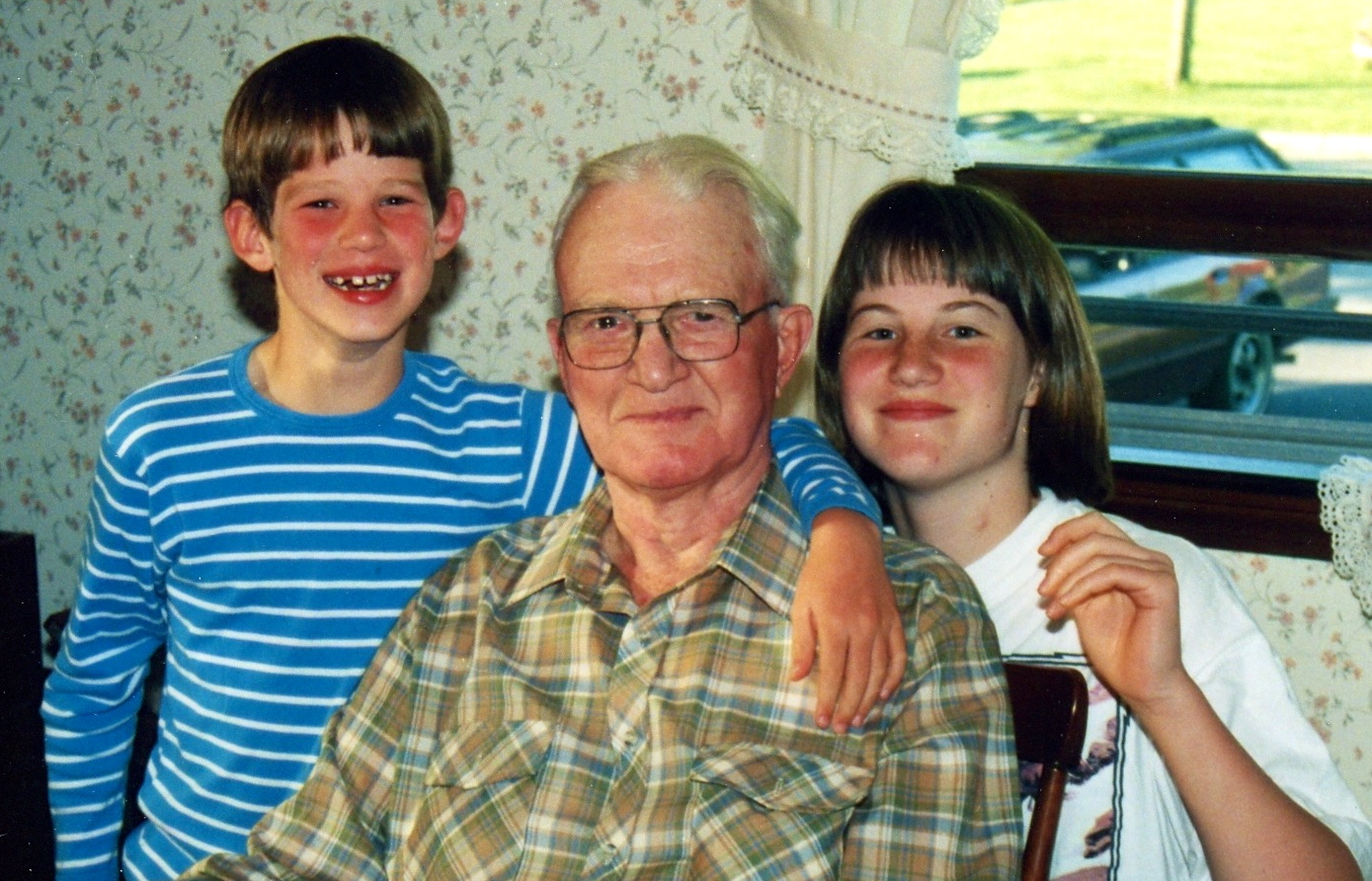
This Historic Day: Francis Matthew Sinclair

One hundred years ago today, on May 27, 1915, my father was born.

Francis Matthew was the sixth of nine children born to Joseph French Sinclair (Nov. 7, 1877 – Jan. 30, 1961) and Mary A. Winkler (March 25, 1887 – Jan. 30, 1970) of Exeter, New Hampshire. Three of the nine children did not live past the age of two.

Francis’ father was born in Exeter as well. Joseph was an eighth-generation descendant of John Sinkler, a Scottish immigrant “seeking liberty, fortune, and a home” who “appeared” in Exeter in 1658. (The settlement of Exeter had been founded twenty years earlier by Rev. John Wheelwright “in the wilderness about the Falls of Squamscott in New Hampshire.”) Francis’ mother had emigrated from Poland with her family when she was around five years old.

When the time came, Francis, like his older brother John before him, received his secondary education at the boys-only Exeter High School. (The girls in town, including Francis’ sisters: Helen, Dorothea, Gertrude and Patricia, spent their high school years at Exeter’s Robinson Female Seminary.) Francis graduated with the other 24 members of his class in an afternoon ceremony at the Exeter Town Hall on Thursday, June 15, 1933. His diploma states that Francis Matthew Sinclair “honorably completed the Mechanic Arts course of study.”

Sinclair

Whatever Francis was planning to do after graduation – possibly attending The Wentworth Institute of Technology in Boston, MA? – those plans were set aside during the winter of his senior year. That was when his girlfriend, Marjorie, announced to him that she was pregnant.

On April 30, 1933, 17 year old Francis M. Sinclair and 16 year old Marjorie Ann Graves were married by the Rev. Harold W. Curtis at the Middle Street Baptist Church in Portsmouth, NH. The newlyweds moved in with Marjorie’s family in Hampton Falls, NH. Francis went to work at The Wellswood Tavern, an establishment in Hampton Falls owned and operated by Marjorie’s mother Bertha.

On September 21, 1933, Marjorie gave birth to a daughter, Barbara Ann Sinclair, at a hospital in Newburyport, MA. Birth records for Barbara Ann list her mother’s occupation  as “housewife.” Francis’ occupation is listed as “clerk.”

Whatever initially brought Francis and Marjorie together did not last. By the end of February, 1934, they were separated. Francis moved back home to Exeter, getting a job stocking shelves at the First National grocery store downtown. Marjorie remained in Hampton Falls, raising Barbara with her family’s help. In October of 1937, Marjorie filed for divorce and full custody of Barbara Ann.

Marjorie eventually remarried. Marjorie and her new husband, George M. Eames, moved to Albany, NY, sometime between 1941 and 1943. Most likely, George adopted Barbara Ann.

Unfortunately I didn’t know that I had a half-sister until 1998. (Thank you, Aunt Gertrude!) I was only able to piece together the info above from researching public records at that time. All my attempts to find Barbara were unsuccessful. I wish I had known about her when I was younger. Maybe we could have gotten to know each other. I have never been able to get a good explanation from anyone as to why I had not been told about Barbara.

Sometime in 1938, Francis met Avis Louise Foss through a mutual friend, Anne Miles Kucharski. Avis was a registered nurse, working at Exeter Hospital. She’d grown up in Center Strafford, NH, the first born of George and Stella (Libby) Foss’ six children. Francis at that time was a truck driver, delivering Squamscot Beverages for the Conner Bottling Works in Newfields, NH. He also worked evenings as an usher at Exeter’s Ioka Theater. During their courtship, Francis would occasionally sneak Avis into the theater to see a movie for free.

Francis and Avis were married on Tuesday, May 27, 1941 at 2:30 pm in the Parish House of St. Michael’s Catholic Church in Exeter. The Rev. Daniel J. Cotter officiated. The happy couple made their home at 14 Green Street, the left-hand-side apartment in a two-story duplex not far from downtown Exeter.

Over the next decade, Francis held several different jobs while Avis continued to work at the hospital. From 1942 – 1943, for instance, Francis was a machinist at the  Portsmouth Naval Shipyard in Kittery, ME. From 1945 – 1947, he was a mechanic at Don Chase’s Amoco Gas & Service Station on Main Street in Exeter.

During these years, Francis also had his first taste of the two jobs that came to mean the most to him and that he would continue to do for the rest of his working life.

In 1942, Francis received his first, small annual paycheck as a “call fireman” for the Exeter Fire Department. He quickly rose to the rank of Captain with Engine Company #1, a position he held until he retired from the Fire Department in 1980. (Francis also held the position of Sargent-At-Arms with the NH State Fireman’s Association from Sept. 1960 – June 1998.)

In 1947, Francis started doing “nursery work” at Charles H. Williams Nurseries – “The Home of Wild Flowers” – out on Newmarket Road, in Exeter. This part-time job for Mr. Williams turned full-time in 1948.

During these years as well, Francis and Avis were trying to start a family. Finally though, they joyfully welcomed their first and ultimately only child – me – into the world in August of 1953.

Image 1

Not long after I was born, my father took a full-time, year-round job at the new Simplex Wire & Cable facility in Newington, NH, loading ships with mile after mile of transatlantic telephone cable. He picked up some additional work, when he could, back at Don Chase’s Amoco Station. After a few more years at 14 Green Street, Dad, Mom and I moved down and across the street to #19, a small but single-family house.

In 1961, my father and mother were presented with a unique opportunity.

Charles H. Williams was ready to retire and he approached Dad about taking over his well-regarded-but-declining nursery and wildflower business. Dad greatly enjoyed the work he had done over the years for Mr. Williams and was more than ready to go to work for himself. So, on September 27, 1961, the paper was signed and Charles H. Williams Nurseries officially became Francis M. Sinclair Wildflowers.

On June 11, 1962, my father and mother took ownership of the land and buildings located on the outskirts of Exeter where Mr. Williams had lived and operated his business for many years. Come August, we said “goodbye” to Green Street and moved to the place that would eventually come to be known as “Newfields Road.”

Year after year, Dad did everything he could to build up the business and keep his ever-growing list of customers happy. He’d never enjoyed any other job he’d ever had as much as he enjoyed being – as his friends gleefully called him – a “bush crook.” As the business thrived and our family prospered, my father was free to use the down time of the “off seasons” as he wished. During the summers, he would immerse himself in planting and maintaining a large vegetable garden. During the winters, he would go ice fishing in his hand-made smelt shack.

When I got to be old enough, Dad started to take me with him; to the garden, to the river, to the fire station and to work.

On many a warm summer evening, I crouched beside him, pulling weeds and picking whatever vegetable was ready to be picked in that large garden that he planted on a piece of land owned by his Uncle Matt Winkler – Mary’s youngest brother – just off Route 108 in Newfields.

On many cold winter afternoons, I sat next to him in that two-person, kerosene stove-heated smelt shack out on the ice in the middle of the Newmarket River, lines baited and down the hole, waiting for the fish to bite.

Countless times, I tagged along when he would stop by the Exeter Fire Station to either take care of some bit of fireman business or just to go in and give his firefighter buddies a “hard time.”

And every summer, from the one before my freshman year of high school to the one after I graduated from college, I went to work for him – for Francis M. Sinclair Wildflowers – full-time, 40 hours a week.

I can’t begin to calculate the number of miles we put on the odometers of his (always) dark green Chevrolet pick-up trucks traveling the highways, byways and very back roads of New Hampshire, Maine and Vermont in search of some tree, shrub, fern, wildflower or plant (“There’s no such thing as a weed.”). That last summer, in 1975, Dad gave my girlfriend Andrea a job, too. Never had the cab of that truck been filled with so much laughter or bug spray as it was during those three months.

The time that Dad and I spent together wasn’t always about working or gardening or fishing. Dad taught me how to play cribbage and whenever we played, we played on an engraved, oak and steel cribbage board that he’d made back in high school.

During baseball season, we both enjoyed catching a Sunday afternoon Boston Red Sox game on TV. Dad even knew a guy who could get us tickets to see a game at Fenway Park any time we wanted to go. I clearly remember he and I watching a Red Sox – Yankees game from seats located only a few rows back from the field; right behind the visiting teams batting circle.

In 1978, Andrea and I got married. We invited Dad to share a few thoughts during a special part of the ceremony that Andrea and I created to give recognition to a few special friends and members of the family. Here are the words Dad stood and spoke that day:

“This is the day Mother and I have wanted for you – we have tried to be patient and understanding. Some people tell us we’re losing a son – No – we think we are gaining a daughter. Our hearts are full of love as we bless you on your way to a bright new beginning. And if we shed a tear you will know it is of gratitude for all the yesterdays we’ve shared, pride for the fulfillment of this day and joy for the promise and beauty of your love. Our best wishes are with you always.”

As happy as Dad was being a father-in-law – finally there was a good card player in the family! – he was absolutely thrilled when we told him he was going to be a grandfather. Dad became “Grampa” first in 1982 with the birth of our daughter and again in 1987 with the birth of our son.

Becoming a grandfather came at the perfect time in my father’s life. He’d retired from the fire department in 1980 and from his beloved wildflower business in 1981. He was also near the end of his last three-year term as an elected member of the board of trustees of Exeter’s Swasey Parkway. My father became an attentive, loving and exuberant grandfather. He was greatly enjoyed and deeply loved by his grandchildren.

Image

In the mid-1990’s, however, both Dad’s and Mom’s health started to fail. Dad had had both knees replaced a few years after our son was born and the unexpected aftereffects of such highly invasive surgery hit him hard. But watching my Mom’s more precipitous decline was devastating. It left my father frustrated, confused and completely broken hearted.

Francis Matthew Sinclair passed away on January 26, 2000.

As I’ve said before, the most valuable lesson that I learned from my father was the incalculable importance of making your living doing something that you love to do.

I would be remiss if I did not include a few of my father’s favorite sayings in this post. (These should be read aloud with a decidedly “New Hampsha” accent.)

“I wouldn’t walk across the street to hear him.”

“I’m not trying to tell you what to do, but…”

“You’re improving with age and pestilence.”

“Your kindness is exceeded only by your extreme beauty.”

Happy 100th Birthday, Dad! You’d have been a great centenarian.



Posted in Random Topics | Tagged , , , | 7 Comments

The Thrill Is Gone

B.B. King passed away yesterday, Thursday, May 14, 2015, in Las Vegas, Nevada.

He was born Riley B. King on September 16, 1925 in Berclair, Mississippi, near the small town of Itta Bena.

In 1950, while working as a DJ for radio station WDIA in Memphis, Tennessee, King was known as the “Beale Street Blues Boy.”  That title was shortened first to “Blues Boy,” and then became simply, “B.B.”

B.B. King made his first record, “Miss Martha King,” for Bullet Records in 1949. His first Number 1 hit on the Billboard magazine Rhythm & Blues chart was “3 O’Clock Blues,” released on RPM records in 1951.

B.B. King’s forty-second and last studio album was One Kind Favor. This extraordinary album came out on August 26, 2008 on Geffen Records.

B.B. King was, and forever will be, The King of The Blues.

No question.

Long live The King. Long live the Blues.

Posted in Posts with Video, Random Topics | Tagged , , | Leave a comment

This Historic Day In Music: The King Of The Delta Blues Singers

One of the first times I heard the words and music of Robert Johnson, I was listening to a Rolling Stones album.

It was December 1969. I was listening to Let It Bleed, the new album by the Stones. The second song on the first side was called “Love In Vain.” With its gorgeous acoustic guitar part, evocative lyrics and passionate Mick Jagger vocals, the recording was a real stunner. The songwriter was listed as “Woody Payne.”

Listen for yourself.


Robert Johnson wrote that song. He recorded it during his last recording session on June 20, 1937 in Dallas, Texas. It was released as “Love In Vain Blues” on the Vocalion label in 1939. In 1970, Columbia Records released the recording, retitled “Love In Vain,” as the last track on the album, King of the Delta Blues Singers, Vol.2.

Here’s that recording.


Robert Johnson was born on May 8, 1911, in Hazelhurst, Mississippi.

To list but three of his many accolades, Cub Koda, writing in The All Music Guide to the Blues said that Robert Johnson is “certainly the most celebrated figure in the history of the Blues.”  Author Peter Guralnick wrote: “Robert Johnson created music of the highest sophistication, music in which not a single note is misplaced, in which metaphor can become meaning without the need for explanation.” Keith Richards once proclaimed that Robert Johnson was “The Bach of the Blues.”

Robert Johnson recorded a grand total of 29 songs or “sides” over the course of five recording sessions. The first three were held on Nov.23, 26 & 27, 1936 in San Antonio, Texas and the last two sessions were held on June 19 & 20, 1937 in Dallas, Texas.

Robert Johnson’s records – 10-inch, 78-rpm discs with one song per side – sold mostly to an African-American audience in the rural South and Southwest. At the time, the total sales from the sides released from his first sessions numbered around 5000 discs.

In 1961, John Hammond and Frank Driggs of Columbia Records gathered 16 of Johnson’s sides together and released them on a 12-inch LP, entitled The King of the Delta Blues Singers. Volume 2 was released in 1970. Both albums are available on excellently remastered CDs and in a boxed set.

Robert Johnson died of mysterious circumstances on August 16, 1938.

Posted in Random Topics | Tagged , , , , , , , | Leave a comment

Quotations Marked 5

“A guitar sounds good even if you drop it on the floor. A beginner can find music in the guitar that has escaped the virtuoso. It’s a magical instrument, constrained by a short range and a peculiar tuning, that produces music beyond the limits of its own nature.”

Leo Kottke

From: Dangerous Curves: The Art of the Guitar by Darcy Kuronen.

This book was published in 2000 by MFA Publications and produced in conjunction with the now-legendary exhibition of the same name that ran from November 5, 2000 to February 25, 2001 at The Museum of Fine Arts in Boston, MA. “Dangerous Curves…” presented an array of over 130 guitars spanning four centuries of the instrument’s very colorful history. It was the first major art exhibit dedicated to the visual design and evolution of the guitar.

Leo Kottke (born September 11, 1945 in Athens, Georgia) is an acoustic guitarist, composer, singer, performer and recording artist.

If you’ve ever had the very good fortune to see Leo Kottke in concert, then you know that he is not only a truly dazzling fingerstyle acoustic guitarist but an entertaining and very funny storyteller as well. Leo’s unpredictable sense of humor also emerges when he’s being interviewed – thus the quote above – and, every now and then, in one of his songs.

“Jack Gets Up” is a song that Leo Kottke wrote and first released on his 1989 album, My Father’s Face. The recording below was made at The Fox Theater in Boulder, Colorado on Easter Sunday, April 16, 1995 and released later that year by On The Spot Records on the album, Live. (Highly recommended)

Posted in Posts with Video, Quotations Marked | Tagged , , , , | 1 Comment

No. 5

sixstr stories was born on Sunday, April 18, 2010, on my daughter’s laptop computer. I sat next to her on the couch in her Somerville, Massachusetts apartment and watched as she made her way through Word Press and set the whole thing up for me.

“There you go, Dad. You’ve got a blog!”

Five years and 292 posts later, sixstr stories is still here and going strong.

Here’s to No. 6!

Take it, Tom.

Posted in Posts with Video, Random Topics | Tagged , , | 2 Comments

John Renbourn, Guitarist & Teacher

On Saturday morning, March 28, 2015, the “Today’s Headlines” email that I receive from The New York Times delivered this very sad news: “John Renbourn, Eclectic Guitarist Who Founded the Pentangle, Dies at 70.”

According to the obituary by Jon Pareles, John Renbourn – “an English guitarist known for his light-fingered fusion of classical, folk, blues and jazz” – was found dead on Thursday, March 26, at his home in Harwick, Scotland, after he failed to show up for a concert in Glasgow on the 25th. Upon further investigation, it was determined that Renbourn had suffered a heart attack.

I offer this post about John Renbourn in tribute not only to the guitarist whose many, truly remarkable recordings have so enriched my life, but also to the teacher who pointed me towards outposts in the world of guitar that I still explore and that I would otherwise, possibly, never have found.


I first learned about John Renbourn from an article in the April, 1979 issue of Guitar Player magazine.

IMG_0124

The article, written by Jas Obrecht, one of Guitar Player’s assistant editors at that time, was based on an extensive interview with the British fingerstyle steel-string guitarist.

From Mr. Obrecht’s piece, I learned that John Renbourn was born in 1944. (August 8, 1944, in Marylebone, London, England, to be precise.) John got his first guitar – a pink, acoustic “Wonder” guitar – when he was 13 years old and enthralled by the film exploits of Roy Rogers, the American singing cowboy. Something called the “skiffle craze” sustained John’s interest in playing guitar until, at the age of 15, he started taking what would turn into two years of formal Classical guitar lessons. John also, at this time, tried his hand at playing some “things” by the American Blues guitarist, Big Bill Broonzy.

In the early 1960’s, while attending the Kingston Art School, John took up the electric guitar and played in a Blues band known as “Hogsnort Rupert And His Famous Porkestra.” In 1964, John moved to London, returned to the acoustic guitar, landed some gigs in the local Folk clubs and met fellow acoustic fingerstyle guitarist Bert Jansch.

I further learned that John Renbourn’s recording career started in 1965 with the release of his first album, John Renbourn on Transatlantic Records. A duet album with Jansch came out in 1966 followed by John’s second solo album, Another Monday in 1967.

More importantly, also in 1967, John and Bert – along with vocalist Jacqui McShee, bassist Danny Thompson and percussionist Terry Cox – formed a band they called “Pentangle.” Pentangle achieved international success, toured Europe and the U.S. several times and released six albums before disbanding in 1973. (You might remember their version of “Sally Go ‘Round The Roses.”)

Mr. Obrecht’s lengthy article also informed me about John Renbourn’s numerous other recordings; including his 1968 solo album, Sir John Alot of Merry Englandes Musyk Thyng & ye Grene Knyghte,

IMG_0129

and an album of duets that he did in 1978 with American guitarist Stefan Grossman for Kicking Mule Records.

IMG_0128

Finally, Mr. Obrecht described the scope of John Renbourn’s music as ranging from “refined Folk to Blues, Ragtime, Jazz, Ballads and Pavanes.” He followed that description with this quote from John: “I see no reason why any good music should be separated, or that people should become specialists. I listen to absolutely everything and I suppose I learn a little bit from it all.”

I started learning from John Renbourn thanks to a monthly column that he wrote for Frets – The Magazine For Acoustic String Musicians. John’s column, called “Fingerstyle Guitar,” debuted in the publication’s June, 1988 issue. The magazine credited John as being “a seminal figure on the international fingerstyle guitar scene since the early ’60’s.”

IMG_0125

From that very first column, I learned all about Lonnie Donegan and the “skiffle craze” that had so inspired the young John Renbourn.

I also learned about the many American Folk and Blues musicians – Big Bill Broonzy, Josh White, Ramblin’ Jack Elliott, Peggy Seeger and Elizabeth Cotten, among them – whose music fueled the players – Davey Graham, Wizz Jones, Bert Jansch, Martin Carthy and Renbourn, to name a few – who were the fingerstyle guitar scene in Britain in the 1960’s.

In future columns, John Renbourn introduced me to many wonderful pieces of music for the acoustic guitar such as:

“Anji” – Davey Graham’s signature guitar piece, most famously recorded by Bert Jansch.

“Kemps’ Jig” and “House Carpenter” – two old, traditional melodies from Great Britain arranged by Renbourn to be played using DADGAD tuning (an alternate guitar tuning credited to Davey Graham),

“Merrily Kissed The Quaker” – a pipe tune played in EADEAE tuning, a guitar tuning developed by Martin Carthy.

(Every column included a complete transcription of that month’s featured piece presented in both standard musical notation and guitar tablature.)

After Frets bid farewell with its August, 1989 issue, John Renbourn soon set up shop in Guitar Player magazine, making regular contributions throughout the early 1990’s to a column first called “Steel-String Acoustic,” and then just “Steel String.”

Through the “Steel String” columns from those years, I learned about the popular late-19th century American Folk guitar style known as “parlor guitar.”

The transcriptions of parlor guitar music that John Renbourn presented to me in those Guitar Player columns included:

“Spanish Fandango” – played using open G tuning (DGDGBD), transcribed in arrangements by Henry Worrall and John Dilleshaw, and found in the repertoire of Elizabeth Cotten.

“Po’ Howard” as played by Huddie Ledbetter,

“Sebastopol” – also by Henry Worrall but played in open E tuning (EBEG#BE), and

“The Blarney Pilgrim” – an Irish dance tune (I guess he couldn’t resist) in the open G tuning of “Spanish Fandango.”

Besides writing about and arranging “old” music for the steel string guitar, John Renbourn composed “new” pieces of music for the instrument as well. From the seven originals on his first album to the six originals on his last album – 2011’s Palermo Snow – John wrote and recorded dozens of acoustic guitar instrumentals in a variety of styles over the course of his long career. His 1988 LP, The Nine Maidens, contained only Renbourn originals.

My favorite John Renbourn composition is called “Buffalo.” It was first released on the Another Monday album, but I discovered this jaunty, Blues-based number on a 1985, 2-record set on the British Cambra Sound label called Renbourn and Jansch.

IMG_0131

I learned how to play “Buffalo” with the help of a taped guitar lesson (I’m talking cassette tape here. Remember those?) that I purchased from Stefan Grossman’s Guitar Workshop, a New York-based mail-order company.

IMG_0132

The Lesson was #1 in a series called The Guitar of John Renbourn – taught by John Renbourn. The audio recording on the cassette tape was of John Renbourn himself (!) first playing “Buffalo,” then teaching – discussing, breaking down, explaining, slowly demonstrating, gradually reconstructing – this instrumental to the carefully listening student.

It seems to be quite appropriate that the only video I can find on YouTube of “Buffalo” to share with you is one in which John Renbourn is heard and shown playing and teaching the piece.

Even if you don’t play the guitar, I think you will enjoy spending a few minutes in the company of the master.


For your additional listening pleasure, here is “Snap A Little Owl,” my favorite track from Stefan Grossman and John Renbourn.


I will be forever grateful to John Renbourn for teaching me that developing an appreciation of the music and players of the past as well as the music being created by the innovative practitioners of today is an essential ingredient in the musical journey of every guitarist.

I only wish that I had been blessed with the opportunity to say “Thank you” to him in person.


Posted in Posts with Video, Random Topics | Tagged , , , , , , , , , , , , , | 1 Comment

This Historic Day In Music: McKinley Morganfield

“Well, my mother told my father, just before I was born

  I got a boy child comin’, gonna be a rollin’ stone,

  Sure ‘nough he’s a rollin’ stone.”

From the song, “Rollin’ Stone” by Muddy Waters.

Many years ago, I bought a songbook called Folk Blues.

IMG_0116

This 9″ x 11 & 3/4″ paperback volume – it did have a cover at one time – was published by ARC Music, Inc. in New York, NY and bears a copyright dated 1965 and 1969. In the foreword, Paul Ackerman, a music editor for Billboard magazine, wrote: “It is the intent of this collection of songs to illustrate the blues in their infinite variety.”

Most of the 103 songs in this collection were written by either Chuck Berry or Willie Dixon. Among the other songwriters represented are Lowell Fulson, John Lee Hooker, Ellas McDaniel and McKinley Morganfield.

McKinley Morganfield performed and recorded under the name Muddy Waters. (His grandmother nicknamed him “Muddy” when he was a child.)

(Ellas McDaniel is better known by his stage name: Bo Diddley.)

One of the four songs attributed to McKinley Morganfield in Folk Blues is “Rollin’ Stone.”

Muddy Waters recorded “Rollin’ Stone” in February, 1950 at the Chess Studios in Chicago, Illinois. That recording, featuring him singing and accompanying himself on an amplified acoustic guitar, became Muddy Waters’ first single released on the Chess Records label. (The B-side was Muddy’s version of Robert Johnson’s “Walkin’ Blues,” recorded at the same session.)

Check it out!


“Rollin’ Stone” was not a big seller for Muddy Waters. But in the 1960’s, the song became immortalized as the source of the name of a rather successful British – and at one time “The World’s Greatest” – Rock & Roll band; as well as the name of an American pop culture magazine that is now in its fifth decade of publication.

Depending on what you read, McKinley Morganfield/Muddy Waters was born on April 4, 1915 in Rolling Fork, Mississippi or on April 4, 1913 at Jug’s Corner, Issaquena County, Mississippi.

Either way, Muddy Waters’ music is, to me, ageless; a true example of the sixstr stories motto: “Good music doesn’t get old.”

If you would like to read more of my posts on Muddy Waters, scroll through the Archives for April 2014, April 2013 and August 2010. The April ones are “This Historic Day In Music…” pieces and the August one is called “It Was The Last Week In August.”

Posted in Posts with Video, This Historic Day In Music | Tagged , , , , , , , | 1 Comment

This Historic Month In Music: Doc, Wes & Lightnin’

It just so happens that three of my favorite guitarists were born in the month of March.

Arthel “Doc” Watson was born in Deep Gap, North Carolina, on March 2, 1923.

John Leslie “Wes” Montgomery was born in Indianapolis, Indiana, on March 6, 1925.

Sam “Lightnin'” Hopkins was born in Centerville, Texas, on March 15, 1912.

I have, of course, written about these gentlemen here in sixstr stories before now.

On March 2, 2013, I posted a “This Historic Day In Music” piece on Doc Watson and on May 30, 2012, the day after he passed away, I composed a brief tribute to him called “So Long, Doc.”

Wes Montgomery got his “This Historic Day In Music” write-up on March 6, 2012.

Lightnin’ Hopkins was featured in a “This Historic Day In Music” post on March 15, 2012 and on March 17, 2011, I wrote my one-and-only “The Day Before Yesterday In Music History” post about the illustrious Mr. Hopkins.

I hope you’ll visit the Archives and check out some – or all! – of those pieces.

This year, I thought I’d let Doc, Wes and Lightnin’ speak for themselves. (Mostly.)

Here’s Doc Watson playing and singing “Sitting On Top Of The World.”


“Sitting On Top Of The World” was written by singer/guitarist Walter Vinson and fiddler Lonnie Chatmon. Performing as “The Mississippi Sheiks,” they recorded the song for OKeh Records in 1930. Doc Watson first cut “Sitting On Top Of The World” for Folkways Records in April, 1962, but the recording was not released until 1994 when Smithsonian Folkways included the track on the 2-CD set The Original Folkways Recordings of Doc Watson and Clarence Ashley. 

The album pictured above, Classic Appalachian Blues, is a 2010 Smithsonian Folkways compilation that puts Doc’s rendition of “Sitting…” in the very good company of songs by 19 other Blues artists including Sticks McGee, John Jackson, Pink Anderson and Etta Baker.

Up next, here is Wes Montgomery playing “While We’re Young.”


“While We’re Young” was written in 1943, music by Alec Wilder & Morty Palitz and lyrics by Bill Engvick. Wes Montgomery recorded his solo electric guitar version on August 4, 1961 at Plaza Sound Studios in New York City for Riverside Records. The track was released on Wes’ album So Much Guitar in 1961.

I first heard that recording on the Riverside LP Wes Montgomery: March 6, 1925 – June 15, 1968.

IMG_0050


Finally, here’s Lightnin’ Hopkins playing and singing “Penitentiary Blues.”


“Penitentiary Blues” is a Lightnin’ Hopkins original. The song was one of nine recorded on January 16, 1959 in a session organized by Blues historian and author Samuel B. Charters. The “studio” was a small rented room at 2803 Hadley Street, Houston, Texas. Having first provided a guitar and a bottle of gin, Mr. Charters then operated the tape recorder and held the microphone as Mr. Hopkins sang, played and reminisced. The resulting album, Lightnin’ Hopkins, was released on Folkways Records later that year.

IMG_0049


Now, I often enthusiastically exclaim to my guitar students that “The World of Guitar is a wide and wonderful place!”

If a student were to question that statement, should ask for an example, for some kind of demonstration of the width and wonderfulness of the World of Guitar, I’d immediately introduce him or her to Doc, Wes and Lightnin’.

Posted in Posts with Video, This Historic Day In Music | Tagged , , , , , , , , | 1 Comment

This Historic Day In Music: George Harrison

“Little darlin’, it’s been a long, cold, lonely winter.”

That’s the first line of the first verse of the song “Here Comes The Sun” written by George Harrison in the Spring of 1969.

George started writing “Here Comes The Sun” in Surrey, England, sitting at the bottom of the garden at the Huntwood Edge home of his friend, Eric Clapton. As George later described it in an interview with British journalist, David Wigg: “It was just a really nice sunny day. And I picked up the guitar, which was the first time I’d played the guitar for a couple of weeks because I’d been so busy. And the first thing that came out was that song. It just came.”

George finished “Here Comes The Sun” in June, 1969, while on holiday in Sardinia.

Recording sessions for “Here Comes The Sun” started on July 7, 1969 at Abbey Road Studios in London. It took George Harrison, Paul McCartney and Ringo Starr – for some reason, John Lennon did not participate – six more sessions to finish the track. George played acoustic guitar and harmonium; sang lead and back-up vocals; and clapped his hands on the recording. He also added the final touch of a part played on a Moog Synthesizer during the last session on August 19, 1969.

“Here Comes The Sun” was released on September 26, 1969, as the first track on the second side of The Beatles’ album, Abbey Road.


George Harrison was born in Liverpool, England, on this day, February 25, in the year of 1943. He was the fourth child and third son of Louise and Harold Harrison.

George passed away on November 29, 2001.

If you’d like to read my first This Historic Day In Music post about George Harrison, scroll down the Archives list and click on February, 2013. It will be at the top of the page.


Posted in Posts with Video, This Historic Day In Music | Tagged , , , | 3 Comments

A 1990’s Love Song Resurrected For The 16th Valentine’s Day Of The 21st Century

Living here in New Hampshire, it often seems that the winter we’re in the middle of is absolutely the worst winter ever.

(OMG! and WTF!)

The winter of 2015 is definitely in the running for that title.

But as the recent chain of grinding, bitterly cold days gains another link and the mountains of plowed, blown and shoveled snow lining the driveway stand poised to continue their climb to record heights, I am reminded…

…of a song.

The song is called “The Shelter Of Your Arms.”

I found the first draft of the lyrics to this song on pg. 12 of the second volume of my songwriting journals. The page was dated: 2/1/94.

Ah, yes, the inspirational winter of 1994.

I found a recording of the song on my 2003 CD, Love Songs (So Far…).

If you click on the blue link below – and wait for it – you can listen to the song.

“The Shelter Of Your Arms” – Words and Music, Guitar & Vocals by Eric Sinclair

Happy Valentine’s Day, 2015, to you and yours.

Posted in EFS Music, Posts with Audio | Tagged , , , , | 1 Comment