Finding Out

My son called the other day.

It had been a couple of weeks since we’d last talked, but he soon started excitedly telling me about this excellent movie he’d recently watched: “The Last Play At Shea.”

“The Last Play At Shea” is a 2010 documentary/concert film centered around the last musical performance given at New York City’s Shea Stadium – home of the major league baseball team, the New York Mets. The July 18, 2008 star-studded concert was headlined by singer/songwriter/piano man Billy Joel.

Besides being about Billy Joel’s big night, the movie also chronicles some of the other concerts at Shea Stadium over the years and, of course, highlights the first and most-historic concert given there: the Sunday, August 15, 1965 show featuring The Beatles. 

Well, having great faith in my knowledge of Beatle lore, my son had questions. Where did this show at Shea Stadium fit into the timeline of The Beatles’ performing career? Did it occur during their first tour of the US? Was it the biggest concert of their career?

Well, I knew some things about The Beatles’ concert at Shea, but I soon had to admit that I couldn’t answer many of his questions.    

So, I did some research and, thanks to The Complete Beatles Chronicle (1992) by Mark Lewisohn,  I found out.

When The Beatles played Shea Stadium in August of 1965, they were in the midst of their second tour of and third visit to America.

Their first trip to America came in February of 1964. They arrived at JFK International Airport in New York City on the 7th; performed on a live national television broadcast of the Ed Sullivan Show on Sunday, the 9th; concertised at the Washington (D.C.) Colliseum on the 11th and New York’s Carnegie Hall on the 12th; did another Ed Sullivan Show live from Miami Beach, Florida on the 16th; and, after a well-deserved vacation, flew home to England on the 22nd.

“The Beatles’ First American Tour” commenced on August 19, 1964 in San Francisco, CA and ended 25 performances later on September 20 at the Paramount Theatre in New York City.

The Beatles started the “1965 North American Tour”, their second of the USA, with the concert at Shea Stadium.

The Sunday, August 15th event brought 55,600 fans to see a concert that featured, in order of appearance: Brenda Holloway and the King Curtis Band, Cannibal & The Headhunters, Sounds Incorporated, The Young Rascals and The Beatles.

The 1965 Shea Stadium concert was the first pop concert held at a major stadium and it set a new world record in terms of attendance and gross revenue – $304,000. The Beatles’ share of that was $160,000, also, at that time, a record. Not bad for a 12-song performance that lasted little more than 30 minutes.

It was indeed the “biggest” concert of their career.

The “1965 North American Tour” ended 9 shows later on August 31st in San Francisco.

But, and this was news to me, August 15, 1965 was the not the only time The Beatles played Shea Stadium.

On Tuesday, August 23, 1966, in the midst of their “1966 North American Tour,” The Beatles again played Shea. This time, 11,000 seats remained empty but the group took home $29,000 more than in 1965.

Sadly, not only The Beatles’ “1966 North American Tour” ended on Monday, August 29 at Candlestick Park in San Francisco, CA, but their performing career did as well.

So, there you go. Now we all know. 

P.S.: Shea Stadium opened on April 7, 1964. After The Beatles’ concert, groups such as Led Zeppelin (1973); Jethro Tull (1976); The Who (1982); The Police (1983); The Rolling Stones (1989); and Bruce Springsteen (2003) gave concerts at Shea. Billy Joel did the last two shows at Shea, one on July 16, 2008 and the finale, as stated above, on July 18, 2008. The last baseball game was on September 28, 2008 and the demolition of Shea Stadium began on October 14, 2008.

P.S.S.: From all of this research, the most fascinating information I discovered was way in the back of The Beatles Chronicle.

In a glossary entitled “Other Engagements Played,” under “1966,” Mr. Lewisohn writes: “The group’s 18 August Boston, Massachusetts concert, at Suffolk Downs Racetrack, was originally intended for the city’s Fenway Park.”

Whoa.

What if…
Posted in Random Topics | Tagged , , , , | 2 Comments

This Historic Day In Music: “I’m Your Hoochie Coochie Man”

Who: Muddy Waters, electric guitar & vocals; Little Walter, harmonica; Jimmy Rogers, electric guitar; Otis Spann, piano; Willie Dixon, upright bass; Fred Below, drums.

What: “I’m Your Hoochie Coochie Man” by Willie Dixon

When: January 7, 1954

Where: the recording studios of Chess Records, South Cottage Grove Avenue, Chicago, Illinois.

58 years young.

Music that good certainly does not get old.

Posted in Posts with Video, This Historic Day In Music | Tagged , , , | 2 Comments

An Old Acquaintance

It was the first Monday afternoon of the new year. I was driving through town, running an errand,  listening to Tom Waits.

The CD playing on the car stereo was one I’d purchased the previous Saturday while doing some end-of-2011 shopping at my favorite store on the planet, Bull Moose Music in downtown Portsmouth, NH.  Entitled Used Songs, it is a “best of” compilation, issued in 2001 by Rhino Records, containing 16 tracks from the seven albums that Waits recorded for Asylum Records from 1973 – 1980.

I hadn’t listened to any Tom Waits in quite a while. So, as the sound of that indescribable voice and those awe-inspiring lyrics dazzled my ears once again, the smile that unfolded across my face was filled with a  joy much like that which comes from being reunited with an old friend.

“Heartattack And Vine” rattled out of the speakers first, followed by the live-in-a-dark-and-smokey-nightclub recording of “Eggs And Sausage (In A Cadillac With Susan Michelson).”  “Eggs And Sausage” comes from one of my favorite Tom Waits’ albums, 1975’s Nighthawks At The Diner. 

The third cut on the CD was “A Sight For Sore Eyes.”

Taken from the excellent 1977 LP Foreign Affairs (the one I was looking for that New Year’s Eve-day afternoon), Waits quotes a familiar and – for me, at that time and on that day – perfectly appropriate melody in the piano-only introduction.

“Auld Lang Syne”

Give a listen.

I hope you enjoyed that.

It’s sure not Guy Lombardo.

If you’re not familiar with the music of Tom Waits, this CD, Used Songs, is a great place to start.

Besides the songs I’ve already mentioned, it is packed with 13 more spectacular numbers including   “Ol’ 55,” “I Never Talk To Strangers” (a fabulous duet with Bette Midler), “Jersey Girl” and “(Looking For) The Heart of Saturday Night.”

Welcome back, Tom Waits: an old acquaintance that should not have been forgot.

Posted in Posts with Video | Tagged , , , , | Leave a comment

Old Long Since

From 1956 to 1976, most American New Year’s Eve celebrations – and certainly the ones that rocked the Sinclair household in Exeter, New Hampshire – included watching the CBS television broadcast of the party going on at the Waldorf Astoria Hotel in New York City.

The house band at the Waldorf Astoria was Guy Lombardo and His Royal Canadians. They made the kind of music that could only be described as “The Sweetest Music This Side of Heaven” and their rendition of “Auld Lang Syne” was the first piece that they played every one of those 21 years just after the clock struck “12.”

The words and melody of  the song “Auld Lang Syne” as we know it today first came together in print in 1799 in a British publication entitled A Select Collection of Original Scotish Airs.

According to The Book of World-Famous Music, 5th Edition (2000), by James J. Fuld, the general attribution of  “Auld Lang Syne” to the Welsh poet Robert Burns is a “point of controversy.”

“It is generally agreed,” Fuld writes, “that (Burns) was not the author of the words of the first verse  – although it is not impossible that it underwent some revision by him – and in most cases the first is the only verse people know.”

Again according to Fuld, “The earliest version of the words with the title Old-Long-Syne and the opening line, ‘Should old Acquaintance be forgot,’ ” is dated 1711. The “germ of the melody” goes back to 1687 and was published under the title The Duke of Bucclugh’s Tune.

Here is my solo fingerstyle rendition of this timeless classic.

Click on the link below and sing along!

“Auld Lang Syne” – arrangement and acoustic guitar by Eric Sinclair. 

“Should old acquaintance be forgot, and never brought to mind,

Should old acquaintance be forgot, and days of auld lang syne?

For auld lang syne my dear, for auld lang syne,

We’ll take a cup of kindness yet, for auld lang syne.”

Way to go!

Happy New Year’s Eve and all the best to you and yours in 2012.

Posted in EFS Music, Posts with Video | Tagged , , , , , | 1 Comment

The New Possibility

In May of 1970, when I started learning how to play the guitar, I had no idea that an acoustic guitar, if played in a certain style, could, on it’s own, sing a song.

I discovered that this was possible thanks to John Fahey.

John Fahey (Feb.28, 1939 – Feb.22, 2001) was a fingerstyle, acoustic, steel-string guitar player. From his first album – 1959’s Blind Joe Death – and on through the other 35 studio and live albums released during his lifetime, John Fahey pioneered, popularized and perpetuated a genre of music he referred to as “American Primitive Guitar.”

In 1968, he released an album entitled The New Possibility: John Fahey’s Guitar Soli Christmas Album. There had never been an album of holiday music played in the American, Country Blues-based fingerpicking style on an acoustic, steel-stringed guitar before this one.

In later years, Fahey recounted what gave him the idea to make such a record.

“I was in the back of a record store in July and I saw all these cartons of Bing Crosby’s White Christmas albums. The clerk said it always sells out.”

In the liner notes on the original LP jacket, Fahey gives credit to 20th Century German-American theologian and Christian existentialist philosopher Paul Tillich for referring to the birth of Jesus Christ as “The New Possibility.” 

“The birth of this New Possibility,” Fahey wrote, “has nothing to do with Christmas trees, presents, Santa Claus, and little to do with superstitious thoughts regarding virgin births, astrologers, bodily ascensions of virgins, etc. The New Possibility is rather the gift of reconciliation between God and man.”

Regarding the music on the album, Fahey’s liner notes explained: “The songs are, wherever possible, syncopated, not because I feel that syncopation or ‘swinging the carols’ is more in keeping ‘with the times,’ but simply because I prefer to play them the way I do.”     

Even though, as Fahey told an interviewer in 1979: “There are more mistakes on this album than on any of the other 17 albums I’ve recorded,” The New Possibility proved to be one of his best selling albums. 

I don’t remember when I bought my copy, but the very first time I listened to it, The New Possibility opened my eyes and ears wide. It has proved to be one of the most personally influential albums I own and one of my favorite acoustic guitar records, at Christmas and any time of the year.

Here, thanks to the depth and wonder of Youtube, is a taste.

Merry Christmas, Happy Holidays and the best of everything in 2012 to you and yours.

Good music doesn’t get old.

Posted in Posts with Video | Tagged , , , , , | Leave a comment

Probably More Of An End of Winter Song, But…

I was sitting at my kitchen table, eating breakfast.

The TV was on, tuned to a Boston station, and I was half-watching/half-listening to the morning news.

The newscaster breathlessly announced a “Commuter Alert!!!”

There was a major traffic jam on the southeast expressway, caused by a large pothole.

The pothole causing all the problems measured in at six feet wide and two feet deep.

There were several, possibly as many as nineteen cars broken down in the vicinity of this pothole.

“That’s not a pothole,” I thought. “That’s a song!”

Thus was born: “Pothole Blues” words & music by Eric Sinclair

Performing on this recording are: Andy Inzenga, bass guitar; Bob Thibodeau, percussion; Dave Johnson, Mary Garrett, Tom Sinclair, Kristin Sinclair and Andrea Sinclair (The Potholers): backing vocals; Eric Sinclair: lead vocals, acoustic guitar & harmonica.

Recorded in 1995 by Jim Tierney at Fishtraks Recording Studios, Portsmouth, NH.

From the EFS Music CD: “There Are (Songs To Be Sung)” by Eric Sinclair

“Pothole!!!”

Posted in EFS Music | Tagged , , | Leave a comment

A Song From A Holiday Past

Thanksgiving has come and gone.

Christmas lies ahead.

Most days we are two.

We were a family of three eating turkey.

We will be all four when opening presents.

I’ve never written a cautionary song.

This one is simply a reminder, from a holiday past.

“Cherish These Moments” – Words, Music, Guitar & Vocals by Eric Sinclair

Posted in EFS Music | Tagged , , , | 1 Comment

This Historic Day In Music: Merle Travis

In the world of guitar music, I know of only a few players who were respected and influential enough to have a style of playing the instrument named after them.

There was Maybelle Carter and the “Carter scratch,” Elizabeth Cotten and her “Cotten picking” and there was Merle Travis and his “Travis picking.”

Merle Travis was born on this day, November 29, in 1917, in Rosewood, Kentucky.

Every fingerstyle guitar player since the 1940’s has been directly or indirectly influenced by the playing of Merle Travis. Whether heard on the radio, back in the days when radio stations broadcast regular shows with musicians playing live “on the air” or heard on one of his many hit records and albums: Merle Travis has made countless guitar players the world over wish they could play like him.

If you are a fan of contemporary players like Tommy Emmanuel, Ed Gerhard and Randy McKee or of older players like Leo Kottke, John Fahey, Doc Watson (he named his son after Merle) and Chet Atkins, you really ought to listen to (and watch) Merle Travis.

By the way, keep an eye on his right hand thumb: that’s the stylistic foundation of Travis picking.

Here’s one where he sings, too.

My, oh my.

If you’d like to get an album of Merle Travis’ guitar music, I highly recommend Walkin’ The Strings. Originally released in 1960, Capitol Records put it out on a CD in 1996.

Merle Travis passed away on October 20, 1983 in Tahlequah, Oklahoma.

Posted in Posts with Video, This Historic Day In Music | Tagged , , , , | Leave a comment

This Historic Day In Music: November 27, 1936, The Gunter Hotel, Rm.414, San Antonio, Texas

Today, November 27, 1936, was the third recording session in five days for the 25-year-old Blues musician from Mississippi, Robert Johnson.

The first session, his first, had been on the previous Monday, November 23. It had been quite productive, with a master disc of each of eight songs recorded, and an equally-fine, alternate take “safety” disc made of most of those eight as well. 

Among the songs recorded on the 23rd in the San Antonio hotel room by the ARC recording crew of A & R man Don Law and engineer Art Satherley were: “Kind Hearted Woman Blues,” “Sweet Home Chicago,” “I Believe I’ll Dust My Broom” and “Terraplane Blues.”

On Thursday, November 26, Johnson recorded again, but cut only one master. The song was “32-20 Blues.”

November 26 was a busy day for the men from ARC, recording a white gospel group known as the Chuck Wagon Gang before Johnson and the Mexican musicians Andres Berlanga and Francisco Montalvo after.

On Friday, Novmber 27, Johnson got to go first in Rm.414.

He started off with two “hokum” tunes, “They’re Red Hot” and “Dead Shrimp Blues.”

Then Robert Johnson got down to business.

In this order, the singer/guitarist recorded “Cross Road Blues,” “Walkin’ Blues,” “Last Fair Deal Gone Down,” “Preachin’ Blues (Up Jumped The Devil)” and “If I Had Possesion Over Judgement Day.”

Years later, Don Law would remember Robert Johnson as being “slender, handsome, of medium height, with beautiful hands.” He also described him in the recording studio as “embarrassed and suffering from a bad case of stage fright, Johnson turned his face to the wall, his back to the Mexican musicians. Eventually he calmed down sufficiently to play, but he never faced his audience.”

In an article about Robert Johnson published in the September 1990 issue of Guitar Player Magazine,  author Jas Obrecht quotes guitarist Ry Cooder’s challenge to this account.

“Listen to Johnson’s singing and his forceful personality. This is a guy who was afraid of his audience? Hell, no! This is a ‘chew them up and spit them out’ kind of guy. I’ll tell you what he was doing. I think he was sitting in the corner to achieve a certain sound that he liked.”

“Find yourself a plaster corner,” Cooder goes on, “without wallpaper or curtains sometime – all those hotel rooms were plaster. Go and sit facing the corner with your guitar tight up against the corner, play, and see what it sounds like. What you get is something called ‘corner loading.’ It’s an acoustic principle that eliminates most of the top end and most of the bottom end and amplifies the middle, the same thing that a metal guitar or an electric guitar does. He wants to hear wang!”

Listen for yourself.

Thanks to the commercial success of the Vocalion 78-rpm record of “Terraplane Blues” (released in March of 1937), Robert Johnson recorded again for ARC, on June 19 & 20, 1937 in Dallas, Texas. The 13 recordings he made at these sessions brought his complete catalogue to a grand total of 29 songs.

29 songs.

Robert Johnson died of mysterious circumstances on August 16, 1938 near Greenwood, Mississippi.

In 1961, Columbia Records released an LP containing 16 of Robert Johnson’s songs, including five from the sessions of November 27, 1936.

The LP was entitled: The King of the Delta Blues Singers.

Posted in Posts with Video, This Historic Day In Music | Tagged , , , , | Leave a comment

Sitting On This Bank Of Sand, 40 Years Later

“What’s the matter with me? I don’t have much to say…”

That lyric has been running through my head for several days now. If you check how long it’s been since my last blog post, you’ll know why.

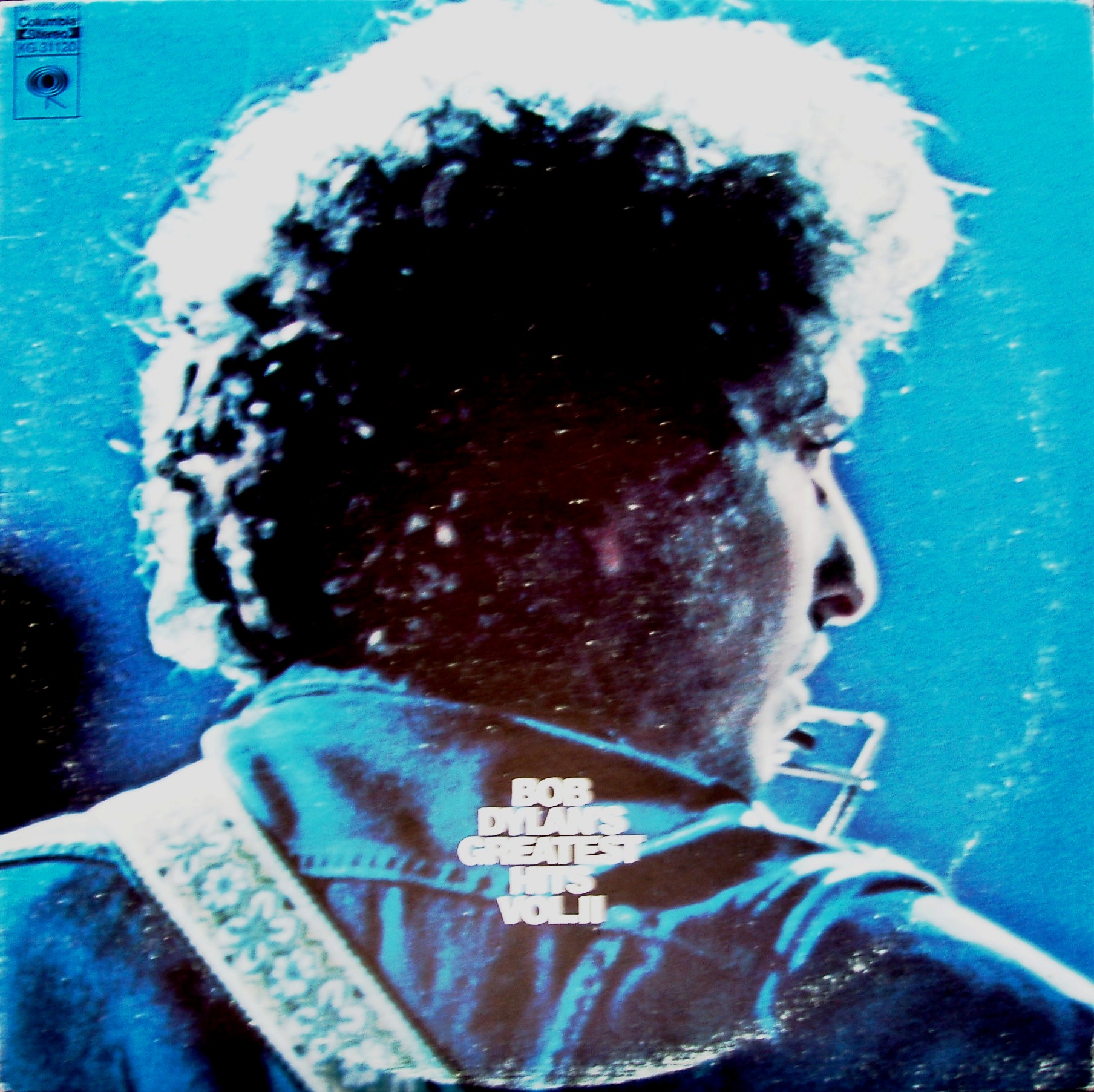
The line is from a Bob Dylan song, “Watching The River Flow.” Though it was released as a single in June of 1971, I’ve always known it as the opening track of the double LP set, Bob Dylan’s Greatest Hits, Vol.2.

Greatest Hits, Vol.2 reached record store shelves on November 17, 1971.

Seen by some at the time as being a “piece of product” whose release was perfectly timed for Christmas gift-giving, this compilation is something more.

According to Anthony Scaduto, in the 1973 paperback edition of his book Dylan: An Intimate Biography, Dylan told him: “I produced every bit of it.” Scaduto writes that Greatest Hits, Vol.2 was “Dylan’s concept from beginning to end, every single note of it, even including jacket photos. The album is as carefully structured as any Dylan concert ever was – and Bob always devoted an enormous amount of energy to planning the sequence of his songs so that he could create precisely the right amount of tension and response from his audiences. Dylan conceives an album the way a writer conceives a book of poetry, or a novel.”

In the 2002 All Music Guide To Rock, Stephen Thomas Erlewine describes the set as “largely comprised of album tracks which became classics, either through Dylan’s own version or through covers” and gives it a starred, “Essential Recordings” rating.

Here’s the track listing for side 1.

1) “Watching The River Flow”

2) “Don’t Think Twice, It’s All Right”

3) “Lay Lady Lay”

4) “Stuck Inside Of Mobile With The Memphis Blues Again”

“Watching The River Flow,” while not the newest recording in the set, sparks and sparkles right from the start with its bluesy, attention-grabbing electric slide guitar solo played by one of the best lead guitarists of the day, Jesse Ed Davis. (Some listings of the credits for this recording have him under the pseudonym “Joey Cooper.”)

Next comes vintage 1963 Dylan at his acoustic-guitar-fingerpicking, harmonica-blowing, Folk Singer/Songwriter best. Then comes slickly produced, almost crooning (is that voice really Bob???), recorded-in-Nashville Dylan from 1969 and finally: the newly-electric, 1966 Blonde On Blonde Dylan in all his image- laden, psychedelicized glory.

Whew.

Did I mention that this was a 2-record set?

The collection ends with four more “previously unreleased” recordings.

The first is Bob’s take on a song of his that the Band had recorded about a year earlier: “When I Paint My Masterpiece.” This vibrant track comes from the same March, 1971, Leon Russell-produced, New York City recording sessions that produced “Watching The River Flow.”

Side 4  finishes with re-recordings of three songs from Dylan and the Band’s yet-to-be-officially-released-but-already-legendary 1967 Basement Tapes sessions.

“You Ain’t Going Nowhere,” “I Shall Be Released” and “Down In The Flood” are presented here in joyous, acoustic renditions that make me think that I’m listening to Bob and his friend Happy Traum jamming away on someone’s back porch up in the hills of Woodstock, NY, or somewhere.

Recorded at Columbia Records’ Studio B in New York City, these performances were the result of a single afternoon session on September 24, 1971. Happy Traum contributes bass guitar, banjo, acoustic guitar and backing vocals to the tracks.

The album jacket photos, by the way, were all taken on August 1, 1971 at the Concert For Bangladesh, an all-star benefit concert organized by George Harrison and held at New York’s Madison Square Garden. Dylan was the “surprize” special guest and he performed with a back-up band consisting of  Harrison on electric guitar, Leon Russell on bass guitar and Ringo Starr on tambourine.

If I had to distill my CD/Record collection down to include only two Bob Dylan albums, I’d be quite happy for another forty years with Greatest Hits, Vol.2 and the first, single disc Greatest Hits

Music this good will never, ever get old.

Posted in Random Topics | Tagged , , , , | Leave a comment