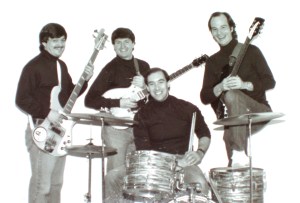
The subject was first broached in the Spring of 2010. It was Les’ idea.
“What do you think about getting Merseyside together again?”
Andy, Bob and Eric each basically gave him the same initial response.
“What did the other guys say?”
In the years since their last performance – Feb. 12, 1994 – the members of Merseyside continued on as they had before and during their time together: they led their lives (with marriage and children for some), continued their careers as performers, teachers, songwriters, recording artists and they remained friends. Amazingly, they each worked the same “day job” in 2010 that they had worked in 1990 and their paths often crossed.
Getting the band together again, however, needed a reason beyond “for old time’s sake.”
Well…
Andy was the choir director at the local middle school. Every spring, his select, 8th-grade Chamber Choir would travel to perform and/or compete in a choral festival and see a bit of the country outside of N.H. The last trip had been to Disneyworld. The 2010-11 Chamber Choir was planning on going to Washington, D.C. Making the trip happen required a school-year long effort involving the singers and the singers’ parents in a host of fundraising activities and events.
One of the members of the 2010-11 Chamber Choir was Aubrey, daughter of Les and his wife, Annie. In September 2010, Annie went to the first organizational parent’s meeting for this year’s choir trip. When the subject of fundraising came up, she saw the possibility: Merseyside could get back together and give a concert to help the Chamber Choir. Annie told Andy about her idea at the meeting and when she got home, she told Les. Soon, Les told Eric and Bob.
Now, given a very good reason, they all said “Yes.”
The first rehearsal was Monday evening, October 18, 2010.
It was an “unplugged” rehearsal: acoustic guitars, a wooden-table-top-turned-drum-set and four voices. Among the songs chosen to run through were: “I Saw Her Standing There,” “Please Please Me” and “She Loves You.” These were some of the first songs they’d played together back in December of 1990. But the main purpose of this rehearsal was to simply see if they could still do it. Could they still play and sing this music and sound good together?
The answer, post-rehearsal, was an enthusiastic “Yes!”
The date for the concert was thus confirmed: Thursday, April 7, 2011. Show time: 7:00 pm.
This would be twenty years and one day from Merseyside’s first gig.
The similar second rehearsal was held on November 15: “It Won’t Be Long,” “This Boy,” and “Help” to name a few. Andy asked if they could add “Let It Be,” one they’d not done before, and he would play piano on that and “Hey Jude.” Eric offered to switch to bass guitar for those two tunes.
The first “plugged” rehearsal – electric guitars, a real drum set, microphones and a PA system – was on Saturday night, February 12. They played for over three hours and made their way quite successfully through all of the now-22 songs on the set list. As Andy later wrote, it was a “good night.”
On February 28, Les emailed the others to say that he’d received an enthusiastic and positive reply from Jeff Landrock to do the “sound” for the concert. Jeff was well known to all the members of Merseyside, mostly as singer/guitarist/keyboard player for the Beatles tribute band All Together Now. Jeff told Les that he and Ace Bailey, drummer for All Together Now, would bring the band’s entire sound sysytem and do the whole deal: an afternoon sound check/rehearsal and the evening concert on April 7.
The month of March saw the first steps towards promoting the “20th Reunion Concert”: the launching of the Merseyside website and the production of a concert poster, all thanks to Les and Annie.
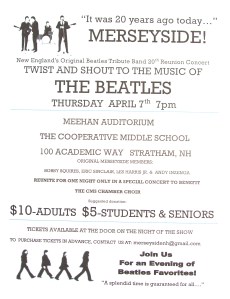
There were also several rehearsals in March, both unplugged and plugged, and the introduction of Melissa Moore, Les’ sister, on back-up vocals and auxiliary percussion (such as the cowbell on “You Can’t Do That” and the bongos on “A Hard Day’s Night”). Melissa brought her wonderful voice, an encyclopedic knowledge of Beatles’ harmonies and immediately added to the overall vocal blend and “tightness” of the band.
March rehearsals also featured the first run-throughs with the aforementioned Aubrey playing the bass guitar on “Something.” This very-talented 8th-grader, who took her first guitar lessons with Eric and studied bass with her uncle (and member of All Together Now), Tom Moore, knew the complex Paul McCartney part note-for-note. Andy was now able to add some colorful keyboard sounds to this number. Aubrey also would play on “Birthday,” “The End” and was enlisted by Eric to take over the bass guitar duties on “Hey Jude.”
On the morning of Saturday, April 2nd, Andy, Les and Eric were special guests on the “Tayles & Company Show” on AM1540-WXEX, an Exeter-based radio station. Besides promoting the up-coming concert, the Mersyside threesome chatted, reminisced and spun their favorite Beatles records with host Bill Taylor.
The remainder of April 2nd was taken up by the final dress rehearsal for the show. The highlight of the afternoon was the addition of Andy’s sons: Alex, on drums and Jay, on guitar, for run-throughs of “Birthday” and “The End.” Besides their impressive skills, these young musicians brought another layer to the web of connections underlying this event: Alex had studied drums with Les, Jay studied guitar with Eric and the day of the concert would be Alex’s 20th birthday!
The promotional/publicity side of things got a big boost when the April 3 edition of the local newspaper, Seacoast Sunday, featured a really exceptional article on the band and the concert by writer Vandy Duffy, whose daughter was a member of the 2010-11 Chamber Choir.
Vandy’s article, read and enjoyed by many, sparked a particular response from a man named Bill Faulkner.
Bill was a friend of Bob’s and a member of the board of directors of the Brad Delp Foundation. Since Brad Delp (original lead singer for the band Boston) had been a long-time friend of Bob’s and they had played together for many years in the Beatles band Beatle Juice, and since Brad had been inspired to form Beatle Juice after attending a Merseyside concert, the Foundation wanted to help in the fund raising effort for the Chamber Choir.
After much emailing between Bill and Annie and Les and Andy and Bob, a most generous donation was offered and a plan made for Pamela Sullivan, a member of the board of the Brad Delp Foundation, to make a presentation to members of the Chamber Choir at the concert.
All of Merseyside went: “Wow!”
Finally, sunny and warm, Thursday, April 7 arrived.
By mid-afternoon, the stage of Meehan Auditorium at the Cooperative Middle School was loaded with sound equipment and musical instruments: stacks of PA speaker cabinets and a row of floor monitors; multiple guitar amps and guitars; two drums sets (at center stage, on a riser, was Les’ Ludwig set with “Merseyside” printed on the bass drum head); an electric keyboard and a baby grand piano; choral risers; and a small forest of microphone stands and microphones.
Thanks to Jeff and Ace, the sound check/rehearsal went very smoothly.
All of the musicians were excited (that’s an understatement) and ready to play.
A few minutes after 7:00 pm, the house went dark. On the large screen hanging in front of the closed curtain, the excellent and very entertaining “History of Merseyside” video that Les had painstakingly put together began to run. With a soundtrack of Beatles songs and screaming Beatles’ fans, archival promotional photos and in-concert shots of Merseyside blended seamlessly with comparable photos of the actual Fab Four.
As the video ended, the screen rose and the curtain opened. The warm applause of a multi-generational audience of several hundred fans, friends and family, flooded the stage.
Les counted off the tempo and… the concert began.
“It was twenty years ago today…,” Bob proclaimed. “We’re Sgt. Pepper’s Lonely Hearts Club Band..,” Eric, Andy, Les and Melissa confirmed, adding their voices in sweet, perfect harmony. The segue into “With A Little Help From My Friends” presented Les singing the part of Billy Shears with his exultant bandmates chiming in with their melodic questions (“Do you need anybody?”) and answers (“high with a little help from my friends”).
A mini-set of rocking, circa-1963 numbers followed. “Please Please Me,” “It Won’t Be Long,” “This Boy” and “Twist and Shout”: ringing electric guitars, joyous vocals, propulsive bass and that unmistakeable Beatle beat rolled out into the welcoming ears of the jubilant listeners.
“You Can’t Do That” featured Bob on electric 12-string (with the help of his friend and long-time Beatle Juice guitar tech, Brian Dixey) and Melissa bringing in that cow bell. “Can’t Buy Me Love” had Eric switching to acoustic guitar (behind Bob’s chart-topping vocals) and then “I Feel Fine” brought him back to the Rickenbacker for his one lead guitar solo of the night. The first set wrapped up with vibrant renditions of the classic hits: “I Want To Hold Your Hand” and “She Loves You.”
“Yeah, yeah, yeah,” indeed.
Set 2.
“One, two” and on “three,” a gorgeous, 19-string, G7sus4 chord erupted from the stage and “A Hard Day’s Night” kicked off the rest of the evening’s entertainment.
“If I Needed Someone” brought Les back to the vocal spotlight, followed by a punchy “Ticket To Ride.” Smooth 3-part harmonies and Andy’s lead vocal highlighted “Nowhere Man” and then the band offered up a spot-on rendering of “Help,” with Bob on lead and Andy and Eric’s “when,” “nows” and “but” perfectly in place.
Les dedicated “In My Life” to his Grandmother, who bought him his first Beatles’ records and invited sister Melissa to sing along with him. Eric took the lead vocals on “Come Together” (one of his favorites from the early days) and switched to bass guitar as Andy moved to the baby grand for “Let It Be.” This song introduced eight members of the 2010-11 Chamber Choir, placing their crystaline background vocals behind their teacher’s superb turn at the lead.
“Something” brought Aubrey and her bass guitar front and center, accompanying her Dad on lead vocal in a performance dedicated to Annie. With Aubrey staying on bass, Jay and Alex took their places behind their respective electric guitar and drums. The now eight-member Merseyside exuberantly thundered their way through “Birthday” followed by the awesome drum solo (played in a bring-the-house-down duet by Les and Alex) and the three guitar, call-and-response solo exchange (dazzlingly played as one by Bob) of “The End.”
Before the next song, Pamela Sullivan from the Brad Delp Foundation was invited to the stage. Her soft-spoken presentation chronicling the connection between Merseyside and Brad and Beatle Juice and the sincere wishes of the Foundation to lend their new friends a helping hand left few eyes dry and brought the audience warmly to their feet.
Then came “Hey Jude.”
Bob took the lead vocal, Andy moved back to the piano, Eric on acoustic, Les at the drums, Mellisa added back-ups, Aubrey still on bass and the entire 2010-11 Chamber Choir filled the risers. From the first “…don’t make it bad” to the last “na.., na.., na., na-na-na-na…,” musicians and audience came together as one. Spirits soared, smiles beamed, all voices rose in euphoric musical bliss. (That’s not an overstatement.)
Before the applause died and before anyone could sit back down, one last “One, two, three, four..” cut through it all and Merseyside romped their way through “I Saw Her Standing There.” The aisles filled with dancers and those at their seats bounced, clapped and shimmied away as well. Andy and Eric gathered around Bob as he played one last sparkling guitar solo. Two electric guitars, one bass guitar and the drums punctuated the climactic E7 chord with a raucous, unison crash.
The Merseyside 20th Reunion Concert was over.
Thanks to the inspiration, dedication, generosity, friendship and hard work of everyone involved, the Merseyside 20th Reunion Concert/2010-11 Chamber Choir fundraiser was a phenomenal success, financially and musically.
For everyone there that evening, Thursday, April 7, 2011, a spendid time, as guaranteed, was most certainly had by all.
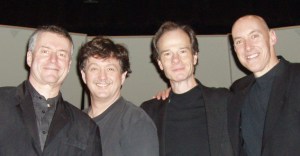
Merseyside
Bob Squires, Andy Inzenga, Eric Sinclair & Les Harris, Jr.