sixstr stories was born on Sunday, April 18, 2010, on my daughter’s laptop computer. I sat next to her on the couch in her Somerville, Massachusetts apartment and watched as she made her way through Word Press and set the whole thing up for me.
“There you go, Dad. You’ve got a blog!”
Five years and 292 posts later, sixstr stories is still here and going strong.
On Saturday morning, March 28, 2015, the “Today’s Headlines” email that I receive from The New York Times delivered this very sad news: “John Renbourn, Eclectic Guitarist Who Founded the Pentangle, Dies at 70.”
According to the obituary by Jon Pareles, John Renbourn – “an English guitarist known for his light-fingered fusion of classical, folk, blues and jazz” – was found dead on Thursday, March 26, at his home in Harwick, Scotland, after he failed to show up for a concert in Glasgow on the 25th. Upon further investigation, it was determined that Renbourn had suffered a heart attack.
I offer this post about John Renbourn in tribute not only to the guitarist whose many, truly remarkable recordings have so enriched my life, but also to the teacher who pointed me towards outposts in the world of guitar that I still explore and that I would otherwise, possibly, never have found.
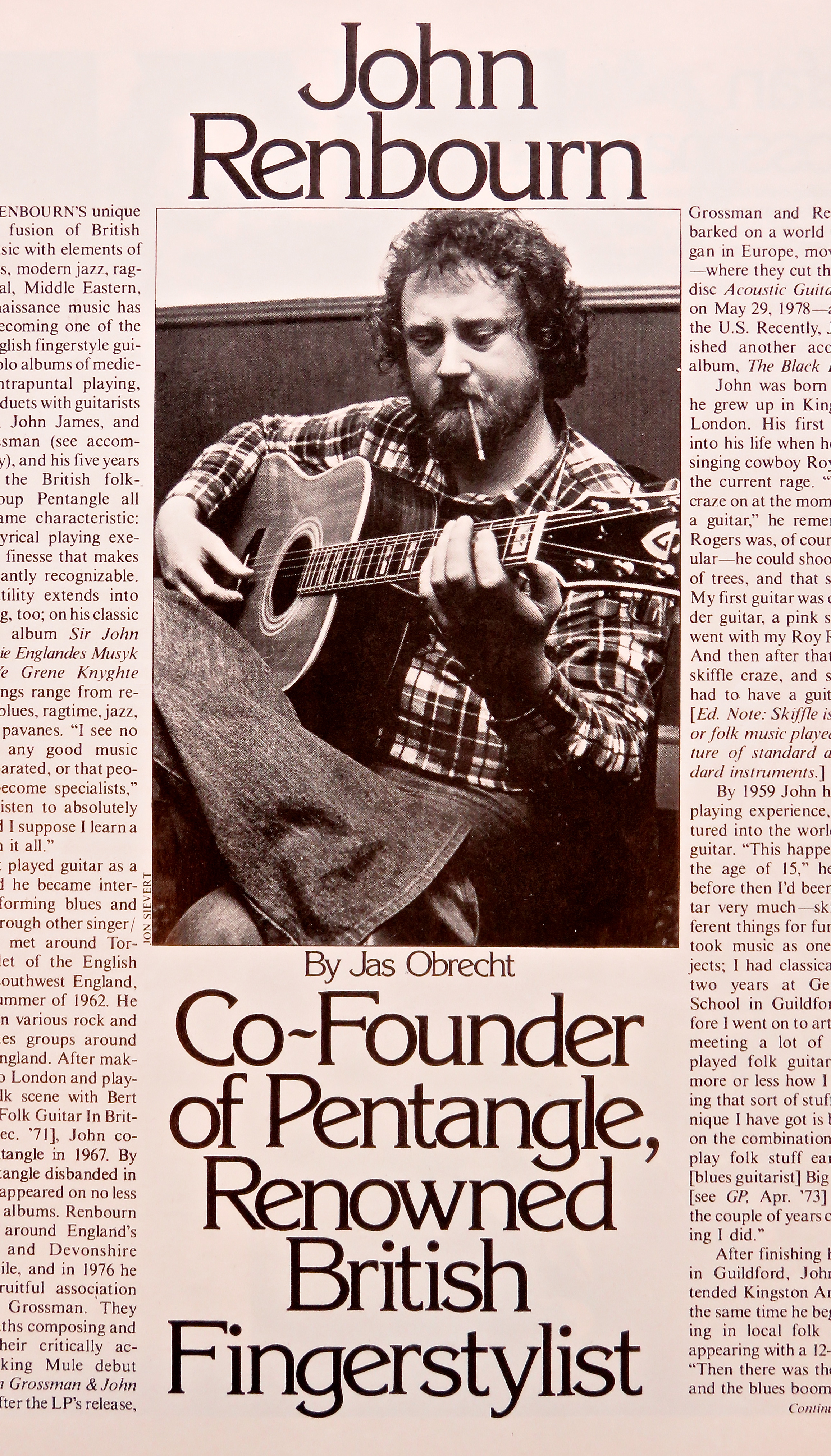
I first learned about John Renbourn from an article in the April, 1979 issue of Guitar Player magazine.
The article, written by Jas Obrecht, one of Guitar Player’s assistant editors at that time, was based on an extensive interview with the British fingerstyle steel-string guitarist.
From Mr. Obrecht’s piece, I learned that John Renbourn was born in 1944. (August 8, 1944, in Marylebone, London, England, to be precise.) John got his first guitar – a pink, acoustic “Wonder” guitar – when he was 13 years old and enthralled by the film exploits of Roy Rogers, the American singing cowboy. Something called the “skiffle craze” sustained John’s interest in playing guitar until, at the age of 15, he started taking what would turn into two years of formal Classical guitar lessons. John also, at this time, tried his hand at playing some “things” by the American Blues guitarist, Big Bill Broonzy.
In the early 1960’s, while attending the Kingston Art School, John took up the electric guitar and played in a Blues band known as “Hogsnort Rupert And His Famous Porkestra.” In 1964, John moved to London, returned to the acoustic guitar, landed some gigs in the local Folk clubs and met fellow acoustic fingerstyle guitarist Bert Jansch.
I further learned that John Renbourn’s recording career started in 1965 with the release of his first album, John Renbourn on Transatlantic Records. A duet album with Jansch came out in 1966 followed by John’s second solo album, Another Monday in 1967.
More importantly, also in 1967, John and Bert – along with vocalist Jacqui McShee, bassist Danny Thompson and percussionist Terry Cox – formed a band they called “Pentangle.” Pentangle achieved international success, toured Europe and the U.S. several times and released six albums before disbanding in 1973. (You might remember their version of “Sally Go ‘Round The Roses.”)
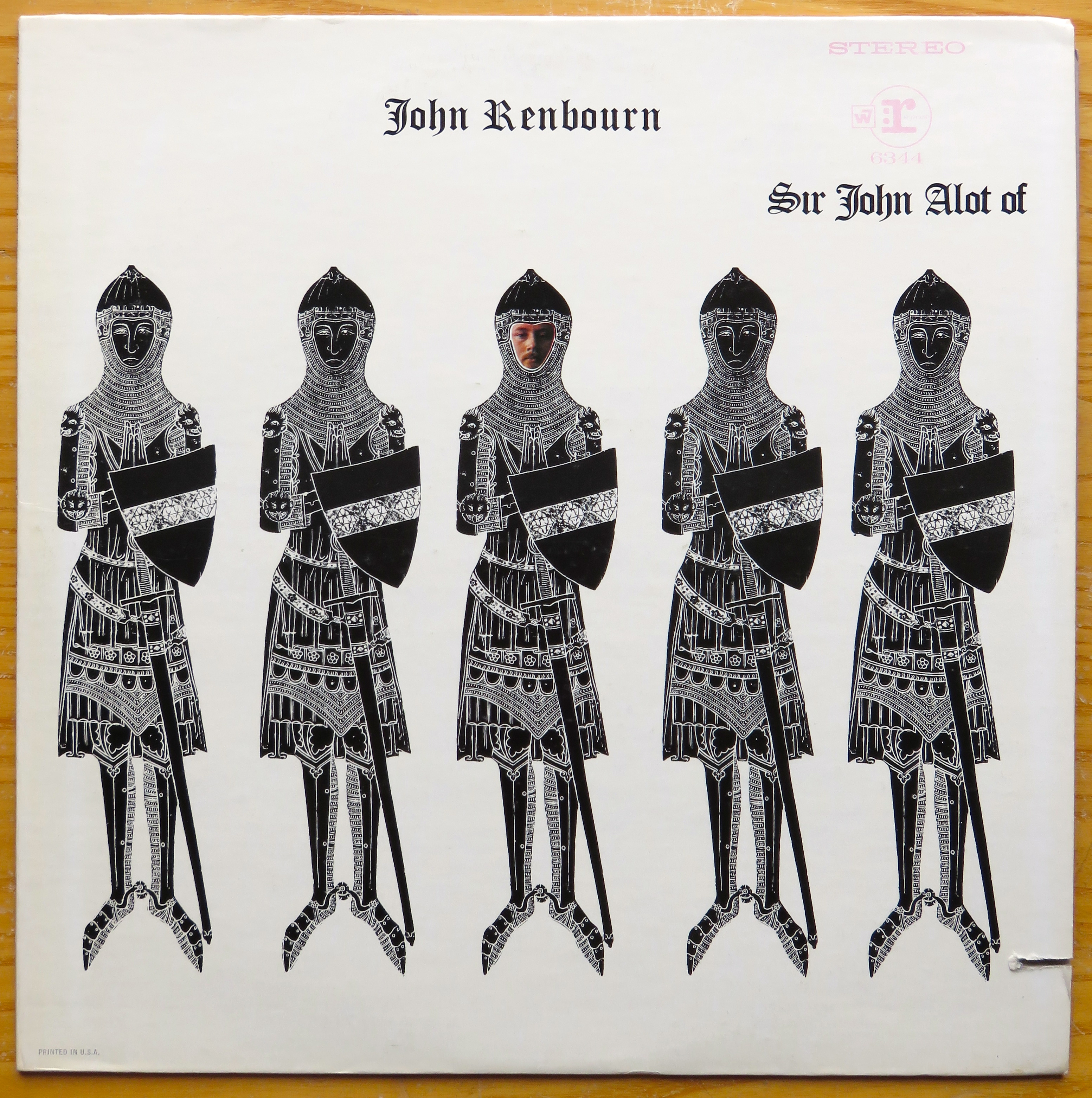
Mr. Obrecht’s lengthy article also informed me about John Renbourn’s numerous other recordings; including his 1968 solo album, Sir John Alot of Merry Englandes Musyk Thyng & ye Grene Knyghte,
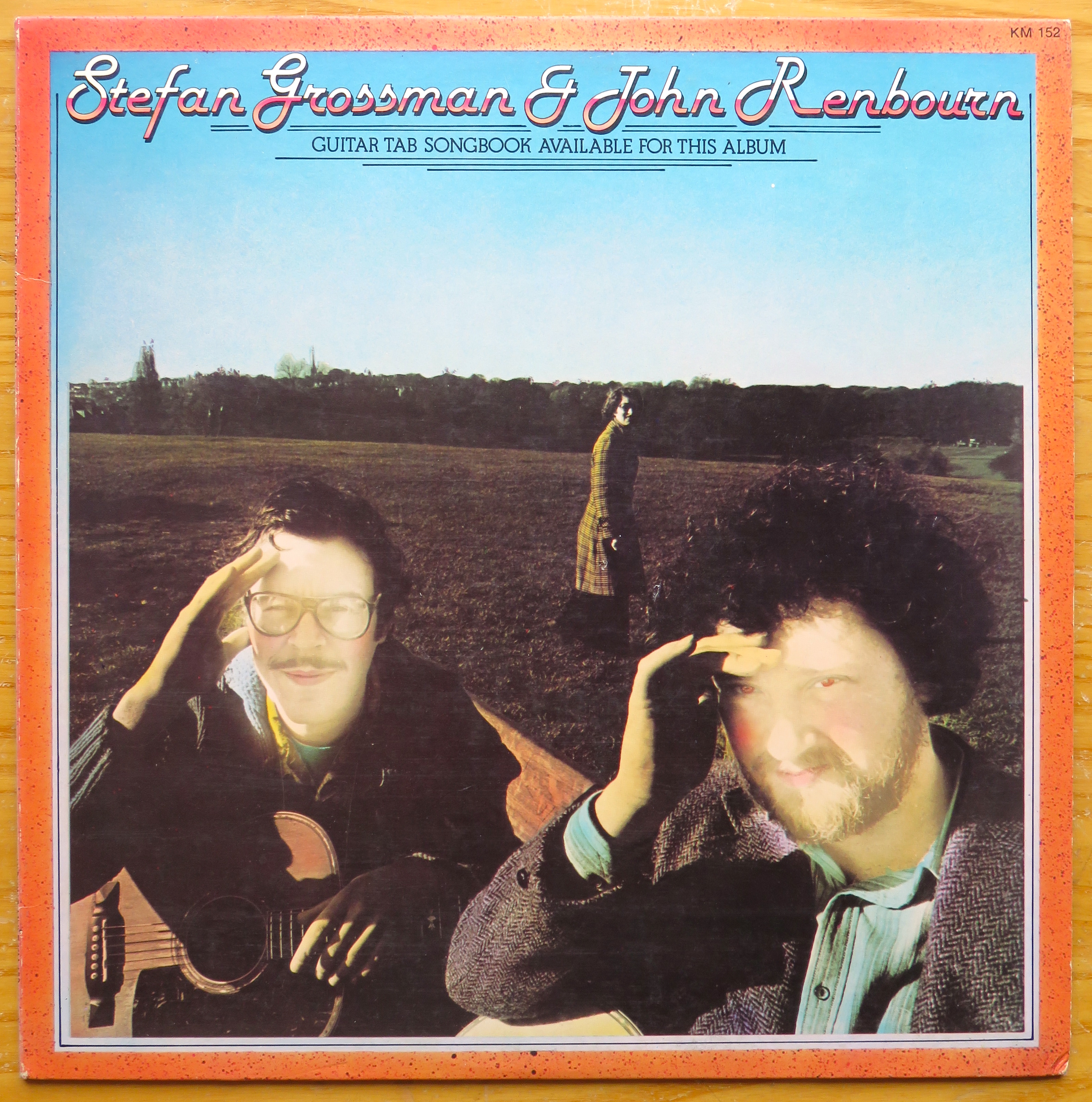
and an album of duets that he did in 1978 with American guitarist Stefan Grossman for Kicking Mule Records.
Finally, Mr. Obrecht described the scope of John Renbourn’s music as ranging from “refined Folk to Blues, Ragtime, Jazz, Ballads and Pavanes.” He followed that description with this quote from John: “I see no reason why any good music should be separated, or that people should become specialists. I listen to absolutely everything and I suppose I learn a little bit from it all.”
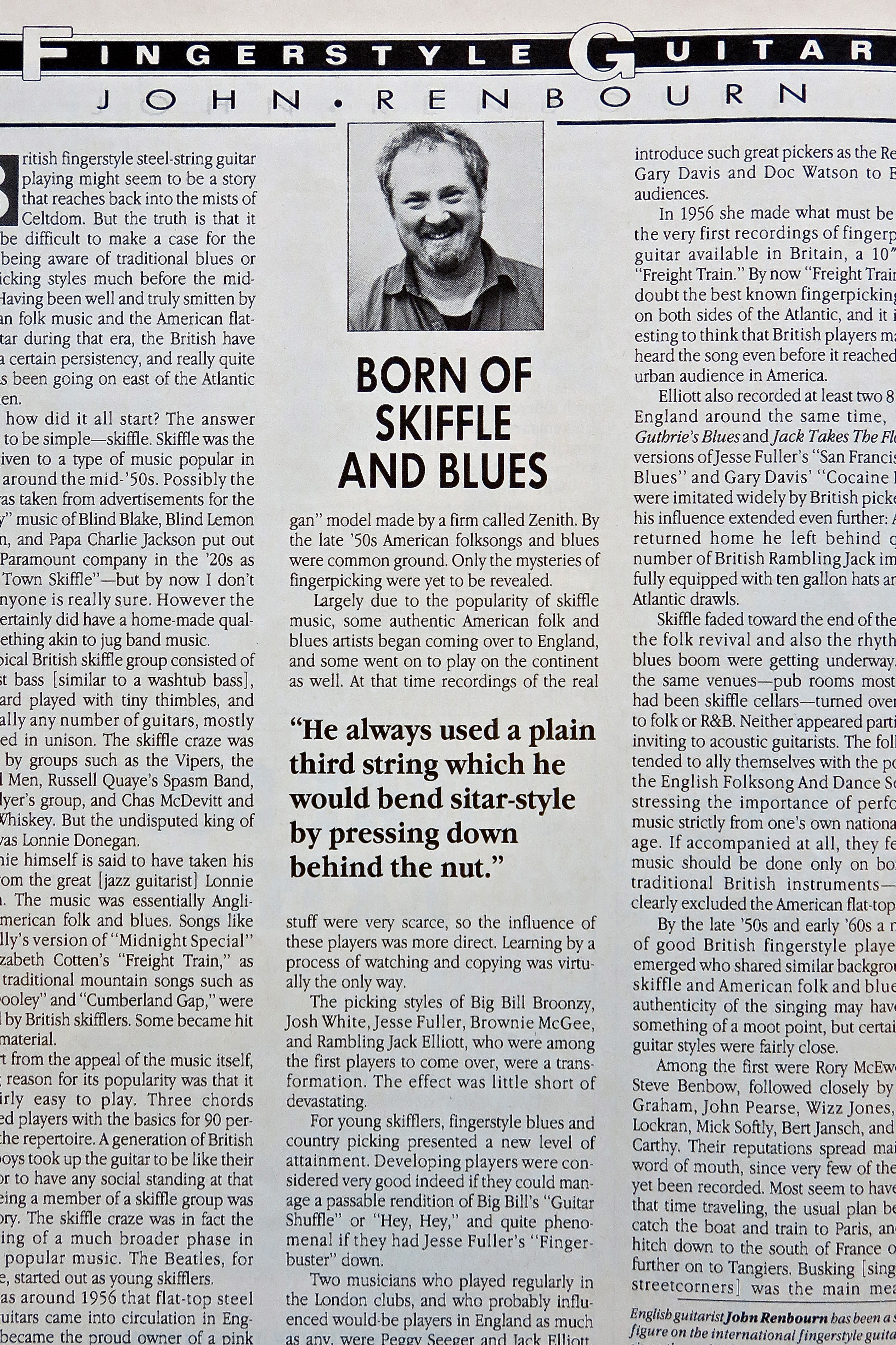
I started learning from John Renbourn thanks to a monthly column that he wrote for Frets– The Magazine For Acoustic String Musicians. John’s column, called “Fingerstyle Guitar,” debuted in the publication’s June, 1988 issue. The magazine credited John as being “a seminal figure on the international fingerstyle guitar scene since the early ’60’s.”
From that very first column, I learned all about Lonnie Donegan and the “skiffle craze” that had so inspired the young John Renbourn.
I also learned about the many American Folk and Blues musicians – Big Bill Broonzy, Josh White, Ramblin’ Jack Elliott, Peggy Seeger and Elizabeth Cotten, among them – whose music fueled the players – Davey Graham, Wizz Jones, Bert Jansch, Martin Carthy and Renbourn, to name a few – who were the fingerstyle guitar scene in Britain in the 1960’s.
In future columns, John Renbourn introduced me to many wonderful pieces of music for the acoustic guitar such as:
“Anji” – Davey Graham’s signature guitar piece, most famously recorded by Bert Jansch.
“Kemps’ Jig” and “House Carpenter” – two old, traditional melodies from Great Britain arranged by Renbourn to be played using DADGAD tuning (an alternate guitar tuning credited to Davey Graham),
“Merrily Kissed The Quaker” – a pipe tune played in EADEAE tuning, a guitar tuning developed by Martin Carthy.
(Every column included a complete transcription of that month’s featured piece presented in both standard musical notation and guitar tablature.)
After Frets bid farewell with its August, 1989 issue, John Renbourn soon set up shop in Guitar Player magazine, making regular contributions throughout the early 1990’s to a column first called “Steel-String Acoustic,” and then just “Steel String.”
Through the “Steel String” columns from those years, I learned about the popular late-19th century American Folk guitar style known as “parlor guitar.”
The transcriptions of parlor guitar music that John Renbourn presented to me in those Guitar Player columns included:
“Spanish Fandango” – played using open G tuning (DGDGBD), transcribed in arrangements by Henry Worrall and John Dilleshaw, and found in the repertoire of Elizabeth Cotten.
“Po’ Howard” as played by Huddie Ledbetter,
“Sebastopol” – also by Henry Worrall but played in open E tuning (EBEG#BE), and
“The Blarney Pilgrim” – an Irish dance tune (I guess he couldn’t resist) in the open G tuning of “Spanish Fandango.”
Besides writing about and arranging “old” music for the steel string guitar, John Renbourn composed “new” pieces of music for the instrument as well. From the seven originals on his first album to the six originals on his last album – 2011’s Palermo Snow – John wrote and recorded dozens of acoustic guitar instrumentals in a variety of styles over the course of his long career. His 1988 LP, The Nine Maidens, contained only Renbourn originals.
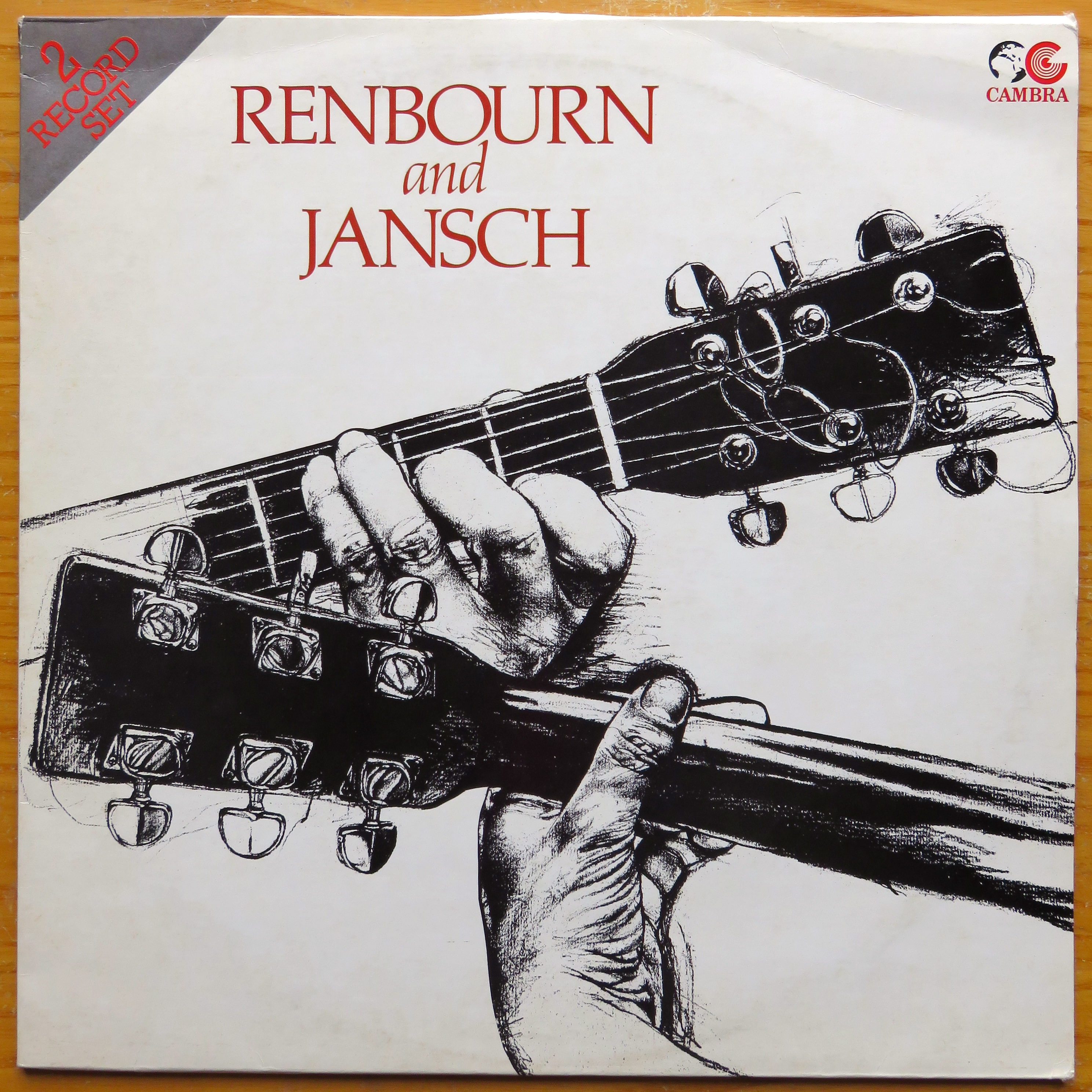
My favorite John Renbourn composition is called “Buffalo.” It was first released on the Another Monday album, but I discovered this jaunty, Blues-based number on a 1985, 2-record set on the British Cambra Sound label called Renbourn and Jansch.
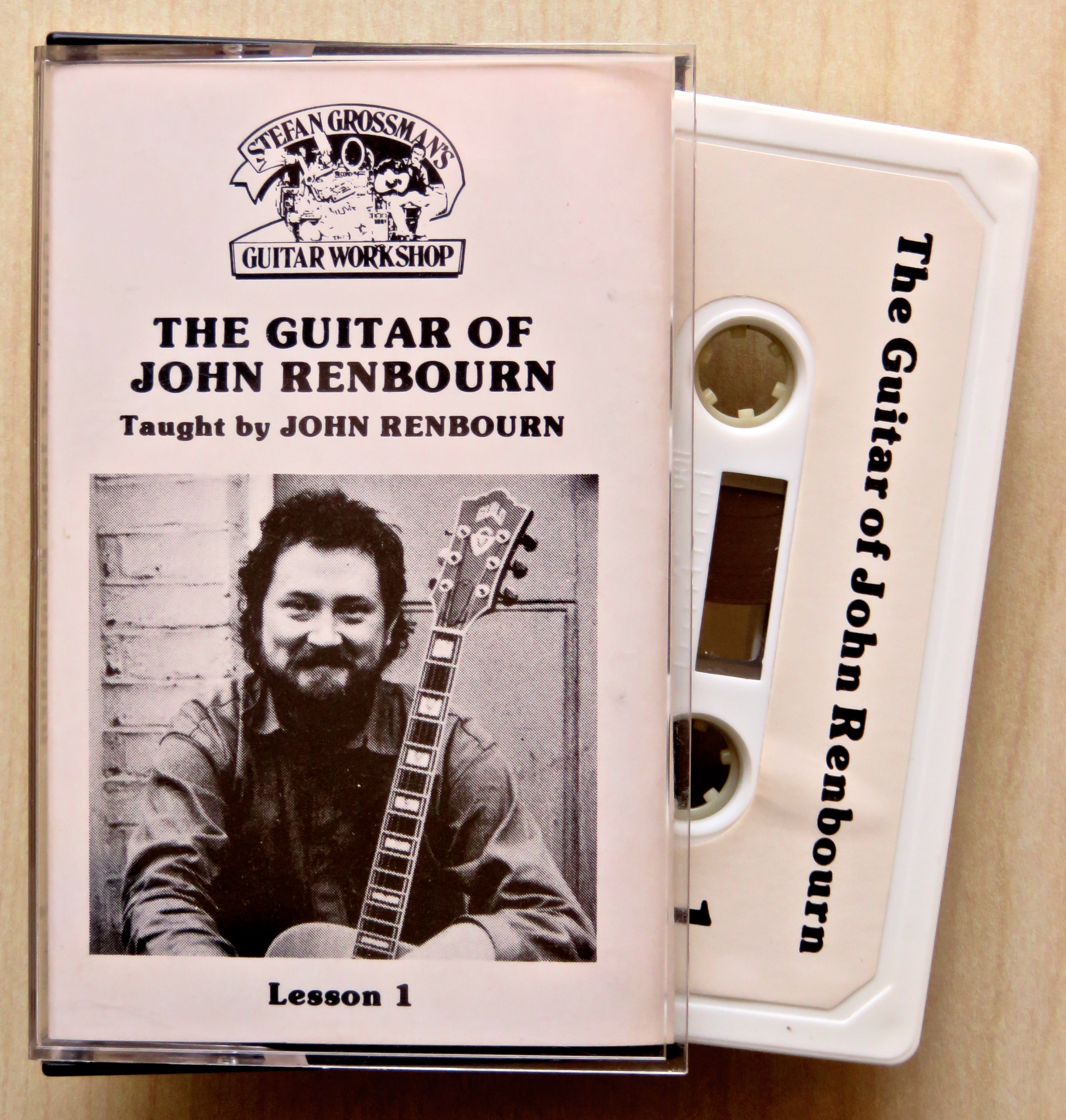
I learned how to play “Buffalo” with the help of a taped guitar lesson (I’m talking cassette tape here. Remember those?) that I purchased from Stefan Grossman’s Guitar Workshop, a New York-based mail-order company.
The Lesson was #1 in a series called The Guitar of John Renbourn – taught by John Renbourn. The audio recording on the cassette tape was of John Renbourn himself (!) first playing “Buffalo,” then teaching – discussing, breaking down, explaining, slowly demonstrating, gradually reconstructing – this instrumental to the carefully listening student.
It seems to be quite appropriate that the only video I can find on YouTube of “Buffalo” to share with you is one in which John Renbourn is heard and shown playing and teaching the piece.
Even if you don’t play the guitar, I think you will enjoy spending a few minutes in the company of the master.
For your additional listening pleasure, here is “Snap A Little Owl,” my favorite track from Stefan Grossman and John Renbourn.
I will be forever grateful to John Renbourn for teaching me that developing an appreciation of the music and players of the past as well as the music being created by the innovative practitioners of today is an essential ingredient in the musical journey of every guitarist.
I only wish that I had been blessed with the opportunity to say “Thank you” to him in person.
“Well, my mother told my father, just before I was born
I got a boy child comin’, gonna be a rollin’ stone,
Sure ‘nough he’s a rollin’ stone.”
From the song, “Rollin’ Stone” by Muddy Waters.
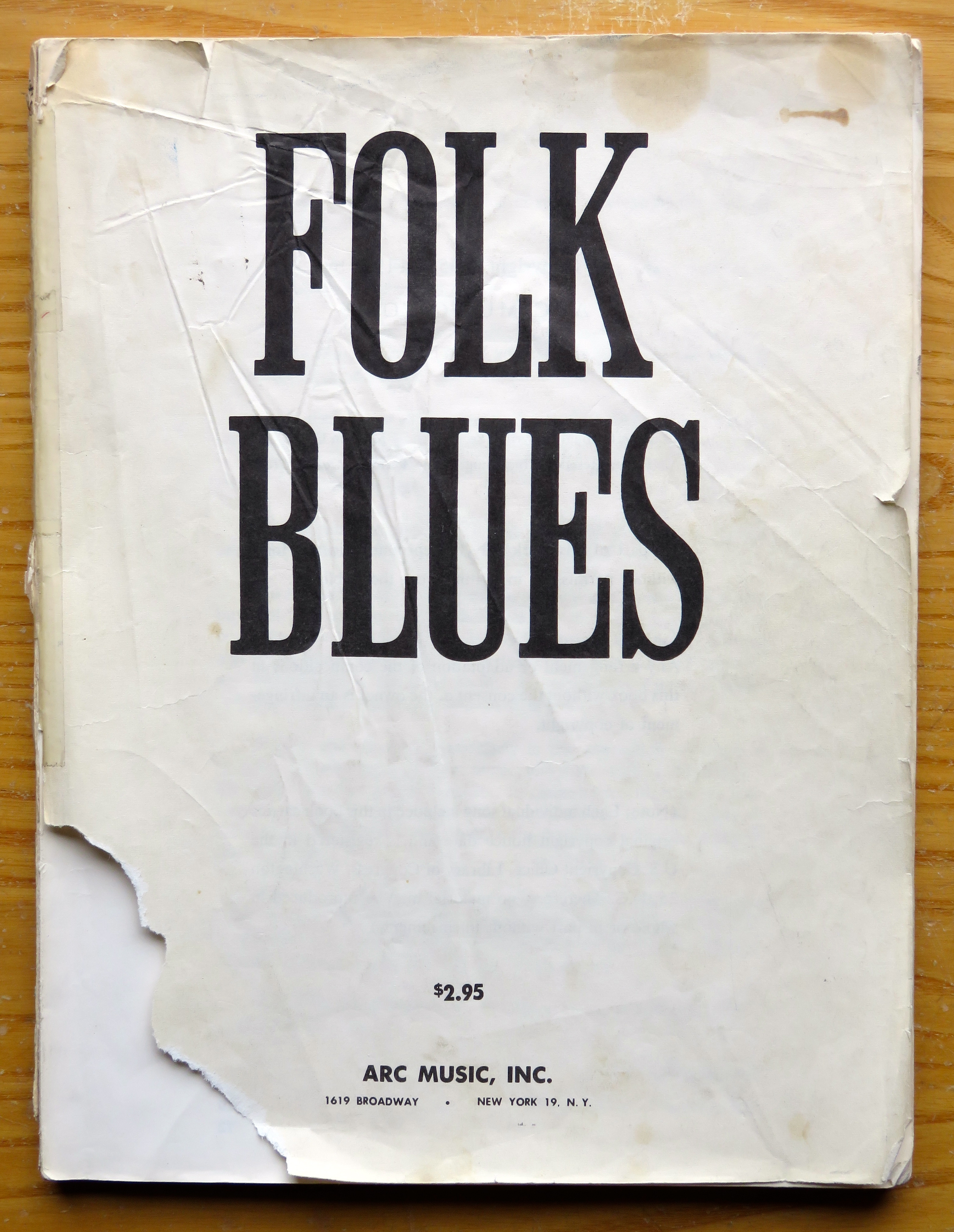
Many years ago, I bought a songbook called Folk Blues.
This 9″ x 11 & 3/4″ paperback volume – it did have a cover at one time – was published by ARC Music, Inc. in New York, NY and bears a copyright dated 1965 and 1969. In the foreword, Paul Ackerman, a music editor for Billboard magazine, wrote: “It is the intent of this collection of songs to illustrate the blues in their infinite variety.”
Most of the 103 songs in this collection were written by either Chuck Berry or Willie Dixon. Among the other songwriters represented are Lowell Fulson, John Lee Hooker, Ellas McDaniel and McKinley Morganfield.
McKinley Morganfield performed and recorded under the name Muddy Waters. (His grandmother nicknamed him “Muddy” when he was a child.)
(Ellas McDaniel is better known by his stage name: Bo Diddley.)
One of the four songs attributed to McKinley Morganfield in Folk Blues is “Rollin’ Stone.”
Muddy Waters recorded “Rollin’ Stone” in February, 1950 at the Chess Studios in Chicago, Illinois. That recording, featuring him singing and accompanying himself on an amplified acoustic guitar, became Muddy Waters’ first single released on the Chess Records label. (The B-side was Muddy’s version of Robert Johnson’s “Walkin’ Blues,” recorded at the same session.)
Check it out!
“Rollin’ Stone” was not a big seller for Muddy Waters. But in the 1960’s, the song became immortalized as the source of the name of a rather successful British – and at one time “The World’s Greatest” – Rock & Roll band; as well as the name of an American pop culture magazine that is now in its fifth decade of publication.
Depending on what you read, McKinley Morganfield/Muddy Waters was born on April 4, 1915 in Rolling Fork, Mississippi or on April 4, 1913 at Jug’s Corner, Issaquena County, Mississippi.
Either way, Muddy Waters’ music is, to me, ageless; a true example of the sixstr stories motto: “Good music doesn’t get old.”
If you would like to read more of my posts on Muddy Waters, scroll through the Archives for April 2014, April 2013 and August 2010. The April ones are “This Historic Day In Music…” pieces and the August one is called “It Was The Last Week In August.”
It just so happens that three of my favorite guitarists were born in the month of March.
Arthel “Doc” Watson was born in Deep Gap, North Carolina, on March 2, 1923.
John Leslie “Wes” Montgomery was born in Indianapolis, Indiana, on March 6, 1925.
Sam “Lightnin'” Hopkins was born in Centerville, Texas, on March 15, 1912.
I have, of course, written about these gentlemen here in sixstrstories before now.
On March 2, 2013, I posted a “This Historic Day In Music” piece on Doc Watson and on May 30, 2012, the day after he passed away, I composed a brief tribute to him called “So Long, Doc.”
Wes Montgomery got his “This Historic Day In Music” write-up on March 6, 2012.
Lightnin’ Hopkins was featured in a “This Historic Day In Music” post on March 15, 2012 and on March 17, 2011, I wrote my one-and-only “The Day Before Yesterday In Music History” post about the illustrious Mr. Hopkins.
I hope you’ll visit the Archives and check out some – or all! – of those pieces.
This year, I thought I’d let Doc, Wes and Lightnin’ speak for themselves. (Mostly.)
Here’s Doc Watson playing and singing “Sitting On Top Of The World.”
“Sitting On Top Of The World” was written by singer/guitarist Walter Vinson and fiddler Lonnie Chatmon. Performing as “The Mississippi Sheiks,” they recorded the song for OKeh Records in 1930. Doc Watson first cut “Sitting On Top Of The World” for Folkways Records in April, 1962, but the recording was not released until 1994 when Smithsonian Folkways included the track on the 2-CD set The Original Folkways Recordings of Doc Watson and Clarence Ashley.
The album pictured above, Classic Appalachian Blues, is a 2010 Smithsonian Folkways compilation that puts Doc’s rendition of “Sitting…” in the very good company of songs by 19 other Blues artists including Sticks McGee, John Jackson, Pink Anderson and Etta Baker.
Up next, here is Wes Montgomery playing “While We’re Young.”
“While We’re Young” was written in 1943, music by Alec Wilder & Morty Palitz and lyrics by Bill Engvick. Wes Montgomery recorded his solo electric guitar version on August 4, 1961 at Plaza Sound Studios in New York City for Riverside Records. The track was released on Wes’ album So Much Guitar in 1961.
I first heard that recording on the Riverside LP Wes Montgomery: March 6, 1925 – June 15, 1968.
Finally, here’s Lightnin’ Hopkins playing and singing “Penitentiary Blues.”
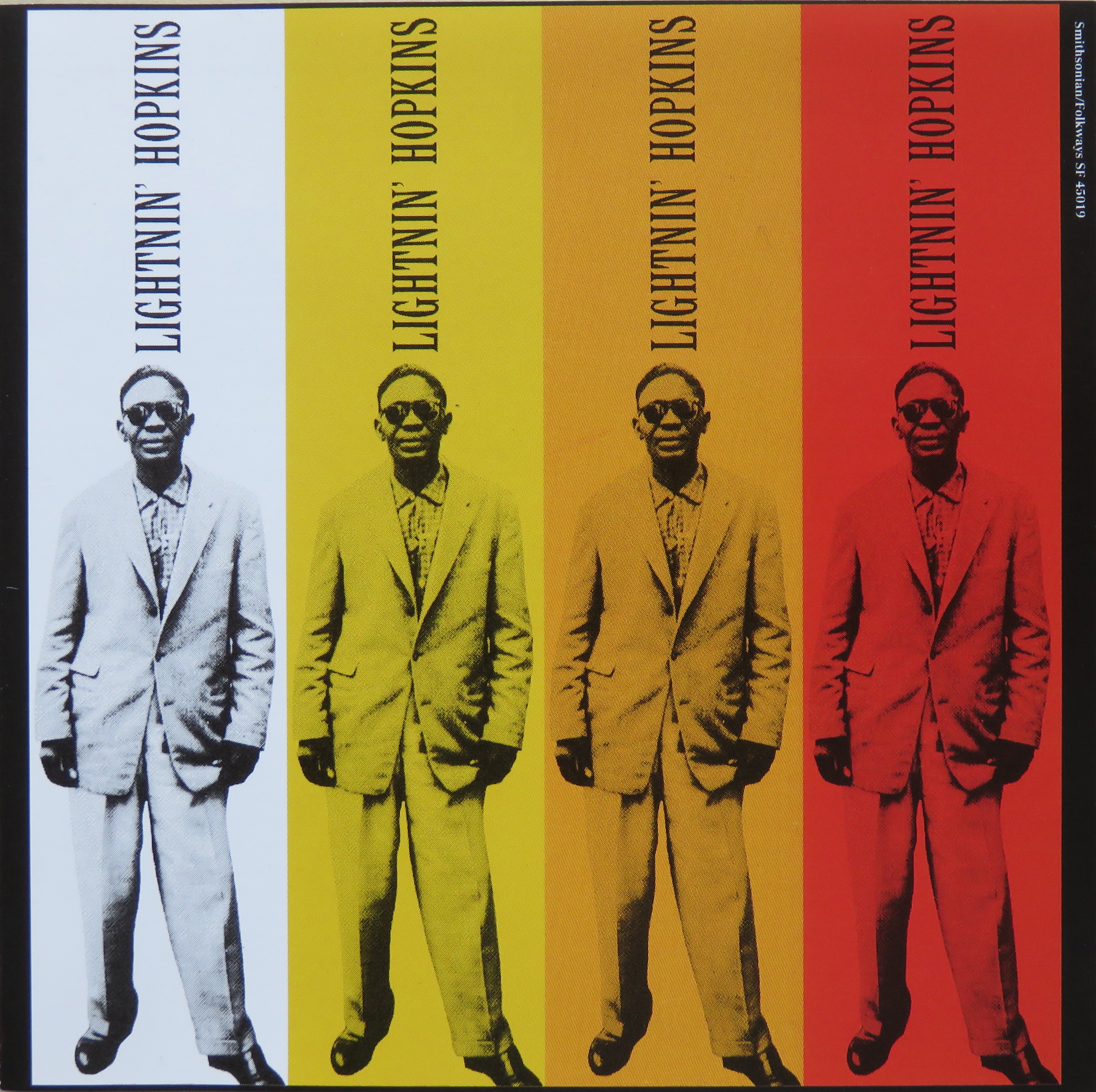
“Penitentiary Blues” is a Lightnin’ Hopkins original. The song was one of nine recorded on January 16, 1959 in a session organized by Blues historian and author Samuel B. Charters. The “studio” was a small rented room at 2803 Hadley Street, Houston, Texas. Having first provided a guitar and a bottle of gin, Mr. Charters then operated the tape recorder and held the microphone as Mr. Hopkins sang, played and reminisced. The resulting album, Lightnin’ Hopkins, was released on Folkways Records later that year.
Now, I often enthusiastically exclaim to my guitar students that “The World of Guitar is a wide and wonderful place!”
If a student were to question that statement, should ask for an example, for some kind of demonstration of the width and wonderfulness of the World of Guitar, I’d immediately introduce him or her to Doc, Wes and Lightnin’.
“Little darlin’, it’s been a long, cold, lonely winter.”
That’s the first line of the first verse of the song “Here Comes The Sun” written by George Harrison in the Spring of 1969.
George started writing “Here Comes The Sun” in Surrey, England, sitting at the bottom of the garden at the Huntwood Edge home of his friend, Eric Clapton. As George later described it in an interview with British journalist, David Wigg: “It was just a really nice sunny day. And I picked up the guitar, which was the first time I’d played the guitar for a couple of weeks because I’d been so busy. And the first thing that came out was that song. It just came.”
George finished “Here Comes The Sun” in June, 1969, while on holiday in Sardinia.
Recording sessions for “Here Comes The Sun” started on July 7, 1969 at Abbey Road Studios in London. It took George Harrison, Paul McCartney and Ringo Starr – for some reason, John Lennon did not participate – six more sessions to finish the track. George played acoustic guitar and harmonium; sang lead and back-up vocals; and clapped his hands on the recording. He also added the final touch of a part played on a Moog Synthesizer during the last session on August 19, 1969.
“Here Comes The Sun” was released on September 26, 1969, as the first track on the second side of The Beatles’ album, Abbey Road.
George Harrison was born in Liverpool, England, on this day, February 25, in the year of 1943. He was the fourth child and third son of Louise and Harold Harrison.
George passed away on November 29, 2001.
If you’d like to read my first This Historic Day In Music post about George Harrison, scroll down the Archives list and click on February, 2013. It will be at the top of the page.
Living here in New Hampshire, it often seems that the winter we’re in the middle of is absolutely the worst winter ever.
(OMG! and WTF!)
The winter of 2015 is definitely in the running for that title.
But as the recent chain of grinding, bitterly cold days gains another link and the mountains of plowed, blown and shoveled snow lining the driveway stand poised to continue their climb to record heights, I am reminded…
…of a song.
The song is called “The Shelter Of Your Arms.”
I found the first draft of the lyrics to this song on pg. 12 of the second volume of my songwriting journals. The page was dated: 2/1/94.
Ah, yes, the inspirational winter of 1994.
I found a recording of the song on my 2003 CD, Love Songs(So Far…).
If you click on the blue link below – and wait for it – you can listen to the song.
(To see more Guitar TAB transcriptions, click on Guitar Music in the Categories list!)
Last April, I wrote a This Historic Day In Music post about “Buck Dancer’s Choice” and “The Franklin Blues”: the first Country Music guitar instrumentals to be put on record.
The guitarist on those recordings was 32-year-old Tennessean Samuel Fleming McGee. Sam recorded both pieces on April 14, 1926 in a New York City recording studio. Sam and his brother Kirk, a banjo player and fiddler, were frequent performers on the Grand Ole Opry and long-time members of a Country band led by Uncle Dave Macon called The Fruit Jar Drinkers.
Writing about and listening to “Buck Dancer’s Choice” led me to want to try my hand at playing the piece, so I went looking for a transcription of it. My copy of Fingerpicking Styles for Guitar (Oak Publications, 1966) by Happy Traum had sheet music for “Buck Dancer’s Choice,” but the transcription was taken from a rather different version of the piece that Sam McGee had recorded in 1964. Most of what I found on-line in the “Guitar TAB” websites that I searched turned out to be variations on the Happy Traum transcription.
I soon realized that if I wanted to play the original 1926 version of “Buck Dancer’s Choice,” I was going to have to figure it out for myself.
So, I did.
And, if I wanted to be able to share what I’d figured out with another guitarist, I would have to transcribe it.
So, I did that, too.
Take a look.
That’s what’s known as Guitar Tablature. Tablature is a system of notation used to write down music for fretted stringed instruments that originated in Europe during the 15th century. The basic concept of tablature is that the horizontal lines represent the strings of the instrument and the numbers on those lines tell the player what fret that string (or strings) should be fingered at to get the desired pitch or note.
If you’re not a guitar player, my transcriptions probably look like they are written in a bizarre, foreign language. TAB transcriptions can sometimes look like that even to someone who does play the guitar!
Here is the recording that started all of this: Sam McGee playing “Buck Dancer’s Choice” as he recorded it on that now-historic day, April 14, 1926. See if you can follow the transcription as you listen!
If you are a TAB-reading guitar player, I hope you’ll take a shot at playing “Buck Dancer’s Choice” from my transcription. (I’m getting better at playing it, but not yet at Sam’s tempo!) Let me know how you think I did transcribing it!
Also, if you have any guitar-playing friends that you think would be interested, please pass a link to this post along to them.
Good music doesn’t get old, especially when it’s this much fun to play or just to listen to.
On Wednesday, January 13, 1965, Bob Dylan entered Columbia Records’ Studio A in New York City to begin recording songs for his fifth album. Joining him in the studio that day was producer Tom Wilson and John Sebastian, a fellow Greenwich Village musician, singer/songwriter and, for this session, bass guitarist.
Of the eleven songs Dylan, Sebastian and Wilson recorded on January 13, six of them would appear on the final album, but none in the versions that were cut during this day’s work.
On Thursday, January 14, Dylan was accompanied in Studio A by a band of New York musicians and session players put together by producer Wilson. The members of this group were: Bruce Langhorne, guitar; Bobby Gregg, drums; John Hammond, Jr., guitar; and William Lee, bass guitar.
With Dylan singing, playing harmonica and either acoustic guitar, electric guitar or piano, this ensemble nailed down album-ready versions of five songs: “Love Minus Zero/No Limit,” “Subterranean Homesick Blues,” “Outlaw Blues,” “She Belongs To Me,” and “Bob Dylan’s 115th Dream.” Three of those – “Love Minus Zero/No Limit,” “Subterranean Homesick Blues” and “She Belongs To Me,” met with Dylan’s approval after the first take!
For the Friday, January 15 session, producer Wilson assembled a somewhat different group for Dylan to work with. Returning guitarist Langhorne and drummer Gregg were joined by guitarists Al Gorgoni and Kenny Rankin, pianist Paul Griffin and bass guitarist Joseph Macho, Jr. This ensemble started off the day with a quick completion of “Maggie’s Farm” and nine takes of “On The Road Again.”
Dylan then cleared the room and recorded “It’s All Right, Ma (I’m Only Bleeding),” “Gates of Eden,” “Mr. Tambourine Man” and “It’s All Over Now, Baby Blue” with just his acoustic guitar, harmonica and vocals. Bruce Langhorne added a high, jangling second guitar part as the finishing touch to “Mr. Tambourine Man.”
“Subterranean Homesick Blues” b/w “She Belongs To Me” was released on March 8, 1965 as the single from the album. It was Dylan’s first Top 40 hit.
Bringing It All Back Home – Columbia LP: CL 2328 (Mono) and CS 9128 (Stereo) – was released on March 22, 1965.
Side One of the album was the “electric side” with “Subterranean Homesick Blues” as the first track.
The “acoustic” Side Two opened with “Mr. Tambourine Man.”
In the poem that is part of his liner notes to the album, Dylan wrote: “I am about t sketch You a picture of what goes on around here sometimes. tho I don’t understand too well myself what’s really happening.”
P.S.: John Sebastian was the lead singer, songwriter and guitarist for The Lovin’ Spoonful, a fabulous Folk/Rock band that had seven consecutive Top 10 hit records from 1965 to 1966.
The sources for the information used in this post were: “Bob Dylan: The Recording Sessions [1960-1994]” (1995) by Clinton Heylin, “Bob Dylan Complete Discography” (2006) by Brian Hinton and Wikipedia.
The Merriam-Webster Dictionary definition of “Songster” is: “one that sings.”
The Norton/Grove Concise Encyclopedia of Music (1988) states that a “Songster” is: “A black American musician of the post-Reconstruction era who performed a wide variety of ballads, dance-tunes, reels and minstrel songs, singing to his own banjo or guitar accompaniment. Songsters were sometimes accompanied by ‘musicianers’, or non-singing string players.” (The post-Reconstruction era officially began in 1877.)
In his liner notes for the 2006 Smithsonian Folkways CD Classic African-American Ballads, Barry Lee Pearson writes that “Songster” is a term drawn from black folk speech by early-twentieth-century sociologist and collector of Southern Folk songs, Dr. Howard W. Odum. (Dr. Pearson is an African-American music scholar and member of the English Department at the University of Maryland.)
Howard Washington Odum (1884-1954) first mentions the term “Songster” in his article “Folk-Song and Folk-Poetry as Found in the Secular Songs of the Southern Negro” which was published in the July-September, 1911 edition of The Journal of American Folk-Lore.
In that article, Mr. Odum states: “In general, ‘Songster’ is used to denote any negro who regularly sings or makes songs.”
Paul Oliver, British architectural historian and prolific author on the Blues, once wrote that “Songsters were the entertainers, providing music for every kind of social occasion in the decades before phonographs and radio.”
In his 2010 Oxford University Press book The Blues: A Very Short Introduction, Elijah Wald explains that during the Folk/Blues Revival of the early 1960’s, musicians like Mississippi John Hurt who were “valued for the breadth of their repertoires and their preservation of pre-twentieth-century styles” were categorized as “Songsters.”
Most recently, in her July 1, 2014 article titled “Before There was the Blues Man, There Was the Songster” on Smithsonian.com, Kirstin Fawcett describes the Songster as: “an itinerant performer with the versatility of a jukebox, a man who’s played for so many different audiences that he can now confidently play for all of them.”
Ms. Fawcett’s article helped to herald the release of the new Smithsonian Folkways album Classic African American Songsters. Among the artists featured on this 21-track compilation are Big Bill Broonzy, Lead Belly, Mississippi John Hurt, Brownie McGee, Reverend Gary Davis and Peg Leg Sam. The 60-minute CD comes with a 40-page booklet containing liner notes and annotations by Jeff Place and Barry Lee Pearson.
Although I have not yet picked up a copy of Classic African American Songsters, I did recently purchase Prospect Hill – the outstanding new Music Maker Relief Foundation CD by Dom Flemons, a singer, songwriter and multi-instrumentalist who bills himself as “The American Songster.”
I initially became acquainted with Dom Flemons (born August 30, 1982 in Phoenix, Arizona) when he was a member of the Carolina Chocolate Drops. I had the very good fortune to see this Grammy Award-winning, contemporary/old-time string band perform twice; once in August, 2012 and again in July, 2013. Both times the Carolina Chocolate Drops were performing at my favorite summertime music venue – the Prescott Park Arts Festival in Portsmouth, NH. (I wrote about their excellent 2012 concert in my August 14, 2012 post titled “August Music, So Far.”)
Dom Flemons, however, left the Carolina Chocolate Drops in November, 2013. Recording sessions for a solo album began on January 28, 2014 – the day after Pete Seeger passed away – and Prospect Hill was released on July 22, 2014. Proclaiming 2014 as “the year of the Folksinger,” Dom Flemons soon took his show on the road.
On Sunday, December 28, 2014, Dom Flemons’ itinerary brought him to The Stone Church in Newmarket, New Hampshire.
During the course of his infectiously joyous and highly entertaining 90-minute performance, Dom sang and accompanied himself not just on acoustic guitar and banjo, but also on harmonica, the quills and the bones.
His talented musicianers for the late-afternoon concert were upright bassist & singer Brian Farrow and drummer, fiddler & singer Dante Pope.
Dom’s wonderful “made” or original songs were among the many highlights of the program. “I Can’t Do It Anymore,” “Too Long (I’ve Been Gone)” – with its Elizabeth Cotten-style fingerpicking accompaniment – and “Hot Chicken” are highlights of ProspectHill, as well.
Here’s Dom doing his song, “I Can’t Do It Anymore.”
All of the material on the set list that afternoon – originals and covers – demonstrated Dom Flemons’ dedication to the preservation of a wide variety of 19th and 20th century styles of music. The elements and flavors of Ragtime, Blues, Country, Traditional Folk, Contemporary Folk, Jazz, Rhythm & Blues, Rock & Roll and String Band music were skillfully woven throughout the musical tapestry of the trio’s marvelous show. In one solo 4-string banjo piece, Dom even quoted two 19th-century Minstrel Show songs: “De Boatman’s Dance” (1843) by Dan Emmett and “Oh! Susannah” (1847) by Stephen Foster!
The cover versions that he presented to the audience that afternoon clearly demonstrated that Dom Flemons is also in possession of a broad and, yes, jukebox-like repertoire of timeless and simply fabulous songs. (I would love to know where one could find a jukebox these days with a selection that included the records of Big Joe Turner, Bob Dylan, Big Bill Broonzy, Eric Anderson, Gus Cannon, Woody Guthrie and Charlie Poole.)
Here’s Dom Flemons & Brian Farrow doing the 1930’s Georgia Tom Dorsey & Tampa Red song “But They Got It Fixed Right On.”
On his website, Dom Flemons says “he would like to use the traditional forms of music he has heard and immersed himself in over the years to create new soundscapes that generate interest in old-time folk music.” In the “Thanks to…” section of the liner notes for Prospect Hill, Dom says: “I hope that this recording can inspire others to listen and love music of all types.”
I say, “Thank you, Dom Flemons for proudly carrying on the Songster tradition here in the 21st century.”





 sixstr stories