Something New

A little while back, I signed up for a free service from N.Y.Times.com that sends me “My Alerts” emails with links to recent articles on Folk music, Jazz, Blues, Rock and all things guitar.

On February 7, 2013, I clicked on an article called: “What to Watch for at the Grammys” by James C. McKinley, Jr. At the very end of the article, Mr. McKinley listed the nominees in the “Americana” category as being: Mumford & Sons, Bonnie Raitt, The Lumineers, The Avett Brothers and “a little known fingerpicking song man named John Fullbright.”

That was all I needed to know.

John Fullbright was born on April 23, 1988 in Bearden, Oklahoma and grew up in nearby Okemah, OK. At one time he was a member of a band called “Turnpike Troubadours” and he released his first solo album – Live at the Blue Door – in 2009. The album that garnered him a Grammy nomination was released on Blue Dirt Records in May, 2012 and is titled: From The Ground Up.

The album (thank you Bull Moose Records!) is excellent and highly recommended. It contains 12 original songs with Mr. Fullbright singing and playing guitar, organ, piano and harmonica. A band accompanies him on six of the cuts.

The first video that popped up on YouTube was from September, 2010, and features John by himself playing guitar and singing his song “Satan and St. Paul.”

Check it out!

I share the sentiments of someone who commented on YouTube about that performance: “well….I wasn’t expecting that….”

Welcome to my list of favorites, John Fullbright.

Music this good won’t get old.

Posted in Posts with Video | Tagged , , , | Leave a comment

“Song For Andrea”

It was the Winter and Spring of 1975.

We were both students at the University of New Hampshire. She was a junior Nutrition major, I was a senior Music Education major. She shared an off-campus apartment with another girl and I was living in a small, studio apartment in North Conway, NH, doing my student teaching in the Conway public school system.

We both worked for The Granite, the school yearbook. She was the secretary/receptionist in the yearbook’s office and I was a sort of freelance, photographer-at-large.

We met one day in February.

It was February vacation week in the Conway schools and I had come down to Durham to have my senior picture taken. The photographer had set up a “studio” in the room that served as the editor’s office. She was at the desk in the front room, checking people in for their appointments.

After my appointment, I hung out in the front room, chatting with the editor, a couple of the other photographers and, mostly, her. The buzz around the office that day was The Granite staff party that was planned for the coming weekend. It took a bit of nudging, but she finally agreed to go to the party with me.

A great time at the party was followed a few days later by a lunch date in Durham at The Tin Palace. Soon we went to our first movie – Young Frankenstein – and dinner in nearby Newington, at The Issac Dow House.

Throughout March, I frequently drove down to Durham to see her. In between those visits, when I was back up in North Conway, we spent many hours on the phone, talking, laughing and getting to know each other. After receiving my phone bill, we started writing and a series of long, detailed and heart-felt epistles were regularly delivered to each of our mailboxes during April and May.

Sometime in April of 1975, I wrote this song.

[Click on the blue link (wait for it!) to listen.]

“Song For Andrea” – Words, Music, Guitar & Vocals by Eric Sinclair

Posted in EFS Music | Tagged , , , | 4 Comments

This Historic Day In Music: Doc Watson

Doc Watson was born this day, March 2, in the year of 1923 in Deep Gap, North Carolina.

Doc is one of my most favorite guitarists, acoustic or electric, any style or genre.

The word that always comes to mind when I think of the sound of his guitar is: pure.

Here’s a very well done video/slide show that I found on YouTube set to Doc’s 1964 recording of “Sitting On Top Of The World” from his first album.

Doc Watson passed away on May 29, 2012 in Winston-Salem, North Carolina.

If you’d like to see, hear and read some more about Doc Watson, check out my May 30, 2012 post “So Long, Doc.”

Posted in Posts with Video, This Historic Day In Music | Tagged , , | Leave a comment

This Historic Day In Music: George Harrison

The cover story in the November, 1987 issue of Guitar Player magazine was written by then-Editor-At-Large, Dan Forte and was titled: “The Jungle Music & Posh Skiffle of George Harrison.”

In the lenghty interview section of the article, Mr. Forte asked Mr. Harrison: “What first attracted you to take up the guitar?”

Mr. Harrison answered: “My earliest recollection is that my dad used to go away to sea in the merchant navy, and sometime when I was a little boy he brought a wind-up gramophone that he bought in New York, and he had all these records. The old 78s with the big needles. And he had Jimmie Rodgers. And I just loved that – just the sound of those old acoustic guitars recorded really roughly.”

“Then there was this big skiffle craze happening for a while in England – which was Lonnie Donegan. He set all them kids on the road. Everybody was in a skiffle group. Lonnie was into, like, Lonnie Johnson and Lead Belly – those kind of tunes. But he did it in this sort of very accessible way for kids. We all just got started on that. You only needed two chords: jing-jinga-jing, jing-jinga-jing.”

“And I think that is bascially where I’ve always been at. I’m just a skiffler, you know. Now I do ‘posh skiffle.’ That’s all it is. It’s just posh skiffle.”

George Harrison was born this day, February 25, 1943, in Liverpool, England.

He passed away on November 29, 2001.

Posted in This Historic Day In Music | Tagged , , , | 1 Comment

This Historic Day In Music: “God Blessed America”

The day was February 23, 1940 and Woody Guthrie was in New York City. He’d arrived a few weeks earlier having hitchhiked from Pampa, Texas, a journey begun just after New Year’s Day.

On that day, Woody’s “home” was Hanover House, a cheap hotel on the corner of 43rd Street and Sixth Avenue, near Times Square. He’d already worn out his welcome as a house guest with the few people he knew in the city and there were no job prospects on the horizon. Woody sat alone in his room, frustrated, sad and annoyed. The combination proved to be inspirational.

Woody’s annoyance however, was not with his situation. It was with a song.

For several months now – starting back in Pampa and following him all the way across the country – it had seemed to Woody that every time he was near a radio or a jukebox, Kate Smith’s 1939 recording of Irving Berlin’s song “God Bless America” would soon be playing.

The song bothered him. To Woody, it was simplistic, encouraged complacency and definitely did not apply to the people he knew or the America that he’d seen and lived in and travelled through, especially over the past several years. Woody had come to the conclusion that a response, maybe a “patriotic” song of his own would soon be necessary and on that February day, the words poured out of him.

When he was done, he’d written six verses, each one ending with the line: “God blessed America for me.” At the bottom of the page he added: “All you can write is what you see” and then the date: February 23, 1940.

When it came time to set his lyrics to a tune, as Woody often did, he borrowed one. This time the melody he adapted to his words came from a Carter Family song called “When The World’s On Fire.”

Later that year, when Woody started recording his Dust Bowl-inspired ballads, “God Blessed America” did not appear. But, in April 1944 – near the end of a multi-day series of marathon recording sessions for Moe Asch’s Folkways Records – Woody recorded a “new song” that he called: “This Land Is Your Land.” The “new” song, it turned out, was the old “God Blessed America” with a new title and a much-improved last line to each verse: “This land was made for you and me.”

The first line of “This Land…” – “This land is your land, this land is my land” -and many of the lines in the other verses were and still are, as the song is sung today, exactly the same as when Woody Guthrie first wrote them down on paper in that New York City hotel room on February 23, 1940.

Posted in Posts with Video, This Historic Day In Music | Tagged , , , , , , | 1 Comment

Let It Snow!

“Let It Snow! Let It Snow! Let It Snow!” was written in July, 1945, in Hollywood, California by Sammy Cahn and Jule Styne.

A blizzard warning was not in effect.

Frank Sinatra recorded this swinging version in 1950.

Enjoy!

Posted in Posts with Video | Tagged , , , | Leave a comment

Songbooks & Sheet Music

Maybe I’d borrowed a songbook too, but I do remember this much about the day in May, 1970, that I sat down and started teaching myself how to play the guitar.

Making music was nothing new. I’d been playing the drums for about five years, singing for several years longer than that and fooling around with a small, electric organ since the previous Christmas.

The acoustic guitar on my lap was on loan to me from my friend and band mate, Jim.

Somehow, the guitar was in-tune and my left hand managed to find the right combination of strings and the frets to finger them at so that my tentatively down-strumming right hand could produce a minor chord (E) and a major chord (D).

My ears recognized those two chords as being just like the two chords in the chorus of a song called “The End” from an album by The Doors that I’d listened to often.

By the end of the afternoon, my soul realized that strumming those two chords and singing that lyric – “This is the end, beautiful friend” – over and over and over had been the perfect salve for my 16-year-old, recently broken heart.

A month or two later, when I bought my own guitar, I bought a songbook to go with it.

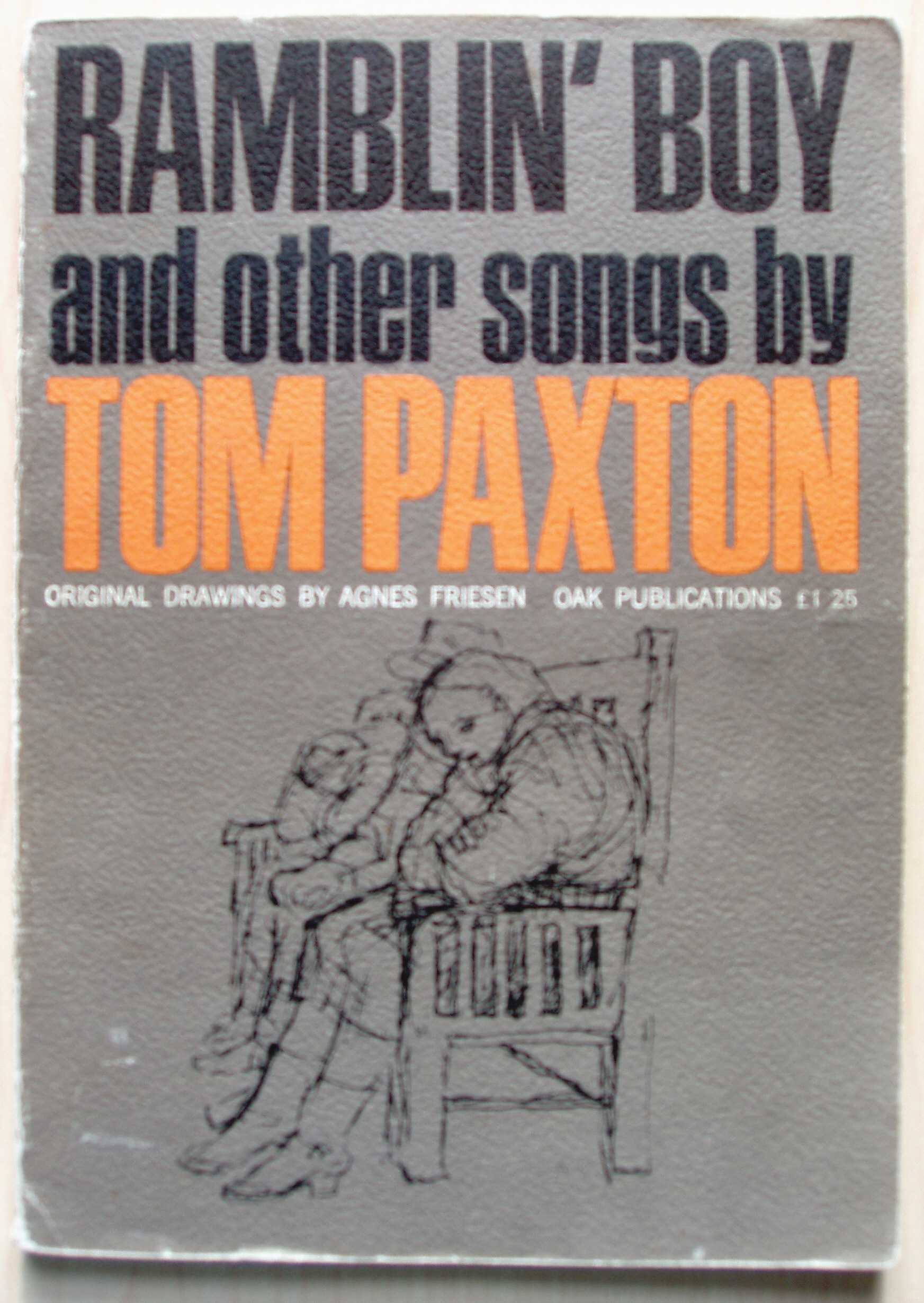
The publication I selected from the racks at Exeter Music was titled: Ramblin’ Boy and other songs by Tom Paxton.

OLYMPUS DIGITAL CAMERA

The folio contained 41 songs by the prolific and somewhat well known Greenwich Village songwriter. The ones I liked the most – “Deep Fork River Blues,” “I Can’t Help But Wonder (Where I’m Bound),” “The Marvelous Toy” and “The Last Thing On My Mind” – provided many hours of thoroughly enjoyable practice as I slowly got better at coaxing music from my brand-new, chocolate-brown, steel-string Harmony acoustic guitar.

Other songbooks soon followed.

Bob Dylan’s Greatest Hits – The matching 1967 LP contained 10 songs; the songbook had 12. Only seven songs were in each. But the songbook’s key-of-G transcription of “Don’t Think Twice, It’s All Right” (a song which later appeared on Greatest Hits, Vol.2) is the one I play to this day.

Beatles Complete – It wasn’t, but it contained enough transcriptions of their songs in keys different from the recordings (and thus using chords that a budding guitarist like me could actually play) for this book to be a gift from heaven. (My favorite: the oh-so-wonderfully-playable, also-in-the-key-of-G entry for “Eight Days A Week.”)

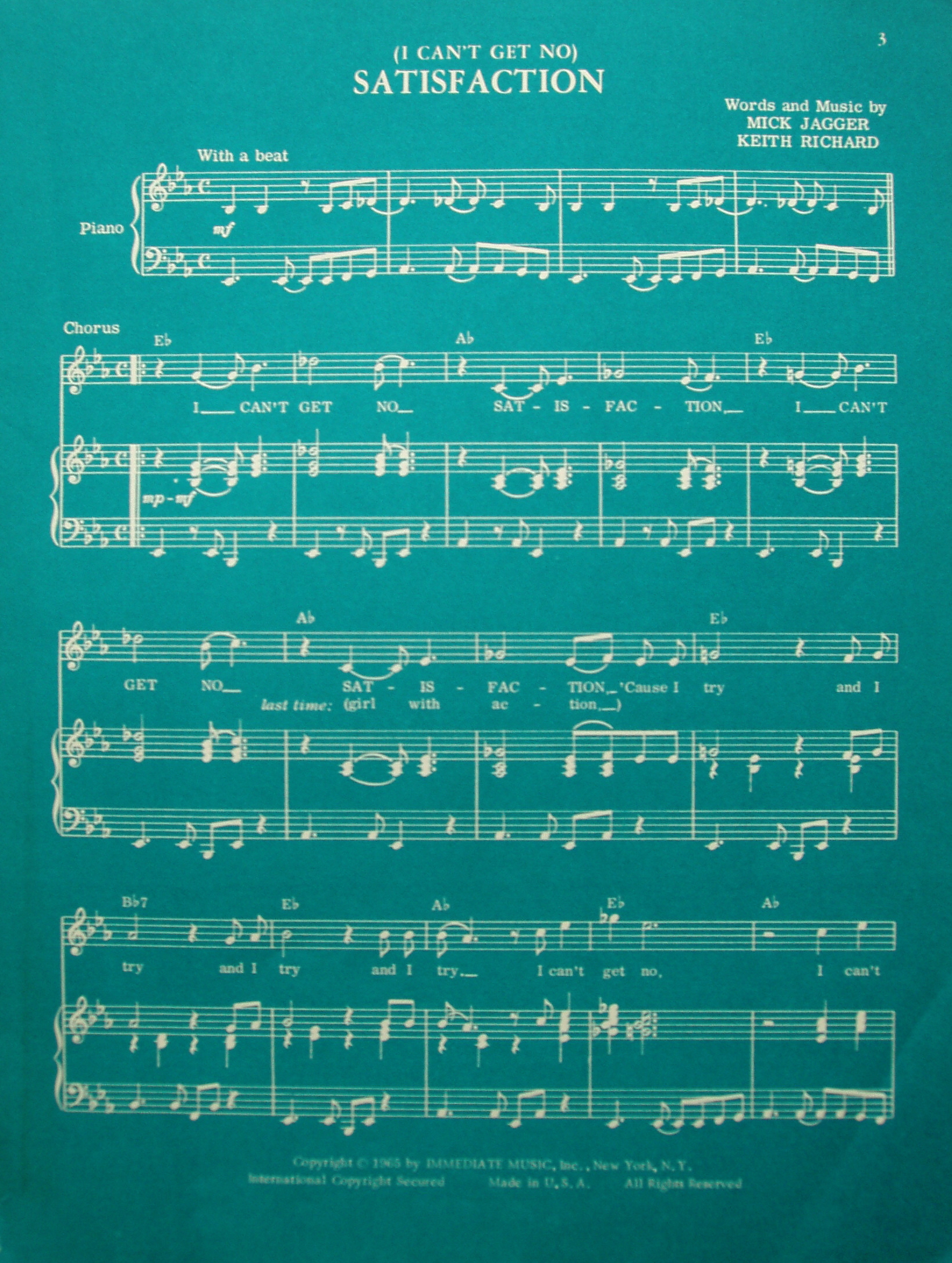
The Rolling Stones Anthology – I learned “Ruby Tuesday” and “Lady Jane” from this one, as well as the not-so-well known album tracks “Back Street Girl” and “Sittin’ On A Fence.” This is still the only music publication I’ve ever seen where the music is printed in white ink on deep, blue-green colored paper.
OLYMPUS DIGITAL CAMERA

The first Jazz song I bought the sheet music for (which I now know was not really a Jazz song) was “Swinging On A Star.” The song was written by Jimmy Van Heusen & Johnny Burke and sky-rocketed to Pop music fame (and an Academy Award) in 1944 thanks to it being recorded by Bing Crosby and included in the film “Going My Way.”

But the sheet music I purchased at a music store in Boston, a few doors down from Symphony Hall, contained chord fingerings and changes I’d never had to negotiate in a Tom Paxton, Bob Dylan or Rolling Stones song.
OLYMPUS DIGITAL CAMERA

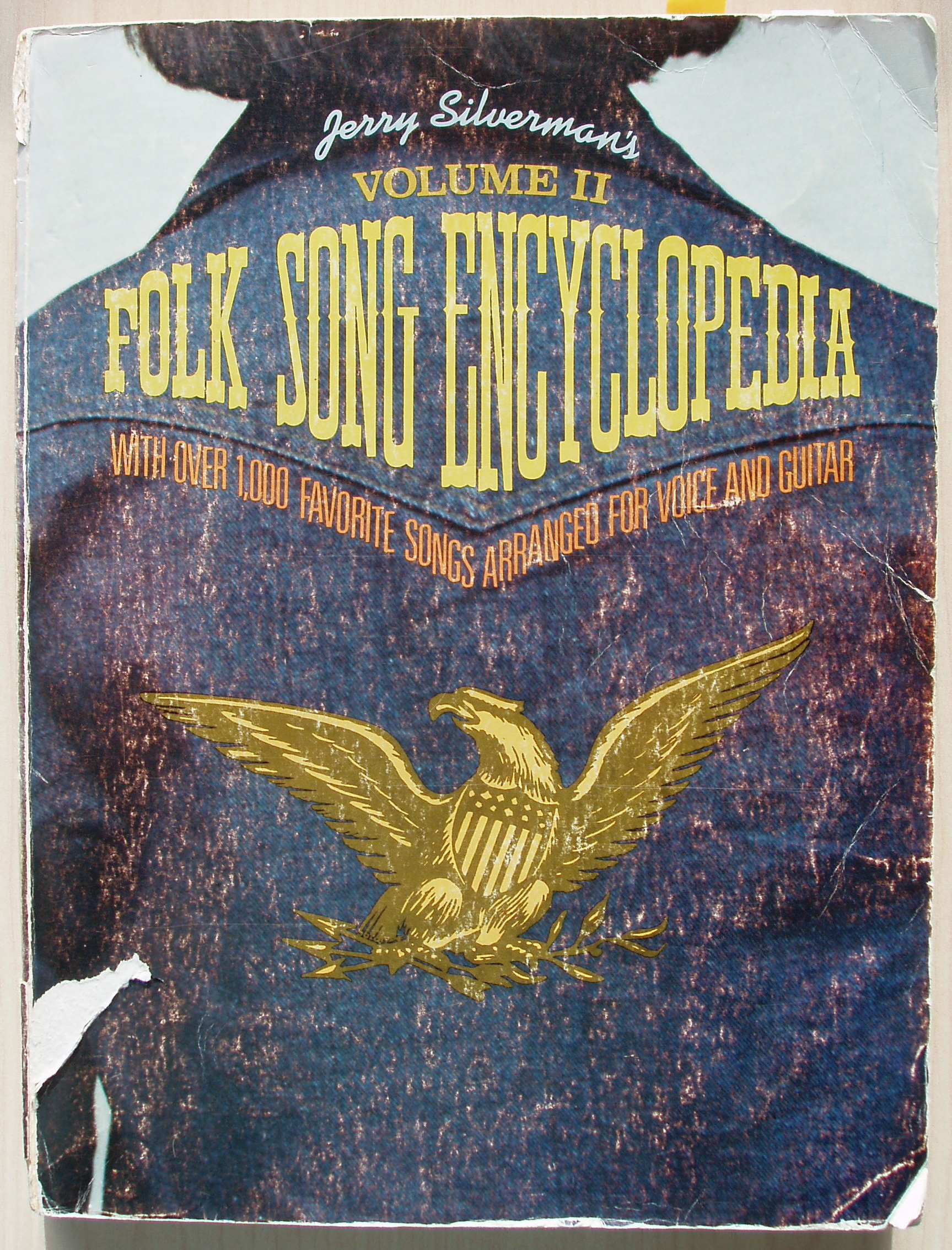
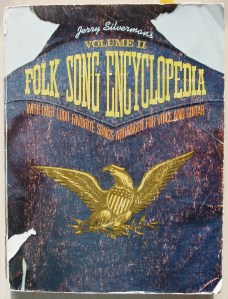
Sometime in the early 1980’s, while exploring Portland, Maine one day with my friend and fellow guitarist Paul, I came upon a copy of Jerry Silverman’s Folk Song Encyclopedia, Volume II in a head shoppe. (Remember those?)
OLYMPUS DIGITAL CAMERA

I learned dozens of songs from this priceless and inspirational 431-page collection including: “Deep River Blues,” “Stealin’, Stealin’,” “Jelly Roll Blues,” “Crawdad Song,” “Roll In My Sweet Baby’s Arms” and “Charlie Mopps.” I eventually found Volume I to complete the set.

Over the years, my library of songbooks and sheet music has grown impressively. The many volumes and binders fill a shelf over my desk, in the den of my house, as well as a long shelf on a bookcase down in the basement and an entire three-shelf-tall, homemade bookcase in my teaching studio.

My most recent purchase: a guitar-TAB songbook containing note-for-note transcriptions of the songs from Mumford & Sons very popular debut album Sigh No More. I bought it this past Labor Day weekend at a music store in Washington, D.C., not far from my son’s apartment.

Exploring, studying and learning from the printed music that fills those countless pages has been a huge and essential part of my musical education and my development as a guitarist and as a songwriter. Those songbooks and pieces of sheet music have also been a major source of the music that still brings great joy every single day to my life.

Posted in Random Topics | Tagged , , , , | 1 Comment

A Belated Birthday Celebration (Elizabeth Cotten – Take 2)

In the process of writing this post, I was feeling bad that I had not gotten my act together in time to have it be a “This Historic Day In Music” post. But then I was reminded that when my children were little (pre-school and kindergarten age), there were years when their birthdays would be celebrated three times and usually not on The Day itself! They’d have a party at school during the week, a “friends party” at home – usually on the weekend before or after The Day – and then a “family party” at home actually (and always) on The Day.

Well, I don’t feel bad anymore.

Here it is: a belated birthday celebration for one of my favorite guitarists: Elizabeth Cotten.

Ta da!

On January 5, 1895, in the town of Carrboro, North Carolina (right next to Chapel Hill), George and Louise Nevills welcomed their fifth child, Elizabeth, into the world.

When Elizabeth (or “Babe” or “Sis” as her family called her) was seven years old, she started playing around with her brother’s five-string banjo. When she was eleven, her brother moved out and took his banjo with him. Missing that banjo but now really wanting a guitar, she went to work doing household chores for a woman in Chapel Hill. Eventually, on a salary of $.75 to $1.00 a month, she saved up the $3.75 needed to buy herself her own guitar.

Right from the start, Elizabeth taught herself to play. She developed a unique style in which she held her guitar left-handed and upside down and she picked out her songs and tunes using just the thumb and first finger of her left hand. Before long, Elizabeth started writing her own songs, one of which she called “Freight Train.”

At the age of 15, Elizabeth married Frank Cotten. At the age of 16, she gave birth to their daughter and only child, Lillie. With her new life, responsibilities and pressure from her church to stop playing those “worldly songs,” guitar playing soon became a thing of the past.

Decades later, thanks to a miraculous string of events – see my post of January 5, 2011 – Elizabeth Cotten regained her guitar playing skills. An album of her songs and tunes – Folksongs And Instrumentals With Guitar – was released on Folkways Records in 1958. Elizabeth became a successful and highly-regarded recording and performing artist, working well into her 80’s. At the time, her unique style of guitar playing, which became known as “Cotten picking,” inspired countless guitarists around the world. It still does.

There are several videos of Elizabeth Cotten to be found on YouTube, though my favorites -which I own on VHS tapes and DVDs – are not.

Here is the best video I could find of Elizabeth playing “Freight Train.”

I just love her playing! If you’ve got a few more minutes, here’s another one of her playing two instrumentals. This is from 1969.

There you go! I hope you enjoyed this belated celebration of Elizabeth Cotten’s birthday.

Ta da, indeed!

Posted in Posts with Video | Tagged , , , | Leave a comment

One Of The Best

Once, we made mix-tapes on cassettes. (Compact Audio Cassettes, to be precise.)

Then, we burned mix-CDs.

Now, we assemble playlists.

Last year at this time, I put together a playlist that I called: The Best of 2011: Discoveries & Resurrections. The collection contained 17 tracks by 17 different artists/groups. Bob Dylan, The Decemberists, Gillian Welch, Joe Liggins & The Honeydrippers, Pat Metheny, Sierra Noble and Erma Franklin were among those who made the cut.

Being an “old school” kind of guy, I burned the playlist to a CD, printed out a label for the disc, typed up a track list and tucked it all into a new, clear jewel- box case. I made two additional copies of the finished package and gave one to each of my two children for Christmas.

This year, having listened often to the Best of 2011 CD and receiving positive reviews from my daughter and son, I assembled a new collection for 2012.

As in 2011, many of the year’s “resurrections” were a direct result of my writings in this blog. Many of my “discoveries” came about (again) thanks to my guitar students. One student in particular, A, introduced me to the music of Ben Howard and his wondrous song “Old Pine.”

In the Fall, A had first mentioned Ben Howard and I helped him try to learn to play a song of Ben’s called “The Fear.” In November, at the end of one of his guitar lessons, A asked if I’d like to hear another Ben Howard song. Plugging the patch cord from my stereo into A‘s smart phone, we sat and listened, smiling, as “Old Pine” danced around my teaching studio.

I was dazzled.

“As the old pine fell, we sang… just to bless the morning.”

(If I may suggest: don’t watch the video. Close your eyes and just listen.) 

Ben Howard is a 25-year-old singer/songwriter/guitarist from West London, England. He first released “Old Pine” on a self-produced EP in 2010 and then included it on his 2011 Island Records CD Every Kingdom.

“Old Pine” is high on my list of the Best of 2012.

Thanks, A.

Posted in Posts with Video | Tagged , , | 2 Comments

Season’s Greetings Again

Rock, Jazz, R&B.

“What, no Folk?!? No collection of Christmas music is complete without a Christmas Folk song!”

“You’re right. How about “Cry Of A Tiny Babe” by Bruce Cockburn?”

“Excellent choice.”

I hope you agree.

This is from Bruce’s 1991 album Nothing But A Burning Light.

Posted in Posts with Video, Random Topics | Tagged , | Leave a comment