This Historic Day In Music: “Blackbird”

In June of 1968, The Beatles were well into the process of recording new songs for their next album.

On Tuesday, June 11, however, only two Beatles were working at London’s Abbey Road Studios. With George and Ringo on a trip to the United States, John and Paul had the place to themselves. They were not, on this evening, working together.

John was ensconced in Studio 3, experimenting with tape loops and sound effects for the track that would be known as “Revolution 9.”

 Paul was in Studio 2.

He had a new song, recently written at his farm in Scotland. The song had started as a guitar piece, inspired by the music of J.S. Bach. The lyrics, written to fit this guitar part, were inspired by the on-going American civil rights movement and meant to be his words of encouragement to an African-American woman, “experiencing these problems in the States.”

“Blackbird” took 32 takes to perfect, only 11 of those being complete run-throughs of the song. The recording contains Paul’s fingerpicked acoustic guitar, his vocals (double-tracked during the chorus), a metronome ticking in the background and the sound of “chirruping blackbirds.” (The bird sounds came from Volume Seven: Birds of Feather from the Abbey Road taped sound effects collection.) 

“Blackbird” appeared on The Beatles, the double-album soon to be known as The White Album.  Released on November 22, 1968, The Beatles entered England’s NME album chart on November 27 at #1, and stayed there for nine weeks.

For any fingerstyle, steel-string acoustic guitar player, “Blackbird” is one of those iconic, must-learn pieces of music. Once learned, and one should learn to play it just like the record, “Blackbird” is a thrill to play and a constant source of pure joy. There really is nothing else quite like this song in the canon of popular guitar music.

“Blackbird” : recorded this day, June 11, in 1968, by Beatle Paul McCartney, Abbey Road Studios, London, England.

Information for this post was found in the following books: Beatlesongs (1989) by William J. Dowlding; Paul McCartney: Many Years From Now (1997) by Barry Miles; and The Beatles: Recording Sessions (1988) by Mark Lewisohn.

P.S.: When I wrote and published this post, it was still June 11 here in New Hampshire.

Posted in This Historic Day In Music | Tagged | 2 Comments

National Jukebox

About a month ago, my father-in-law, Phil, sent me a link to a news article announcing the on-line arrival of something called the “National Jukebox.” After reading the article, I immediately logged onto this new website.

My, oh my. It is amazing. Really, really amazing.

Let me try to give you a simple description.

The Library of Congress digitized, organized and categorized over 10,000 78 rpm “disc sides” from their collection. These records, originally released between 1900 and 1925 by the Victor Talking Machine Company, are now available for free and unlimited listening on their new site entitled: “National Jukebox.”

As the site says: “Imagine your computer as a new Gramophone purchased for family and friends to enjoy in your home  parlor.”

Well, this new Gramophone comes with one heck of a record collection.

I’ve not spent a huge amount of time browsing the site, but I have already found a few gems.

From the home page, under: “Genres,” then: “Popular Music,” then: “Blues,” I found The Memphis Blues. This is a 1914 recording of a song by W.C. Handy (the Father of the Blues), featuring vocalist Morton Harvey.

(This recording pre-dates Crazy Blues by Mamie Smith by 6 years!) 

Under: “Browse All Recordings,” then: “Composer,” then: “Foster, Stephen Collins,” I found a 1919 recording of my favorite Foster song: Hard Times, Come Again No More, fearturing vocalist Louise Homer.

Then, when I just searched “guitar” and then: “instrumental,” I found (among a list of 77 selections) a 1914 recording of a piece called The Rosary played on slide guitar by Pale K. Lua. Gorgeous music.

This site is well worth your time. It is a treasure chest of vintage recordings and priceless music that, thank-you-oh-thank-you, Library of Congress, can no longer be considered “lost.”

And, of course, you, my wise and well-informed readers do know: “Good music doesn’t get old.”

So: ready, set, go: www.loc.gov/jukebox/ .

You’ll be very glad you did.

P.S.: Make it a “favorite.”  “Like it.” Tell your friends!

Posted in Random Topics | 1 Comment

Summer’s Here…Again

The last day of my 36th year of teaching was Thursday, June 2. 

That made the first day of my summer vacation yesterday, Friday, June 3.

I spent the celebratory day – and a glorious, New-England-in-June day it was – in Boston, with my cousin, Jack, on our 3rd Annual “Eric-&-Jack-Go-To-Boston-and-See-the-Red-Sox Day.”

Through my daughter’s connections with a generous season ticket holder, I was able to buy two tickets (Grandstand, First Base side) to a Red Sox night game vs the Oakland Athletics. Thanks to Jack being able to take the day off from his job, we were eager to make a whole day of it and thus caught the 8:30 am, C&J bus from Dover into Beantown.

From South Station, we first took the “T” to the North End in search of ravioli and cannoli for lunch. We found both – delicious ravioli at “Rabias,” on Salem St.; justifiably-famous cannoli at “Mike’s,” on Hanover St. – and then started our day long saunter towards Fenway Park. 

Along the way, I was struck by how often we encountered music.

In the Downtown Crossing subway station, deep under ground, a steel drum player bounced his metallic melodies off the dingy walls. On the Boston Common, a bearded fiddler enlivened a grassy corner. In the Public Gardens, a saxophonist, wearing a Berklee School of Music sweatshirt, serenaded on the foot bridge over the Swan Boat pond. On Newbury St, at the Mass. Ave. end, another saxophonist played and swayed in a patch of shade against the wall of a vacant store front.

On Lansdown St. and Yawkey Way, music, both live and recorded, is a major part of the Fenway Park Experience.

From the still-chill-inducing strains of “The Star Spangled Banner” (sung on this occasion by an excellent, local, adult  a capella vocal group) to the victorious (yes, despite a horrendous top-of-the-first inning, the Sox won, 8-6!) clangor of “Dirty Water” by 60’s hometown heros, the Standells, music is constantly being played at Fenway when the game isn’t.

For example: at the start of the second inning, the thunderous riff of “Voodoo Chile” by Jimi Hendrix caught my ears. I’m not sure who it was being played for – the coming-up-to-the-plate Oakland batter or the beleagured Boston starting pitcher, Clay Buchholz as he worked on the mound taking his warm-up throws – but it ceratinly implied that someone needed to get serious about the task at hand. 

Fenway Park maintains the wonderful tradition of the singing-along of “Take Me Out To The Ballgame” during the 7th inning stretch (complete with electric organ accompaniment by Josh Kantor) and no Red Sox baseball game would be complete without the every-voice-in-the-house rendering (or rending) of Neil Diamond’s 1969 hit “Sweet Caroline,” halfway through the 8th inning. (“So good, so good…”)

And then, since the score of last night’s game was close going into the ninth, the portentous and threatening opening chords of “I’m Shipping Up To Boston” by the Dropkick Murphys (lyrics by Woody Guthrie) filled the stadium and announced the arrival of  the Red Sox closer, Jonathon Papelbon. 

There are few more definitve moments of the power of the perfectly placed piece of music.

What a day!

Summer’s here…again!

If every day is as filled with music and fun as the first one was, this is going to be one incredible summer!

Posted in Random Topics | 3 Comments

This Historic Day In Music: “Sgt. Pepper’s Lonely Hearts Club Band”

It was 34 years ago today,

“Sgt. Pepper” was the disc to play.

It never has gone out of style,

It’s still guaranteed to raise a smile.

So, let me send a thought to you,

Treat yourself and your ears:

Play it!

“Sgt. Pepper’s Lonely Hearts Club Band”

P.S.: Play it loud.

P.S.S.: Check out my post for June 1, 2010 entitled: “A Splendid Time Is Guaranteed For All.”

Posted in This Historic Day In Music | 1 Comment

Revisiting The “T-Bone Shuffle”

Back on April 21, 2010, my first “On This Day In Music History” post was about the song “T-Bone Shuffle” by Blues singer/electric guitarist T-Bone Walker.

The date of that post was the anniversary of Walker’s recording of the song in 1955, in Chicago, IL for Atlantic Records.

But I had missed one detail: that recording done in 1955 was not T-Bone Walker’s first recording of  “T-Bone Shuffle.” It was a re-recording of the song: something that Blues artists of that era commonly did when they changed record labels.

How had I missed this? Where had I gone wrong?

Here’s what led to my startling (and somewhat embarrassing) discovery.

On April 21, 2011, I was telling a student who was working on “T-Bone Shuffle,” about the significance of the day. During the conversation, I opened up my copy of Wolf Marshall’s 1998 book: Blues Guitar Classics (an excellent collection of transcriptions) and read from the section about “T-Bone Shuffle.” Marshall said that the recording he had transcibed was released in 1949.

Hmmm?

When I got home that evening, I checked the liner notes to my copy of the 2000 Rhino CD Blues Masters: The Very Best of T-Bone Walker and sure enough, it listed April 21, 1955 as the recording date. Then I listened to the track.

Ooops.

This was not the “T-Bone Shuffle” I knew and loved.

Quickly, I popped my copy of the 1986 Charly CD, T-Bone Walker: Low Down Blues into my player and clicked on Track 16. There it was!

The liner notes to the Charly CD, by Alan Balfour, stated that the 22 tracks on the disc had all been recorded between late-1946 and early-1948 in Los Angeles, CA for Black & White Records.

Further research (a big “Thank You” here to the Dimond Library at the University of New Hampshire) into the discography section of the T-Bone Walker biography Stormy Monday: The T-Bone Walker Story by Helen Oakley Dance, revealed just the information I was looking for.

Drum roll, please.

The original “T-Bone Shuffle” was recorded in November of 1947. (An exact date was not given.) It was one of four sides recorded in a session at the Los Angeles recording studio of Black & White Records, the others being: “Vacation Blues,” “Inspiration Blues” (aka “Born To Be No Good”) and “Description Blues.”

The musicians on the session were: T-Bone Walker, electric guitar & vocals; George Orendorff, trumpet; Bumps Meyers, tenor saxophone; Willard McDaniels, piano; John W. Davis, bass; and Oscar Lee Bradley, drums.

“T-Bone Shuffle” was not released, however, until sometime in 1949. (You were right, Wolf Marshall!) The July 30, 1949 issue of Billboard Magazine lists T-Bone Walker as #31 on the list of “Top Selling Rhythm & Blues Artists” and the Comet Records single “T-Bone Shuffle” as one of the three records whose sales earned him that distinction.

So: mystery solved.

We can all sleep better now.

Next time: listen first. Titles can be deceiving.

P.S.: The original, 1947 recording is the hands-down better version of the two.

Posted in Random Topics | 1 Comment

Merseyside, Part 2

The subject was first broached in the Spring of 2010. It was Les’ idea.

“What do you think about getting Merseyside together again?”

Andy, Bob and Eric each basically gave him the same initial response.

“What did the other guys say?”

In the years since their last performance – Feb. 12, 1994 – the members of Merseyside continued on as they had before and during their time together: they led their lives (with marriage and children for some), continued their careers as performers, teachers, songwriters, recording artists and they remained friends. Amazingly, they each worked the same “day job” in 2010 that they had worked in 1990 and their paths often crossed.

Getting the band together again, however, needed a reason beyond “for old time’s sake.”

Well…

Andy was the choir director at the local middle school. Every spring, his select, 8th-grade Chamber Choir would travel to perform and/or compete in a choral festival and see a bit of the country outside of N.H. The last trip had been to Disneyworld. The 2010-11 Chamber Choir was planning on going to Washington, D.C. Making the trip happen required a school-year long effort involving the singers and the singers’ parents in a host of fundraising activities and events.

One of the members of the 2010-11 Chamber Choir was Aubrey, daughter of Les and his wife, Annie. In September 2010, Annie went to the first organizational parent’s meeting for this year’s choir trip. When the subject of fundraising came up, she saw the possibility: Merseyside could get back together and give a concert to help the Chamber Choir. Annie told Andy about her idea at the meeting and when she got home, she told Les. Soon, Les told Eric and Bob.

Now, given a very good reason, they all said “Yes.”

The first rehearsal was Monday evening, October 18, 2010.

It was an “unplugged” rehearsal: acoustic guitars, a wooden-table-top-turned-drum-set and four voices. Among the songs chosen to run through were: “I Saw Her Standing There,” “Please Please Me” and “She Loves You.” These were some of the first songs they’d played together back in December of 1990. But the main purpose of this rehearsal was to simply see if they could still do it. Could they still play and sing this music and sound good together?

The answer, post-rehearsal, was an enthusiastic “Yes!”

The date for the concert was thus confirmed: Thursday, April 7, 2011. Show time: 7:00 pm.

This would be twenty years and one day from Merseyside’s first gig.

The similar second rehearsal was held on November 15: “It Won’t Be Long,” “This Boy,” and “Help” to name a few. Andy asked if they could add “Let It Be,” one they’d not done before, and he would play piano on that and “Hey Jude.” Eric offered to switch to bass guitar for those two tunes.

The first “plugged” rehearsal – electric guitars, a real drum set, microphones and a PA system – was on Saturday night, February 12. They played for over three hours and made their way quite successfully through all of the now-22 songs on the set list. As Andy later wrote, it was a “good night.”

On February 28, Les emailed the others to say that he’d received an enthusiastic and positive reply from Jeff Landrock to do the “sound” for the concert. Jeff was well known to all the members of Merseyside, mostly as singer/guitarist/keyboard player for the Beatles tribute band All Together Now. Jeff told Les that he and Ace Bailey, drummer for All Together Now, would bring the band’s entire sound sysytem and do the whole deal: an afternoon sound check/rehearsal and the evening concert on April 7.

The month of March saw the first steps towards promoting the “20th Reunion Concert”: the launching of the Merseyside website and the production of a concert poster, all thanks to Les and Annie.
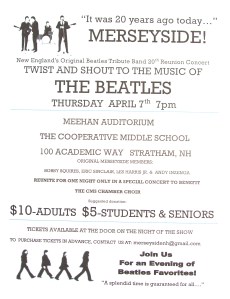
There were also several rehearsals in March, both unplugged and plugged, and the introduction of Melissa Moore, Les’ sister, on back-up vocals and auxiliary percussion (such as the cowbell on “You Can’t Do That” and the bongos on “A Hard Day’s Night”). Melissa brought her wonderful voice, an encyclopedic knowledge of Beatles’ harmonies and immediately added to the overall vocal blend and “tightness” of the band.

March rehearsals also featured the first run-throughs with the aforementioned Aubrey playing the bass guitar on “Something.” This very-talented 8th-grader, who took her first guitar lessons with Eric and studied bass with her uncle (and member of  All Together Now), Tom Moore, knew the complex Paul McCartney part note-for-note. Andy was now able to add some colorful keyboard sounds to this number. Aubrey also would play on “Birthday,” “The End” and was enlisted by Eric to take over the bass guitar duties on “Hey Jude.”

On the morning of Saturday, April 2nd, Andy, Les and Eric were special guests on the “Tayles & Company Show” on AM1540-WXEX, an Exeter-based radio station. Besides promoting the up-coming concert, the Mersyside threesome chatted, reminisced and spun their favorite Beatles records with host Bill Taylor.

The remainder of April 2nd was taken up by the final dress rehearsal for the show. The highlight of the afternoon was the addition of Andy’s sons: Alex, on drums and Jay, on guitar, for run-throughs of “Birthday” and “The End.” Besides their impressive skills, these young musicians brought another layer to the web of connections underlying this event: Alex had studied drums with Les, Jay studied guitar with Eric and the day of the concert would be Alex’s 20th birthday!

The promotional/publicity side of things got a big boost when the April 3 edition of the local newspaper, Seacoast Sunday, featured a really exceptional article on the band and the concert by writer Vandy Duffy, whose daughter was a member of the 2010-11 Chamber Choir.

Vandy’s article, read and enjoyed by many, sparked a particular response from a man named Bill Faulkner.

Bill was a friend of Bob’s and a member of the board of directors of the Brad Delp Foundation. Since Brad Delp (original lead singer for the band Boston) had been a long-time friend of Bob’s and they had played together for many years in the Beatles band Beatle Juice, and since Brad had been inspired to form Beatle Juice after attending a Merseyside concert, the Foundation wanted to help in the fund raising effort for the Chamber Choir.

After much emailing between Bill and Annie and Les and Andy and Bob, a most generous donation was offered and a plan made for Pamela Sullivan, a member of the board of the Brad Delp Foundation, to make a presentation to members of the Chamber Choir at the concert. 

All of Merseyside went: “Wow!”

Finally, sunny and warm, Thursday, April 7 arrived.

By mid-afternoon, the stage of Meehan Auditorium at the Cooperative Middle School was loaded with sound equipment and musical instruments: stacks of PA speaker cabinets and a row of floor monitors; multiple guitar amps and guitars; two drums sets (at center stage, on a riser, was Les’ Ludwig set with “Merseyside” printed on the bass drum head); an electric keyboard and a baby grand piano; choral risers; and a small forest of microphone stands and microphones.

Thanks to Jeff and Ace, the sound check/rehearsal went very smoothly.

All of the musicians were excited (that’s an understatement) and ready to play.

A few minutes after 7:00 pm, the house went dark. On the large screen hanging in front of the closed curtain, the excellent and very entertaining “History of Merseyside” video that Les had painstakingly put together began to run. With a soundtrack of Beatles songs and screaming Beatles’ fans, archival promotional photos and in-concert shots of Merseyside blended  seamlessly with comparable photos of the actual Fab Four.

As the video ended, the screen rose and the curtain opened. The warm applause of a multi-generational audience of several hundred fans, friends and family,  flooded the stage.

Les counted off the tempo and… the concert began.

“It was twenty years ago today…,” Bob proclaimed. “We’re Sgt. Pepper’s Lonely Hearts Club Band..,” Eric, Andy, Les and Melissa confirmed, adding their voices in sweet, perfect harmony. The segue into “With A Little Help From My Friends” presented Les singing the part of Billy Shears with his exultant bandmates chiming in with their melodic questions (“Do you need anybody?”) and answers (“high with a little help from my friends”).

A mini-set of rocking, circa-1963 numbers followed. “Please Please Me,” “It Won’t Be Long,” “This Boy” and “Twist and Shout”: ringing electric guitars, joyous vocals, propulsive bass and that unmistakeable Beatle beat rolled out into the welcoming ears of the jubilant listeners.

“You Can’t Do That” featured Bob on electric 12-string (with the help of his friend and long-time Beatle Juice guitar tech, Brian Dixey) and Melissa bringing in that cow bell. “Can’t Buy Me Love” had Eric switching to acoustic guitar (behind Bob’s chart-topping vocals) and then “I Feel Fine” brought him back to the Rickenbacker for his one lead guitar solo of the night. The first set wrapped up with vibrant renditions of the classic hits: “I Want To Hold Your Hand” and “She Loves You.”

“Yeah, yeah, yeah,” indeed.

Set 2.

“One, two” and on “three,” a gorgeous, 19-string, G7sus4 chord erupted from the stage and “A Hard Day’s Night” kicked off the rest of the evening’s entertainment.

“If I Needed Someone” brought Les back to the vocal spotlight, followed by a punchy “Ticket To Ride.”  Smooth 3-part harmonies and Andy’s lead vocal highlighted “Nowhere Man” and then the band offered up a spot-on rendering of “Help,” with Bob on lead and Andy and Eric’s “when,” “nows” and “but” perfectly in place.

Les dedicated “In My Life” to his Grandmother, who bought him his first Beatles’ records and invited sister Melissa to sing along with him. Eric took the lead vocals on “Come Together” (one of his favorites from the early days) and switched to bass guitar as Andy moved to the baby grand for “Let It Be.” This song introduced eight members of the 2010-11 Chamber Choir, placing their crystaline background vocals behind their teacher’s superb turn at the lead.

“Something” brought Aubrey and her bass guitar front and center, accompanying her Dad on lead vocal in a performance dedicated to Annie. With Aubrey staying on bass, Jay and Alex took their places behind their respective electric guitar and drums. The now eight-member Merseyside exuberantly thundered their way through “Birthday” followed by the awesome drum solo (played in a bring-the-house-down duet by Les and Alex) and the three guitar, call-and-response solo exchange (dazzlingly played as one by Bob) of “The End.”

Before the next song, Pamela Sullivan from the Brad Delp Foundation was invited to the stage. Her soft-spoken presentation chronicling the connection between Merseyside and Brad and Beatle Juice and the sincere wishes of the Foundation to lend their new friends a helping hand left few eyes dry and brought the audience warmly to their feet.

Then came “Hey Jude.”

Bob took the lead vocal, Andy moved back to the piano, Eric on acoustic, Les at the drums, Mellisa added back-ups, Aubrey still on bass and the entire 2010-11 Chamber Choir filled the risers. From the first “…don’t make it bad” to the last “na.., na.., na., na-na-na-na…,” musicians and audience came together as one. Spirits soared, smiles beamed, all voices rose in euphoric musical bliss. (That’s not an overstatement.)

Before the applause died and before anyone could sit back down, one last “One, two, three, four..” cut through it all and Merseyside romped their way through “I Saw Her Standing There.” The aisles filled with dancers and those at their seats bounced, clapped and shimmied away as well. Andy and Eric gathered around Bob as he played one last sparkling guitar solo. Two electric guitars, one bass guitar and the drums punctuated the climactic E7 chord with a raucous, unison crash. 

The Merseyside 20th Reunion Concert was over.

Thanks to the inspiration, dedication, generosity, friendship and hard work of everyone involved, the Merseyside 20th Reunion Concert/2010-11 Chamber Choir fundraiser was a phenomenal success, financially and musically.

For everyone there that evening, Thursday, April 7, 2011, a spendid time, as guaranteed, was most certainly had by all.
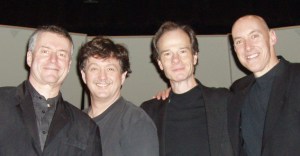
                                           Merseyside

           Bob Squires, Andy Inzenga, Eric Sinclair & Les Harris, Jr.
Posted in Random Topics | 2 Comments

sixstr stories: The First Year

Today, April 18, 2011, is the first birthday of this blog.

Thanks to my amazing daughter and her familiarity with WordPress, sixstr stories came to life as I sat next to her on her couch in her Somerville, MA apartment. I watched in awe as she casually zipped through the whole registration/pick-a-password/”What do you want to call it, Dad?” process on her laptop until she said: “There you go. You’ve got a blog!”

Since then, I’ve written 86 posts (many with a link to an audio track), received 116 comments and tallied 4,427 views. My busiest day was May 18, 2010 with 84 views.

The whole experience has been fantastic. The process of researching and then writing about this wonderful world of music that is such a big part of my life and then sending it out onto the world wide web for all of you to read (and listen to) has been more challenging, rewarding and fun than I’d ever imagined it would be. Though I must say, I don’t know what I was imagining when I told my daughter: “I’m thinking about starting a blog.”

I do know that the rewards and the fun have been because of all of the comments, feedback and responses I’ve gotten from all of you, my readers.

Thank you, thank you, thank you.

So, here I go.

My motto – “Good music doesn’t get old” – remains the same as I step into the second year.

I look forward to your good company as I continue this journey.

Posted in Random Topics | 2 Comments

Merseyside, Part 1

    It started as an idea, casually tossed out in a conversation between three friends with a shared passion.

    “Hey, we should get together sometime and play some Beatles’ songs.”

    “Yeah!”

    But, they were two singer/guitarists and a drummer.

   “I know a guy who plays bass and sings,” one of the singer/guitarists said. “Want me to give him a call?”

   “Sure.”

   The first get-together was on December 12, 1990: Bob Squires (guitar & vocals), Eric Sinclair (guitar & vocals), Les Harris, Jr. (drums & vocals) and Andy Inzenga (bass guitar & vocals). As they played that day, it sounded good: “Please Please Me,” “I Saw Her Standing There,” “A  Hard Day’s Night.” They got together again on December 28. This was fun. They were having a great time together, singing and playing this incredible music and starting to sound really good.

   It was so much fun, they decided to keep at it.

   Through January and February of 1991, they rehearsed often, building up a repertoire. By March, they had a name: “Merseyside.” According to several books about the Beatles, the word, in the 1960s, referred to an area in Northern England that bordered the Mersey River and included the city of Liverpool. For Bob, Eric, Les and Andy, the name fit three criteria: it was one word, obviously-but-not-blatantly Beatle-ish and it had a letter near the middle that could be extended down when printed on the head of a bass drum like the original Fab Four did with the “T” in Beatles.

    Merseyside performed for the first time on the afternoon of Monday, April 8 in the gymnasium of the Exeter (NH) Area Junior High School. The next day, Tuesday, April 9, they gave an evening concert down the street in the Assembly Hall at Phillips Exeter Academy.

    From then until their last gig on February 12, 1994, at Dover (NH) High School, Merseyside played throughout the New Hampshire seacoast (in Exeter at the IOKA Theatre, the Loaf & Ladle Restaurant and for PEA’s Summer School; in Portsmouth at Market Square Day, the Pressroom and Rosa’s Restaurant; in Dover at the Cochecho Arts Festival and the Firehouse Restaurant) and mountains (Waterville Valley, Gunstock and Attitash), with occasional visits down into Massachusetts (Newburyport and Cape Cod), once each to Maine and Connecticut (the night club “Boppers” in Hartford), and a most-important and memorable trip to South Fallsburg, NY for the Good Day Sunshine 1992 “Beatles Weekend Getaway” at the Pines Resort Hotel.

     During that weekend in South Fallsburg, besides being the featured “house band,” Merseyside performed one evening as the back-up band for special guest Tony Sheridan. Tony was the British singer who the Beatles played back-up for on a 1961 recording session in Hamburg, Germany that produced rocking versions of “When The Saints Go Marching In,” “Sweet Georgia Brown” and “My Bonnie.” 

    Along the way, towards the end of their run, Merseyside directly inspired the formation of two other “Beatles Bands” that continue performing to this day: Beatle Juice (originally led by Brad Delp, lead singer for the mega-popular Rock band Boston) and All Together Now.

    From the start, Merseyside’s main goal was to accurately reproduce the recorded music of the Beatles live, on stage, and to fulfill to their audience, and themselves, the promise of a splendid time guaranteed for all.

Posted in Random Topics | Tagged | 1 Comment

This Historic Month In Music: “Louie Louie”

Through the walls of the dressing room, he could hear the band.

It was summer, 1955. Richard Berry was the featured singer that night at the Harmony Park Ballroom in Anaheim, California. The band was Ricky Rillera and The Rhythm Rockers, led by brothers Bobby and Barry Rillera. As the band played the first set without him, warming up the crowd, Richard relaxed and waited backstage.

The repeated rhythm of the introduction of this one number caught his attention: duh duh duh.. duh duh. It stuck in his head, gave the songwriter in him an idea. Richard picked up the handiest piece of paper, a crumpled bag, and jotted down a couple of lines.

Later, he asked the Rillera brothers what the song was with that great intro. “That was ‘El Loco Cha Cha’ by Rene Touzet.”

Richard Berry (born April 11, 1935, Extension, LA) was an accomplished R&B singer with a strong and versatile voice. He was capable of doing a frantic, Little Richard-style lead, switch to a deep, Muddy Waters-style Blues growl and then turn in a smooth and soulful performance on a slow ballad. He’d had hit records as a member of The Flairs, with The Robins on their classic “Riot In Cell Block #9,” and with Etta James on her hit “The Wallflower.”

As a songwriter, Richard knew how to follow a moment of inspiration and how to remain open to influence by other songwriters. “El Loco Cha Cha” had provided the riff, the basic rhythm, to build his new song on. “Havana Moon,” the Chuck Berry song that served as the B-side to Chuck’s 1956 single “You Can’t Catch Me,” and the Johnny Mercer/Harold Arlen 1940’s-era standard “One For My Baby (and One More for the Road)” served as melodic and lyrical inspiration.

When the new song was done, Richard took it to a recording session with his band, The Pharoahs. In April of 1956, at Hollywood Recorders on Santa Monica Boulevard in Los Angeles, CA, Richard Berry and The Pharoahs recorded four songs: “You Are My Sunshine,” “Somewhere There’s A Rainbow,” “Sweet Sugar You” and the new one: “Louie Louie.”

In April of 1957, “Louie Louie” was released on a Flip Records single as the B-side to “You Are My Sunshine.” When “Louie Louie” started getting more attention and airplay, it was re-released as the A-side of a single with “Rock Rock Rock” on the back.

In April of 1963, two popular Northwest Rock & Roll bands: Paul Revere & The Raiders and The Kingsmen, went into the studios of Northwest Recorders in Portland, OR and each recorded their version of “Louie Louie.”

In late 1963/early 1964, “Louie Louie” b/w “Haunted Castle” by The Kingsmen had reached #1 on the Cashbox chart and held the #2 spot on the Billboard Hot 100 chart for six weeks in a row. 

Dave Marsh, author of “Louie Louie: The History & Mythology of the World’s Most Famous Rock ‘n’ Roll Song; Including the Full Details of Its Torture & Persecution at the Hands of the Kingsmen, J. Edgar Hoover’s F.B.I., & a Cast of Millions; & Introducing for the First Time Anywhere, the Actual Dirty Lyrics”  and the liner notes to the CD compilation “Love That Louie: The Louie Louie Files,” wrote: “‘Louie, Louie’ is either the essence of Rock ‘n’ Roll or definitive proof that no such essence ever could exist – unless it’s both of those at once.”

Information for this post was drawn from the two sources by Dave Marsh as listed above and The All Music Guide to Rock.

P.S.: According to the website www.louielouie.net , Monday, April 11, 2011, was International Louie Louie Day. I wish I’d known!

Posted in Random Topics | Tagged | 2 Comments

The Day Before Yesterday In Music History: Lightnin’ Hopkins

Sam Hopkins was born in Centerville, Texas on March 15, 1912.

Having two older brothers, John Henry and Joel, who played the Blues, Sam had learned enough on the guitar to be able to play and sing at local suppers and social functions when he was still a teenager. In 1920, he even had the chance to meet and play with the now-legendary Texas Blues singer/guitarist Blind Lemon Jefferson.

A few years later, Sam started accompanying the singer/lyricist Texas Alexander around Houston. This relationship continued off and on through the 1930s and into the 1940s when, in 1946, they were playing on Dowling Street in Houston and caught the ear of Aladdin Records talent scout Lola Anne Cullum. She arranged for Sam, without Texas, to travel with her to Los Angeles, CA for a recording session.

At the studio, Mrs. Cullum decided to pair Sam with pianist/singer Wilson “Thunder” Smith. When the recording engineer heard Sam picking out his rapid-fire Blues licks behind Smith, he christened him “Lightnin'” and the name stuck.

Singer/guitarist Lightnin’ Hopkins, with Thunder Smith helping out on piano, cut his first  record on November 9, 1946. Entitled “Katie May,” it sold well enough around Texas for Lightnin’ to return to California and record his second hit: “Short Haired Woman.” 

Lightnin’ Hopkins went on to become one of the greatest, most prolific and most popular of all of the Texas Country Blues musicians. His career as a singer, guitarist, songwriter and performing artist stretched into the 1980s.

My favorite Lightnin’ Hopkins album, and one of my most favorite albums by any Blues artist, is the Smithsonian/Folkways CD simply entitled “Lightnin’ Hopkins.”

Recorded with a single microphone on January 16, 1959 in Hopkins’ one-room apartment at 2803 Hadley St., in Houston, Texas by musicologist Sam Charters, the album contains a mere ten songs. But those ten songs, those ten, naked and unvarnished performances “arguably capture the essence of Lightnin’ Hopkins better than any of his other recordings.” (Thom Owens, All Music Guide to the Blues) In the liner notes for the 1990 CD of the album, Sam Charters says that over the years, when “asked if there was some way to describe the Country Blues… the easiest way I could think of was to play this album.”

When released in 1959, the album introduced Lighnin’ and his music to a whole new audience and brought his recording and performing career to heights he’d never known. The album also played a major part in sparking the Blues revival of the late-1950’s/early-1960’s.    

Very Highly Recommended.

Sam “Lightnin'” Hopkins passed away on January 30, 1982 in Houston, Texas.

Posted in Random Topics | Tagged | 1 Comment